

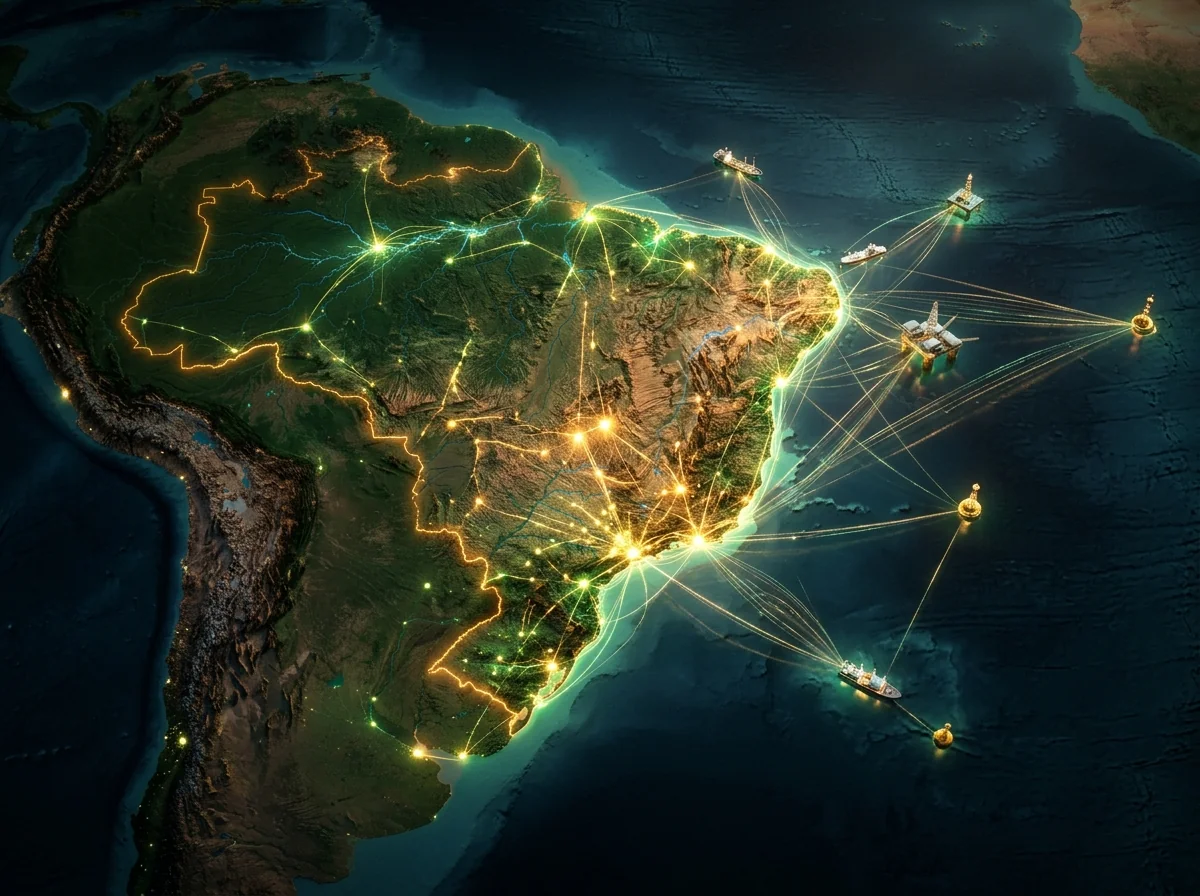
Across the global corporate technology ecosystem, artificial intelligence is almost universally discussed through the narrow lens of immediate convenience: automated workflow pipelines, productivity metrics, and efficiency gains in software code. Global audiences have been conditioned to view every new generative model announcement as a pure consumer spectacle, where users simply click a button, pay a monthly dollar subscription, and query American APIs. Yet we rarely pause to inspect the invisible physical and geopolitical infrastructure powering this illusion: who actually controls national strategic data, how much freshwater and clean electricity do these clusters drain from host soil, and what are the tangible consequences of technological dependence on the human mind?
This urgent critique took center stage during an extraordinary national broadcast featuring world-renowned neuroscientist Miguel Nicolelis and prominent economist José Kobori, streamed live on September 3, 2026, on the Kritikê Podcast under the banner ‘A NATIONAL PROJECT FOR BRAZIL’.
Building upon the neurobiological frameworks we examined in our analysis of what neuroscience and economics reveal about the human mind, this second dialogue delivered an uncompromising diagnosis: developing nations risk being relegated to mere data colonies for the Global North. In this essay, we examine how digital colonialism operates on the ground, why rigid fiscal austerity suffocates scientific sovereignty, and what bold strategic blueprints can place sovereign nations at the vanguard of contemporary civilization.
Digital Colonialism and the Unseen Power of Big Tech Over Sovereignty
Historically, colonial domination and territorial conquest were executed through marching imperial armies, naval blockades, and the direct extraction of raw minerals through coerced physical labor. In the twenty-first century, the mechanics of hegemony evolved, but the underlying extractive logic remains intact. Nicolelis warns that the world now navigates an era of aggressive digital colonialism, where territorial occupation has been replaced by the capture of data streams and the exploitation of critical natural resources:
“We are witnessing a new form of colonialism. Unlike traditional military occupation, today corporations like Microsoft and Google assert dominance over entire sovereign nations through data centers that consume local natural resources and dictate operational sovereignty over host territory.”
Miguel Nicolelis
The myth that ‘the cloud’ is an ethereal, green domain shatters against the physical thermodynamics of computer hardware. A single dense AI compute facility can draw as much electrical power as a mid-sized metropolitan city while consuming millions of gallons of treated water daily for server rack evaporative cooling. Under the regime of digital colonialism, multinational giants erect hyperscale data centers across the Global South to exploit cheap utility grids, while the intellectual property and economic profits flow straight back to corporate headquarters abroad.
This erosion of autonomy becomes catastrophic when a sovereign state voluntarily surrenders custody of its most sensitive citizen databases, handing the storage and processing of strategic civilian records to foreign corporations with intimate ties to external intelligence agencies:
“It is deeply alarming to witness government contracts transferring strategic datasets from foundational public institutions, such as the Aeronautics Institute of Technology (ITA) and the national education fund (FUNDEB), to foreign intelligence-linked corporations like Palantir. We are relinquishing the core of our informational sovereignty.”
Miguel Nicolelis
Transferring the educational records of millions of school children or sensitive defense aerospace intelligence from public institutions like the Aeronautics Institute of Technology (ITA) to servers managed by entities like Palantir grants foreign powers a master key to domestic infrastructure. No geopolitical superpower — whether the United States, China, or France — would ever permit its defense intelligence or citizen demographics to reside under the legal jurisdiction of an overseas power.
The Fiscal Austerity Trap and the Silent Exodus of Talent
On the macroeconomic front, José Kobori and Miguel Nicolelis demonstrated that frontier scientific breakthroughs never emerged spontaneously from unguided free-market dynamics. Every foundational pillar of modern computing — from the internet and GPS engineered by DARPA to Taiwan’s semiconductor fabs and state-backed Chinese battery supply chains — originated from aggressive, multi-decade public investment.
Yet developing nations remain trapped in a dogmatic fiscal austerity regime that global superpowers routinely disregard when their own technological supremacy is at stake:
“The dogma of fiscal austerity acts as a paralyzing barrier against public investment in transformative national projects. Meanwhile, nations like China and the United States completely ignore such accounting straightjackets to heavily finance their own technological sovereignty and industrial leadership.”
José Kobori
While the United States enacted the bipartisan CHIPS and Science Act to inject hundreds of billions in direct public subsidies into semiconductor fabs, and China mobilizes state development banks to fund 50-year technological roadmaps, developing economies continuously slash scientific grants to hit quarterly fiscal surplus targets. The systemic fallout of this digital colonialism is the collapse of scientific research careers and an unprecedented brain drain:
“A nation’s failure to maintain coordinated state planning and provide frontier scientific projects condemns its top engineers and researchers to emigrate, fueling the innovation ecosystems of foreign competitor nations.”
José Kobori and Miguel Nicolelis
Educating an aerospace engineer, a biophysicist, or an artificial intelligence researcher at elite public universities costs hundreds of thousands of dollars in public capital. When those graduates encounter underfunded laboratories, precarious research stipends, and an absence of ambitious national missions, they purchase one-way tickets to Zurich, Berlin, or Silicon Valley. The host nation pays the full educational bill; foreign technology hubs reap the commercial fruits.
Demystifying ‘Artificial Intelligence’: Statistics, Hype, and Verbal Atrophy
For builders and technology leaders, confronting conceptual limitations with intellectual honesty is the foundational prerequisite for technological maturity. During the broadcast, Nicolelis forcefully challenged the marketing label ‘Artificial Intelligence’, exposing the corporate rhetoric that frames probabilistic software tools as conscious minds:
“The term ‘artificial intelligence’ is an illusion; what we actually possess are remarkably powerful statistical estimation tools. The relentless commercial hype surrounding this software masks the complete absence of genuine solutions to urgent human bottlenecks, such as efficient hospital triage or public safety.”
Miguel Nicolelis
Large language models do not possess an ontological model of reality: they execute high-dimensional statistical matrix multiplications to predict which token is most likely to follow another based on terabytes of human text scraped from the internet. The authentic danger is not machines developing runaway biological consciousness; it is humans regressing to mirror the deterministic rigidity of machine prompts under digital colonialism.
More concerning than venture-backed hyperbole is how the chronic outsourcing of writing and deep reading actively rewires the neurobiology of younger generations:
“Recent studies already indicate progressive vocabulary loss and serious cognitive degradation among youth who indiscriminately rely on chatbots for assignments that are meant to cultivate critical reasoning and personal verbal expression.”
Miguel Nicolelis
Language constitutes the cognitive scaffolding of human thought. When a student stops drafting original arguments, abandons challenging non-fiction books, and delegates email writing to a predictive chatbot, their conceptual repertoire shrinks. Instead of cultivating pioneering intellects capable of asking unprecedented questions, society risks manufacturing passive software operators dependent on automated answers.
The Sovereign Blueprint: Oceanic Research Cities and Scientific Expansion
Diagnosing the systemic harms of digital colonialism without articulating concrete strategic solutions would be an exercise in despair. The defining triumph of the dialogue between Nicolelis and Kobori was formulating a visionary, practical blueprint to break technological dependency and position sovereign nations at the forefront of the twenty-first century.
Professor Miguel Nicolelis outlined three foundational pillars to counter digital colonialism and build a sovereign scientific future:
1. Oceanic Research and Defense Cities in the South Atlantic
Brazil commands one of the most biodiverse maritime territories on Earth — the ‘Blue Amazon’ —, spanning strategic mineral deposits, unmapped marine ecology, and oceanic currents that regulate global climate systems. Nicolelis proposes constructing floating scientific platforms and advanced research hubs every 1,000 kilometers along the South Atlantic coastline.

These oceanic hubs would serve as permanent laboratories for deep-sea oceanography, real-time meteorological forecasting, tidal energy harvesting, and naval territorial defense, securing an indigenous sovereign data grid over national waters.
2. The Scientific Conservation Arc of the Amazon and Center-West
Rather than treating the rainforest as an empty expanse destined for low-yield cattle grazing, the blueprint designs a continuous green belt of environmental conservation and frontier biotechnology. As highlighted in our report on how AI listens to the Amazon Rainforest in real time, bioacoustics, environmental genomics, and sovereign satellite tracking produce economic dividends that vastly outshine predatory deforestation.
3. Universal Youth Scientific Literacy
Drawing from the pioneering educational model established by Nicolelis at the Santos Dumont Institute, the ultimate weapon against digital colonialism is world-class foundational education. Placing robotics, chemistry, and biology laboratories directly inside public primary schools teaches young citizens to engineer original technologies rather than passively consume foreign screen feeds.
Watch the Full Debate: Digital Colonialism and National Sovereignty on Kritikê Podcast
To experience the full intellectual rigor of this historic discussion uncut, watch the original Kritikê Podcast livestream below. Across three and a half hours of thorough debate, José Kobori and Professor Miguel Nicolelis analyze digital colonialism, fiscal straightjackets, and practical blueprints to secure authentic national sovereignty:
Frequently Asked Questions About Digital Colonialism and Sovereign AI
What does digital colonialism mean in practical economic terms?
Digital colonialism is a structural dependency relationship where multinational tech conglomerates (primarily based in the Global North) control the digital infrastructure, subsea fiber cables, cloud server farms, and proprietary software licenses of developing economies. Developing nations supply raw personal data and absorb local utility costs (water and electricity), while intellectual property profits remain exclusively concentrated overseas.
Why is contracting corporations like Palantir a national security concern?
The core danger is the loss of informational sovereignty. Palantir is an American enterprise with longstanding ties to defense and foreign intelligence agencies. Allowing private foreign defense contractors to process national education datasets (such as FUNDEB) or elite aerospace engineering records (such as ITA) places critical domestic data under the legal reach of foreign powers, accelerating digital colonialism.
What is the vision behind Miguel Nicolelis’s ‘Oceanic Cities’?
The proposal calls for establishing high-tech offshore floating research stations situated every 1,000 km along the coastline. These stations operate as continuous research centers for climate telemetry, oceanic biotechnology, clean marine energy, and territorial surveillance, transforming maritime borders into hubs of sovereign data.
How can emerging economies compete against global AI superpowers?
Emerging nations should not attempt to replicate multi-trillion-dollar generic LLM clones. Instead, as outlined in sovereign technology roadmaps like the Brazilian Artificial Intelligence Plan (PBIA), sovereign nations can transcend digital colonialism by building upon their distinct comparative advantages: planetary biological biodiversity, green renewable power grids, universal public healthcare data, and precision ecological agriculture.
Thinking Beyond Passive Software Consumption
If artificial intelligence is to serve as a genuine engine of human emancipation and societal progress, emerging nations must immediately outgrow the naive status of dazzled consumers. Licensing closed software tools and paying monthly cloud bills in foreign currencies is not a mark of technological maturity; it is the modern face of colonial subservience.
The true frontier to break digital colonialism does not lie in consuming foreign application interfaces, but in protecting the strategic data of our citizens, investing boldly in universal scientific schooling, and building sovereign public digital infrastructure. Artificial intelligence is an extraordinary instrument, but the destiny of a nation is written only by independent, autonomous minds.
What is your perspective on digital colonialism? Do you believe developing countries can achieve true technological sovereignty or will they remain reliant on foreign Big Tech? Share your analysis in the comments below!