

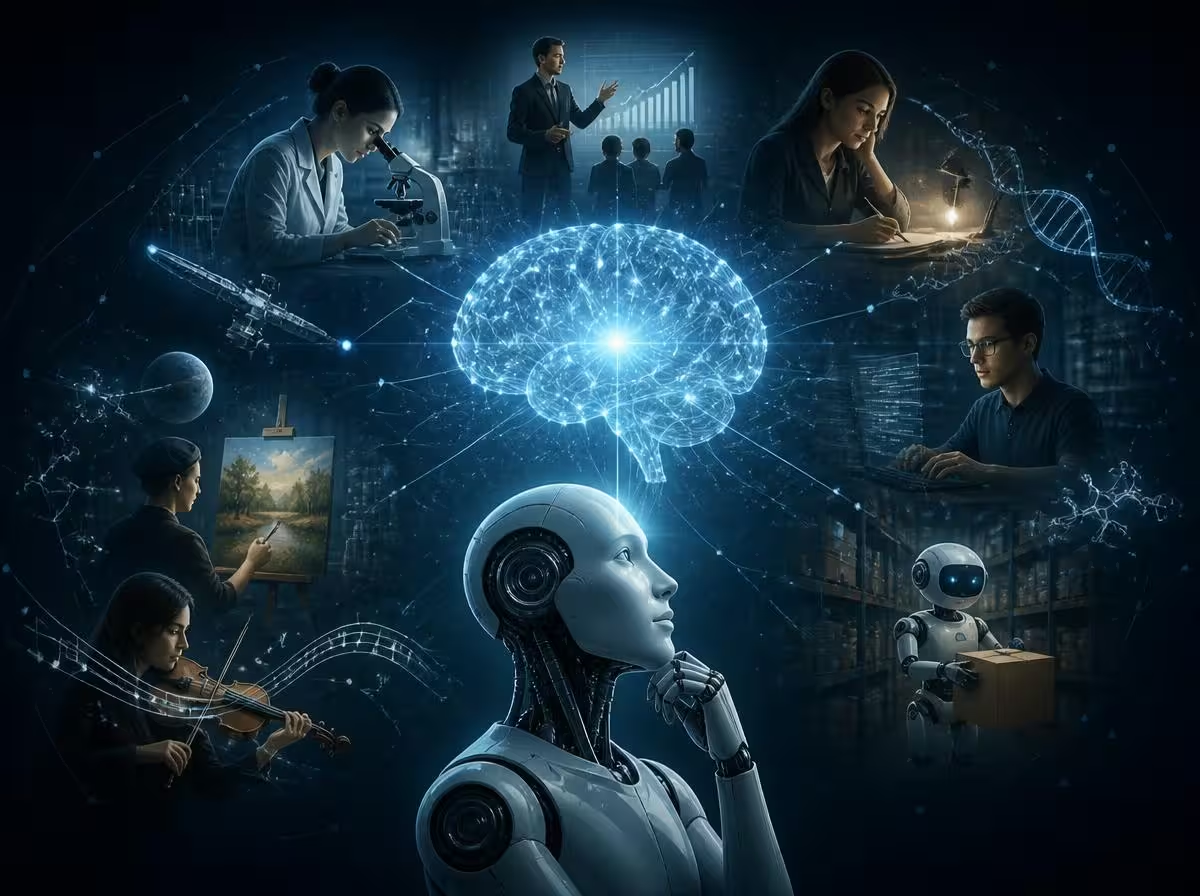
In tech boardrooms, academic laboratories, and international policy summits, three letters have come to dominate every conversation about the future of civilization: AGI. Tech leaders claim it is merely years away, pouring hundreds of billions of dollars into gigawatt data centers and proprietary silicon. Meanwhile, skeptics argue that today’s large language models are merely “stochastic parrots” incapable of genuine understanding.
Amid the deafening crossfire of corporate hype and apocalyptic headlines, what does the term actually signify? Understanding what is AGI—and how it differs fundamentally from the narrow AI systems powering our smartphones today—is the single most important technological concept of our generation. Let us strip away the science-fiction tropes and examine the engineering reality, rigorous evaluation benchmarks, and societal ramifications of Artificial General Intelligence.

Defining AGI: Narrow AI vs. Artificial General Intelligence
To grasp what is AGI, we must contrast it with Narrow AI (Weak AI). Every artificial intelligence system deployed in the world today—including GPT-4o, Claude 3.5 Sonnet, Tesla Autopilot, and AlphaFold—is technically a narrow system. It is exceptionally brilliant within its trained domain, but fundamentally brittle outside of it.
AlphaGo can defeat the world’s greatest human Go champion, but it cannot play Tic-Tac-Toe, diagnose a patient’s cough, or write a condolence letter. It has zero generalized transference. By contrast, Artificial General Intelligence refers to a synthetic system that possesses the cognitive flexibility of an educated human: the capacity to learn unfamiliar skills, reason across disparate disciplines, adapt to novel environments without retraining, and independently solve problems it was never explicitly programmed to address.
How Today’s AI Works (And Why It Isn’t AGI Yet)
Modern Large Language Models (LLMs) operate on statistical pattern matching across vast text corpora. When prompted, they calculate the probability of the next token based on billions of weighted parameters. This architecture yields remarkable conversational fluency, but reveals critical gaps in true generalized cognition:
- Lack of an Autonomous World Model: LLMs process language tokens, not physical causality. They do not maintain an intuitive physics model of time, spatial embodiment, or physical object permanence.
- Brittle Out-of-Distribution Generalization: When confronted with scenarios that deviate from internet training data, models frequently hallucinate or produce catastrophic errors.
- Absence of Continuous Learning: Once weights are frozen post-training, the model cannot update its baseline architecture through real-time experience without external memory scaffolding.
The Benchmark Hierarchy: How Will We Know When AGI Arrives?
Alan Turing’s classic 1950 “Imitation Game” (The Turing Test) was broken years ago by chatbots that simulate text dialogue. Today, leading researchers at institutions like Google DeepMind propose rigorous multi-tiered evaluation frameworks:
| AGI Level | Cognitive Capability Benchmark | Current Frontier Status |
|---|---|---|
| Level 0: No AI | Static software, rigid databases | Legacy systems |
| Level 1: Emerging AGI | Equal to or somewhat better than an unskilled human across broad tasks | GPT-4o, Claude 3.5 Sonnet, Gemini 1.5 Pro |
| Level 2: Competent AGI | At least 50th percentile of skilled adults across all cognitive work | In active development (Agentic AI) |
| Level 3: Expert AGI | At least 90th percentile of skilled adults across all cognitive domains | Anticipated 2027–2030 |
| Level 4: Virtuoso AGI | At least 99th percentile of skilled adults (world-class expertise in every field) | Research horizon |
| Level 5: Superhuman (ASI) | Outperforms 100% of humans across all intellectual and creative disciplines | Theoretical horizon |

When Will AGI Arrive? Timelines from Industry Leaders
Forecasts vary dramatically depending on whether researchers believe scaling compute alone is sufficient or whether fundamentally new mathematical architectures are required:
- Sam Altman (OpenAI): Has consistently stated that competent AGI is plausible before the end of the current decade (2028–2029), driven by synthetic data recursion and self-supervised reinforcement learning.
- Demis Hassabis (Google DeepMind): Projects human-level cognitive capabilities within the next five to ten years, emphasizing multimodal grounding and scientific discovery.
- Yann LeCun (Meta Chief AI Scientist): Remains a prominent skeptic of pure LLMs, arguing that text alone cannot yield AGI and predicting that true world-model architectures will take decades to mature.
Real-World Risks: Moving Beyond Hollywood Apocalypses
Public discourse often fixates on sci-fi scenarios involving killer robots. In reality, serious AI alignment researchers focus on immediate, grounded systemic hazards:
- Economic Dislocation: If intellectual labor becomes effectively free and infinitely scalable, white-collar knowledge economies face unprecedented restructuring before social safety nets can adapt.
- Cybersecurity Asymmetry: Autonomous agents capable of finding zero-day exploits and orchestrating adaptive cyberattacks could outpace human defensive response times.
- Power Concentration: The capital expenditure required to train frontier models (tens of billions in computing infrastructure) concentrates immense geopolitical and narrative influence into the hands of a few multinational corporations.

What Changes in Your Daily Life When AGI Arrives?
The transition to AGI will not happen overnight in a dramatic flash; it will arrive as a steady creep of compounding utility. First, AI moves from passive text assistants to autonomous computer-use agents that execute end-to-end workflows: booking travel, negotiating insurance claims, conducting medical literature reviews, and refactoring full codebases.
As we analyzed in our breakdown of ChatGPT as an Operating System, computing is shifting from human-driven point-and-click interfaces to intention-driven autonomous execution.
To take your practical workflow further, explore our hands-on guide on foundational concepts of artificial intelligence for beginners.
Frequently Asked Questions
Does AGI require human consciousness or sentience?
No. Intelligence is the computational capacity to achieve complex goals across diverse environments. Sentience is the subjective phenomenal experience of being alive. A synthetic system could possess superhuman general problem-solving competence while having zero subjective conscious awareness.
Is AGI the same thing as Artificial Superintelligence (ASI)?
No. AGI represents human-level general competence across cognitive tasks. ASI (Artificial Superintelligence) refers to a hypothetical system whose intellect vastly exceeds the collective cognitive output of all human minds combined.
Can today’s ChatGPT pass as AGI?
Under Google DeepMind’s classification, current models qualify as “Emerging AGI” (Level 1). They exhibit broad conversational knowledge, but lack the reliable autonomous agency, self-directed research capabilities, and physical grounding required for Competent AGI.
The Defining Chapter of Human Ingenuity
The pursuit of Artificial General Intelligence is not merely an engineering quest; it is a profound philosophical mirror. By attempting to construct synthetic minds, humanity is forced to clarify what truly defines intelligence, wisdom, and consciousness. How do you view the arrival of AGI—with optimism, caution, or skepticism? Share your perspective and join the discussion in the comments below!