

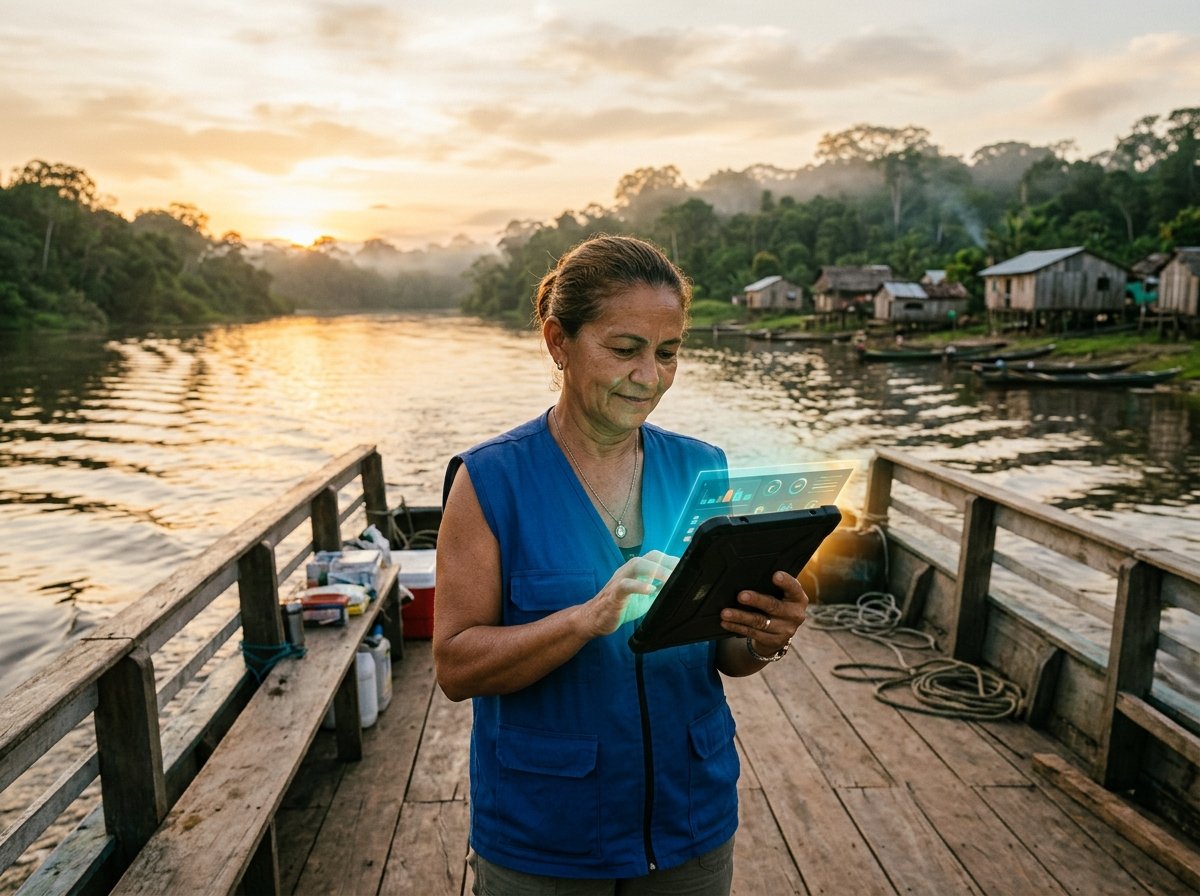
The quiet rise of AI in public healthcare is fundamentally transforming one of the most pressing humanitarian challenges in Latin America: bringing specialized medicine to communities that live days away from the nearest hospital.
Picture a remote riverine settlement along the Solimões River, deep in the Amazon basin. For an isolated resident battling a relentless cough or declining vision to see a medical specialist, the journey historically demanded up to 72 hours on a wooden regional ferry to Manaus.
Most of the time, that expedition meant losing days of farming income, spending scarce funds on boat fuel, and still facing months on a brutal waiting list just for a routine chest X-ray or retinal scan.
Today, that heartbreaking reality is beginning to shift. In Brazil’s Unified Health System (SUS)—the world’s largest public universal healthcare network—deep learning models and computer vision algorithms are finding their most vital mission: operating on the extreme front lines.
Equipped with simple tablets connected to low-Earth-orbit satellites, community health workers can now capture diagnostic imaging and receive a high-confidence triage readout in less than sixty seconds.
This is not about replacing human doctors with automated machines; it is about granting diagnostic superpowers to frontline primary care workers. In this investigative report, we step into the real-world deployment of artificial intelligence across Brazil’s most remote frontiers, revealing how algorithms are slashing waiting queues and proving that high technology only achieves true greatness when it serves human dignity.
From the Amazon to the Sertão: The Challenge of Distance and the Arrival of Diagnostic Algorithms
Brazil is a country of continental scale. While major metropolitan hubs like São Paulo and Rio de Janeiro boast European-level physician density per capita, rural municipalities across the Amazonian interior and semi-arid northeast endure years without a single resident radiologist, pulmonologist, or ophthalmologist.
This geographic imbalance produces a crippling bottleneck: even when a remote clinic secures an X-ray machine via municipal funding, the image must be dispatched to distant urban reading centers. Lacking radiologists to review scans in real time, routine tests for tuberculosis or bacterial pneumonia historically sat unattended in file drawers for months.
By the time a formal report returned, the infection had often progressed into irreversible or fatal stages. It is precisely within that fatal gap between image acquisition and specialist interpretation that computer vision algorithms are tipping the scales between life and death.
“In the deep heartlands, the greatest barrier to recovery was never the lack of medicine, but the agonizing time lost in the queue of uncertainty. When an algorithm scans a diagnostic test in sixty seconds and flags a patient for immediate hospitalization, artificial intelligence achieves its highest humanitarian purpose: equalizing the right to survive.”
— Minha Dose de IA
Joint partnerships connecting the Ministry of Health, federal research universities, and leading philanthropic hospitals have begun deploying lightweight deep learning models directly into floating riverboat clinics and rural outposts.

Chest X-Ray and Retinal Screening: Catching Pathology Before Queues Explode
On the ground, two medical frontiers are demonstrating the immediate power of algorithms in universal public care: infectious pulmonology and preventive ophthalmology.
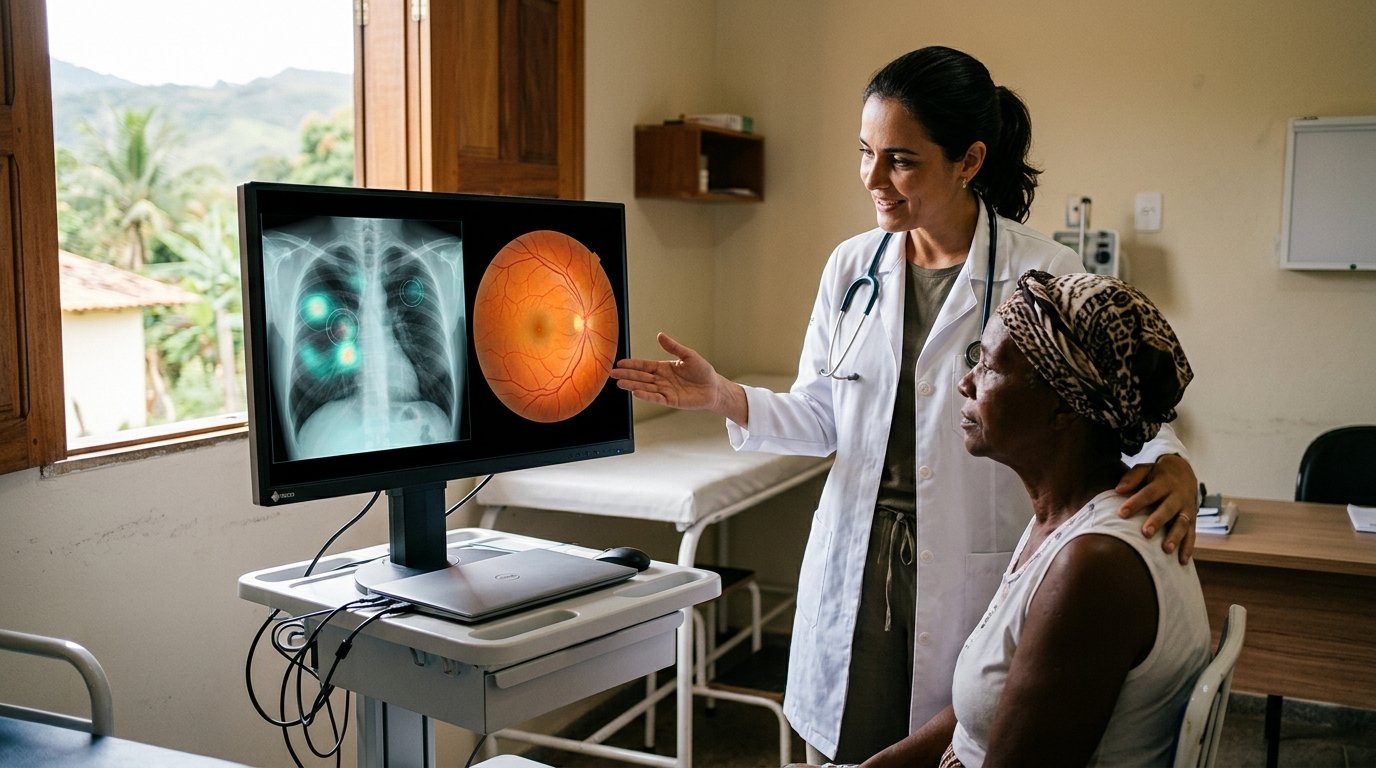
In the struggle against tuberculosis—a persistent disease that claims thousands of lives annually in developing regions, especially among vulnerable indigenous populations—AI functions as an ultra-fast radiographic scanner. The patient undergoes a chest X-ray; the neural network parses pixel matrices for microscopic patterns of opacity, consolidation, and pulmonary cavitations hallmark to Koch’s bacillus.
Within seconds, a color-coded heatmap appears on the nurse’s screen indicating contagion probability. Suspected cases immediately bypass the general backlog, enabling medical staff to initiate isolation and antibiotic regimens that very afternoon—snapping the transmission chain before entire families become infected.
A parallel breakthrough is taking place against preventable blindness caused by diabetic retinopathy. Millions of individuals live with untreated type 2 diabetes without regular eye care. When noticeable vision deterioration begins, permanent retinal damage has already occurred.
Using portable handheld retinal cameras connected to smartphones, community health agents capture fundus photos inside residents’ living rooms. AI models evaluate microaneurysms and vascular hemorrhages instantaneously. Patients at critical risk are fast-tracked to regional laser therapy centers, preventing irreversible vision loss.
Predictive Maternal Health and Emergency Interventions
Another profound application of clinical intelligence protects maternal and infant health. In isolated northeastern territories, maternal mortality stemming from preeclampsia and postpartum hemorrhage remains a critical public health challenge.
In collaboration with institutions like the Oswaldo Cruz Foundation (Fiocruz), predictive models analyze municipal electronic medical records: blood pressure curves, gestational age, routine lab metrics, and family history. When the model detects subtle early-stage risk patterns during the first 16 weeks of pregnancy, a priority alert is triggered.
This allows local health workers to schedule patient transfer to an obstetric intensive care unit weeks in advance. Boat and ambulance transport can be safely coordinated in daylight rather than in a midnight emergency rush. This data-driven philosophy reflects what we examined in our feature on building smart automated workflows and our coverage of public health tracking.
Data Sovereignty and Training on Diverse Domestic Demographics
A central hazard in medical machine learning is algorithmic bias. Historically, the vast majority of clinical software was engineered and benchmarked using datasets from the Global North: predominantly homogenous populations with dietary habits and genetic baselines vastly distinct from the multicultural fabric of South America.
Directly importing foreign clinical models into equatorial South America yielded unacceptable rates of false negatives and skewed diagnoses. Recognizing this risk, Brazilian data scientists and medical researchers prioritized training algorithms on SUS databases—incorporating diverse demographics, environmental realities, and neglected tropical diseases.
Safeguarding national health records within sovereign domestic infrastructure, while training transparent open models, is fundamental to digital self-determination and equitable healthcare delivery.
The Horizon: Machines Triage, Humans Heal
The definitive takeaway from deploying artificial intelligence in public health is a lesson in perspective: algorithms cannot offer empathy, hold a grieving patient’s hand, or understand the social fabric of pain.
AI was never designed to replace the physicians, nurses, and community agents who brave scorching heat and treacherous waterways to deliver care. It exists to serve as a precision lens in their hands. By automating the cognitive strain of initial triage, the algorithm grants healthcare professionals their most precious asset: the uninterrupted time to listen, comfort, and heal.
According to frameworks published by the Pan American Health Organization (PAHO/WHO), ethical AI integration in primary care offers the most direct pathway to democratizing modern medicine. In facing its vast geography, Brazil is actively engineering an inspiring blueprint of public health innovation for the world to follow.
To take your practical workflow further, explore our hands-on guide on how predictive AI models and drones fight dengue outbreaks in Brazil.
Frequently Asked Questions About AI in Public Healthcare
Does AI replace consultation with a licensed doctor in public health clinics?
No. AI systems in public health environments operate strictly as clinical decision-support and prioritization tools. Final diagnoses, prescription orders, and therapeutic decisions remain the exclusive legal and professional responsibility of licensed medical practitioners.
Are public patient medical records exported to commercial tech corporations?
No. Public healthcare AI initiatives adhere to stringent data protection mandates under Brazilian privacy legislation (LGPD). Records used for model training are fully anonymized and hosted on secure domestic server infrastructure under national governance.
How do clinics without stable internet run machine learning algorithms?
Many modern diagnostic algorithms are compressed for edge deployment directly on tablets or laptops. The application processes X-ray scans and fundus images entirely offline, syncing telemetry and batch reports only when the medical team returns to a regional hub.
Is this technology already deployed across all Brazilian states?
Currently, deployment progresses through structured pilot programs, research partnerships, and regional state initiatives under the National Digital Health Strategy (ESD28), with the objective of nationwide primary care coverage across future expansion phases.
Were you aware of these artificial intelligence initiatives saving lives across remote riverine and rural outposts? What role do you envision for ethical AI in public medicine? Share your reflections and join the conversation in the comments below!