

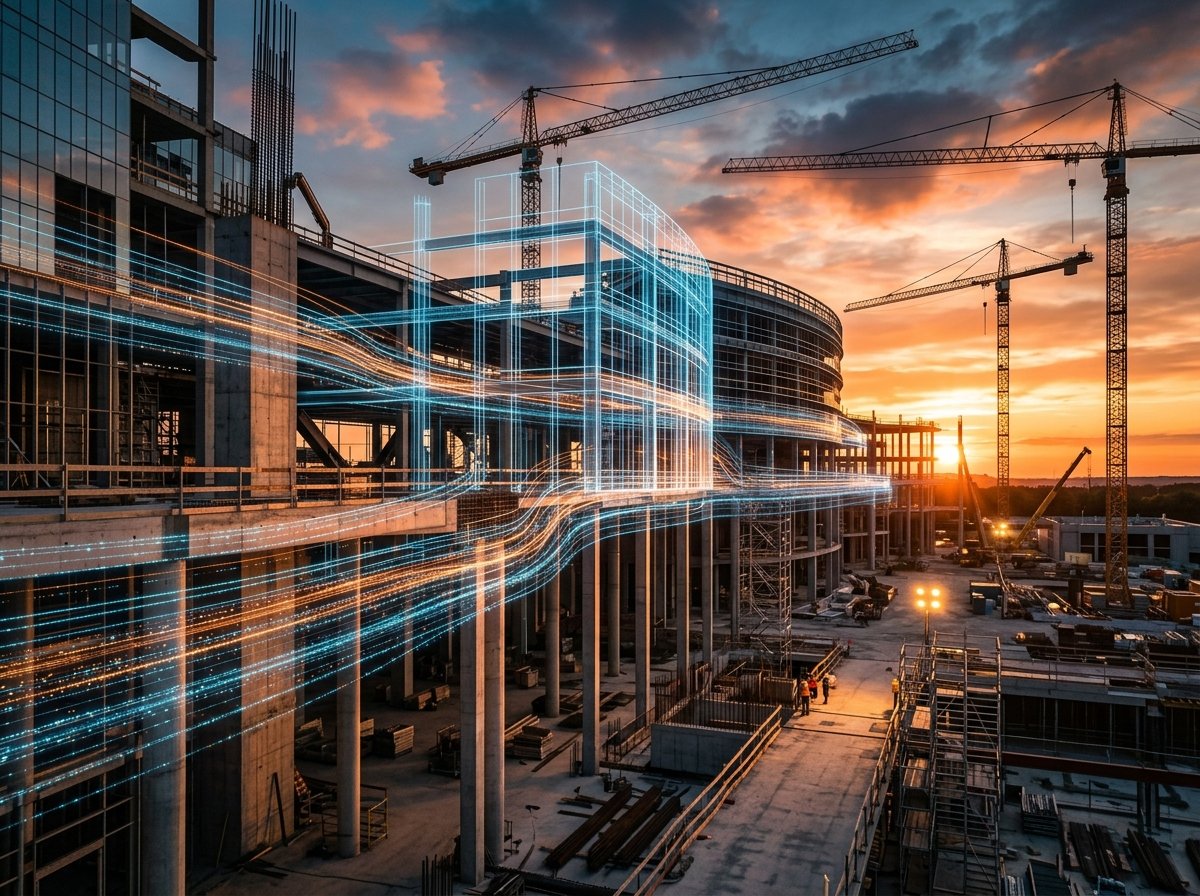
The rapid rise of AI in construction is finally tackling one of the oldest, most painful realities of the building industry: the near-certainty that every major project will blow past its budget and drag on months behind schedule.
Whether you have overseen a commercial high-rise or simply remodeled a kitchen, you know the script by heart. The Gantt chart looks immaculate, projected numbers align neatly with your spreadsheet, and the contractor assures you the handover date is solid.
Then reality strikes. An unseasonal week of torrential downpours halts excavation, raw steel spikes 15% overnight, or a subcontracted crew fails to show up on site. What began as a confident schedule quickly morphs into an expensive financial headache.
In 2026, progressive general contractors are no longer accepting this chaos as business as usual. By feeding real-time site variables into predictive algorithms, AI in construction is replacing gut feelings and optimistic guesswork with accurate, data-backed probability modeling.
The Fallacy of the Perfect Schedule: How AI in Construction Changes the Game
Historically, capital projects have suffered from what behavioral economists define as optimism bias. During early project phases, developers and engineering teams systematically assume ideal operational conditions: uninterrupted clear skies, zero supply chain hiccups, and flawless labor productivity.
According to landmark global research by McKinsey & Company on capital projects and infrastructure, large-scale construction builds routinely run 80% over budget and slip 20% behind schedule. Across civil engineering, cascading delays are the norm rather than the exception.
This historical failure is not due to a lack of competence; it stems from human cognitive limits when juggling millions of moving parts. A standard commercial jobsite involves hundreds of interdependent material deliveries, dozens of specialized trades, and complete vulnerability to regional weather events. Static spreadsheets simply cannot keep pace with dynamic jobsite realities.
This is where modern AI in construction marks a fundamental turning point. Rather than hoping for perfect conditions, predictive engines continuously run probabilistic risk models, identifying schedule slippage and cost bottlenecks weeks before heavy equipment even touches the soil.
“Traditional construction scheduling has long been a letter of good intentions written for an ideal world. AI in construction replaces wishful thinking with statistical probability, uncovering trade delays two weeks before they happen.”
— Industry Analysis, Building Information Modeling Consortium
Weather and Supply Chain Dynamics: Harmonizing Chaotic Variables
To understand how AI in construction achieves high forecasting precision, we must look under the hood at its data inputs. Advanced machine learning models do not merely analyze static blueprints; they process immense streams of real-time environmental and commercial intelligence.
The first core pillar is hyper-local meteorological tracking. Instead of relying on generic regional weather forecasts, specialized construction AI integrates Doppler radar tracking and a decade of microclimate historical trends mapped to the jobsite’s exact GPS coordinates.
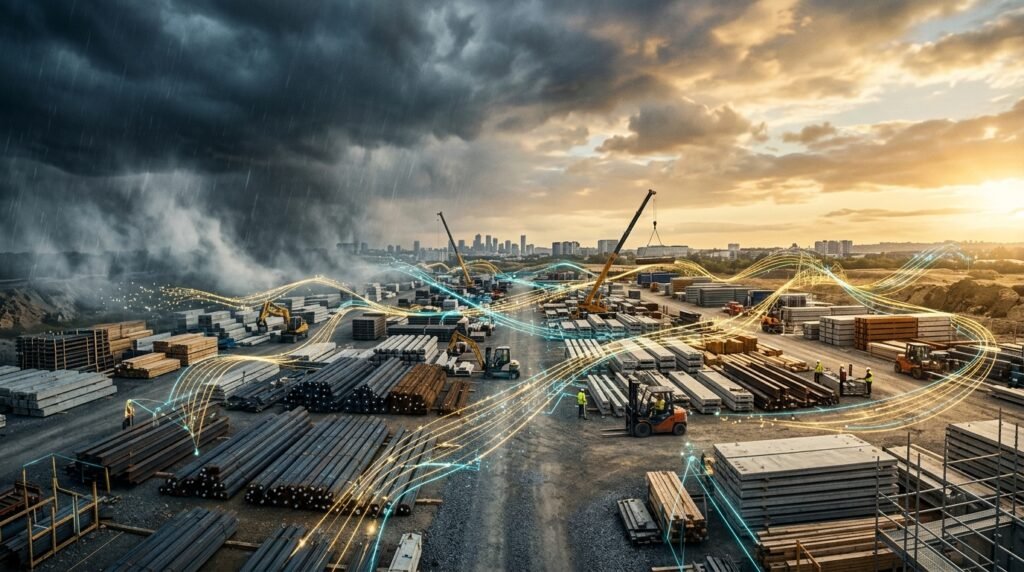
For instance, concrete pours require specific ambient humidity and dry windows for structural curing. If the predictive algorithm spots an 82% probability of severe storms heading toward the site next Wednesday, it alerts project managers days ahead. This stops costly concrete mixer trucks from dispatching into a wash-out and keeps site crews productive on dry, indoor tasks.
IMAGEM_1_PLACEHOLDER
The second pillar of this connected ecosystem is predictive procurement. Intelligent algorithms track commodity indices, regional warehouse inventories, and freight logistics for rebar, cement, aggregates, and fuel. Much like how forward-thinking teams set up free AI automations to orchestrate operational tasks, contractors deploy smart bots to identify the ideal procurement window for volatile materials.
When market signals suggest steel prices will jump due to scrap metal export bottlenecks, the platform recommends locking in mill contracts early. This cushions the balance sheet against inflation and eliminates construction standstills caused by backordered structural components.
5D BIM and Computer Vision: The Fully Connected Jobsite
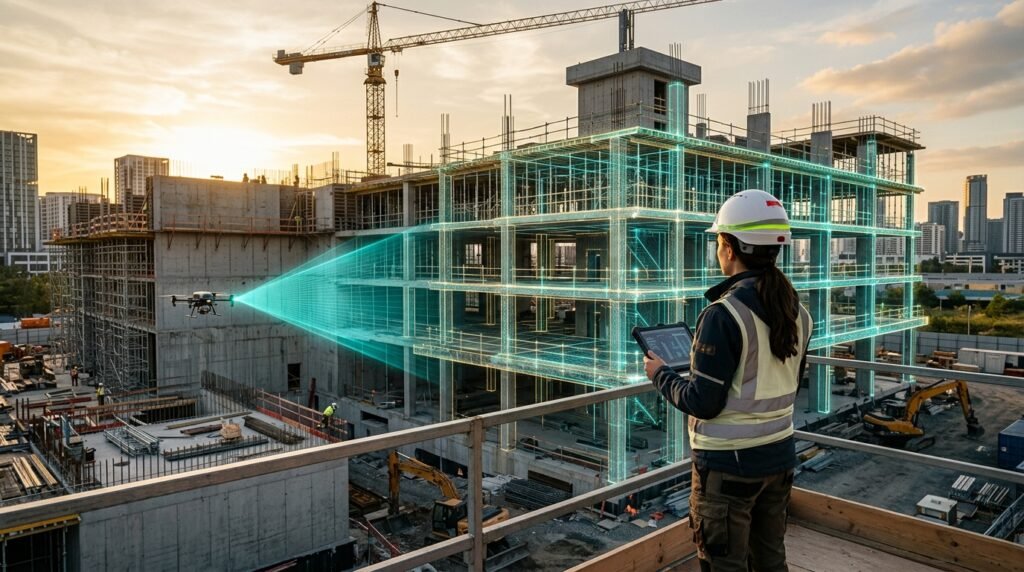
Another major leap forward powered by AI in construction is the union of 3D Building Information Modeling (BIM) with autonomous computer vision. Modern jobsite tracking no longer relies on superintendents walking floors with clipboards to manually estimate percentage completion.
Modern platforms like Buildots, OpenSpace, and Doxel allow field engineers to walk jobsites equipped with lightweight 360-degree cameras mounted directly on hard hats. As they complete their routine safety walks, the platform analyzes the visual stream, comparing spatial data pixel-by-pixel against the 5D BIM model—which integrates 3D geometry, project schedules (4D), and line-item costs (5D).
IMAGEM_2_PLACEHOLDER
Within minutes, the system produces a visual heat map detailing installed components versus planned baselines. If a subcontractor mounts electrical conduit or plumbing risers across the wrong drywall stud on level four, the AI detects the clash before sheetrock is hung and finishes are applied. Eliminating structural rework saves massive sums across commercial developments.
This automated accountability streamlines trade coordination. Just as we explored in our guide on how to unstick projects with AI when teams hit friction, site supervisors leverage automated daily logs and AI contract review safeguards to resolve trade disputes before they turn into costly claims.
Dynamic Crew Scheduling: Eliminating Idle Downtime
One of the most valuable capabilities of AI in construction is parametric schedule optimization. In traditional workflows, when one critical path activity falls three days behind, field schedulers spend hours wrestling with Primavera or Microsoft Project to update critical paths, often generating confusion and trade stacking on site.
Generative AI engines (such as those pioneered by ALICE Technologies) run millions of schedule simulations in seconds. If rain shuts down exterior scaffolding on Thursday morning, the algorithm automatically restructures task sequences, routing drywallers and electricians to interior framing and rough-in tasks without losing a single hour of billable trade labor.
The operational advantages are substantial:
- Zero Idle Downtime: Work crews are proactively shifted to sheltered interior work areas before storms arrive, protecting daily productivity rates.
- Minimizing Liquidated Damages: Continuously compressing critical path tasks prevents contract penalty clauses and reduces construction loan interest expenses.
- Data-Backed Claims and Change Orders: Automated weather and production logs give developers clear objective documentation when negotiating contractual delay claims.
For property developers and general contractors, this translates into dependable delivery dates. Instead of offering vague delivery windows, leadership teams deploying predictive analytics can quote delivery schedules with over 90% statistical confidence.
The Human Element: Why Professional Responsibility Remains Essential
With algorithms automating so much complex planning, a logical question arises: will artificial intelligence replace civil engineers, estimators, and project superintendents? According to leading industry bodies like the Autodesk Construction Cloud and structural engineering boards, the answer is a clear no.
AI in construction serves as a high-speed analytical copilot. No neural network stamps structural blueprints or bears legal liability for site safety. Human estimators remain vital for confirming supplier quotes, evaluating constructability, and ensuring that pricing assemblies reflect regional market nuances.
What changes is the strategic value of the job. Engineers spend far less time doing manual takeoffs in spreadsheets and more time solving high-value site challenges. Firms adopting artificial intelligence on jobsites are not cutting technical headcount; they are scaling their project throughput and safeguarding their profit margins.
The digital transformation of the jobsite is well underway in 2026. Teams clinging to outdated spreadsheets will continue to face systemic budget overruns, while technology-forward builders deliver complex structures on time and within budget.
Frequently Asked Questions (FAQ)
What is AI in construction and how does it work?
AI in construction refers to the application of machine learning, computer vision, and predictive analytics to optimize bidding, site scheduling, progress tracking, and inventory management. It processes historical production rates, commodity prices, and weather trends to forecast potential bottlenecks and eliminate budget overruns.
How do predictive algorithms use weather data to prevent delays?
AI tools integrate local Doppler radar data and decade-long microclimate trends. When models detect high probabilities of weather events that disrupt outdoor tasks (such as grading or crane operations), the software automatically reallocates crews to weather-protected indoor tasks, preventing idle labor costs.
Can small and mid-sized contractors adopt these tools?
Yes. While platforms like ALICE Technologies cater to mega-infrastructure projects, many cloud-based SaaS tools are designed specifically for small-to-midsize general contractors. Mobile 360-degree reality capture apps and AI-powered estimating tools now offer accessible pricing without massive upfront IT investments.
Does artificial intelligence replace licensed civil engineers and estimators?
No. AI functions as an analytical assistant. Licensed professional engineers (PEs) and certified estimators must still validate cost assemblies, oversee structural integrity, and assume formal legal responsibility for project sign-offs.
Have you ever experienced a construction project that went wildly over budget or suffered months of weather-related delays? How do you see predictive algorithms transforming jobsites in your region? Leave your thoughts in the comments below!