


You probably hear the buzzword everywhere—on morning news segments, across LinkedIn feeds, and in hallway chats with coworkers. But when you strip away the hype, what is artificial intelligence in everyday life? Are we talking about rogue robots from Hollywood blockbusters, or something far more practical, quiet, and already woven into your daily routine?
If you don’t consider yourself a tech enthusiast, take a deep breath. Artificial intelligence isn’t some impenetrable mystery reserved for software engineers with multiple PhDs. In reality, it is a tool designed to solve problems—and chances are, you relied on it multiple times before you even finished your morning coffee.
Whether you want to understand how your smartphone anticipates your next move or discover how modern tools like ChatGPT can reclaim hours of your work week, this straightforward guide breaks down what artificial intelligence actually is, how it functions behind the scenes, and how anyone can start putting it to work right away without writing a single line of code.
What Is Artificial Intelligence and How Does It Actually Work?

At its core, what is artificial intelligence? Artificial Intelligence (often abbreviated as AI) is a branch of computer science dedicated to building machines and software capable of mimicking human cognitive functions—such as learning, recognizing patterns, reasoning, and making contextual decisions.
To grasp the difference, consider traditional computer software. A pocket calculator follows rigid, deterministic rules: when you press “2 + 2”, it produces “4” because a human programmer hardcoded that arithmetic rule into its silicon circuits. It cannot think, it cannot adapt, and it certainly cannot learn. If you feed it a messy spreadsheet with missing numbers, it simply throws an error.
By contrast, an artificial intelligence system operates by analyzing immense volumes of historical data, detecting subtle underlying patterns, and refining its predictions through continuous trial and error. Rather than waiting for a programmer to script every possible scenario, AI systems adapt to new circumstances based on the examples they have observed.
As documented by research from Stanford University’s Human-Centered AI Institute, the true milestone of modern computing is this transition from explicit rule-following to dynamic pattern recognition. If you want to see how this capability is already transforming complex professional workflows, explore our analysis of practical automation workflows.
How Artificial Intelligence Operates in Plain English
To understand the mechanics without drowning in mathematical jargon, imagine training a young puppy to fetch a tennis ball.
You cannot crack open a puppy’s brain to install instructions. Instead, you toss the ball, say the word “fetch,” and observe what happens. When the dog runs after the ball and brings it back, you offer praise and a delicious treat. When the dog wanders into the kitchen instead, you withhold the treat and gently try again. Over dozens of repetitions, the puppy connects the vocal sound with the desired behavior. That is reinforcement learning in action.
Artificial intelligence operates through a very similar tandem of two core ingredients:
- The Algorithm: Think of the algorithm as the master recipe. It is a mathematical structure that tells the computer how to process signals, calculate probabilities, and adjust its weights whenever it makes a mistake.
- The Data: Data serves as the textbook or practice reps. Without hundreds of thousands—or billions—of real-world examples, an algorithm is like an empty brain with tremendous potential but zero experience.
Consider image recognition. If engineers feed an AI model two million photos of cats and two million photos of dogs, the system does not memorize every pixel. Instead, the algorithm gradually identifies characteristic markers: the unique angle of feline ears, the texture of whiskers, the geometry of a snout. When you subsequently upload a brand-new snapshot of your own pet, the AI calculates the probability of those features and confidently announces: “That is a cat with 99.2% certainty.”
This dynamic learning mechanism is also what powers modern generative AI platforms, from conversational chatbots to autonomous agents. To see where this evolutionary leap is heading next, take a look at our breakdown of next-generation AI operating systems.
4 Everyday Examples of AI You Are Already Using
You don’t need to visit a robotics lab to interact with cutting-edge technology. Here are four ubiquitous examples of artificial intelligence actively working in your daily life:
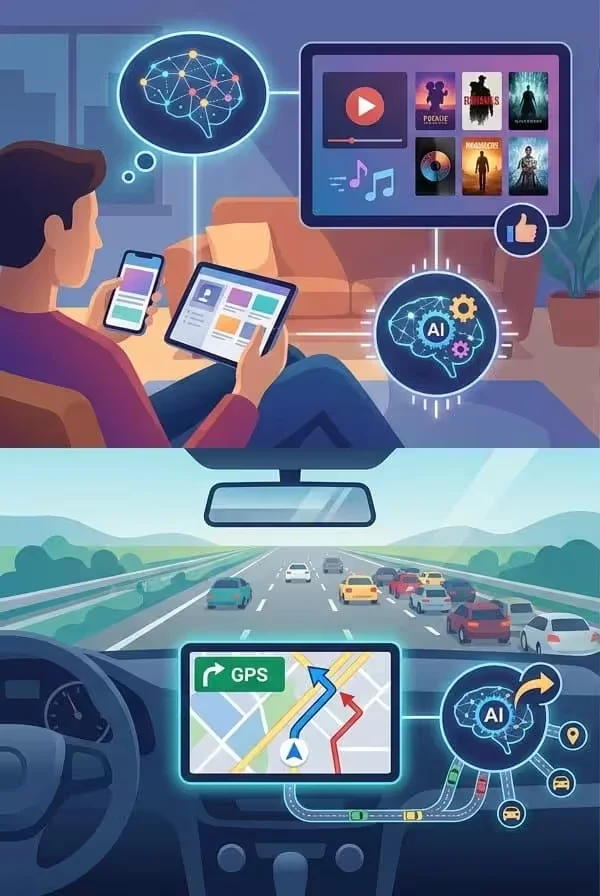
- Streaming Recommendations (Netflix & Spotify): Whenever Spotify builds your “Discover Weekly” or Netflix lines up a movie that matches your weekend mood, an AI recommendation engine has crunched your history alongside millions of similar listeners to predict what you will enjoy next.
- Smart Email Spam Filters: Your inbox encounters hundreds of phishing scams and spam messages every day. AI language filters scan sender behavior, link patterns, and suspicious phrasing to quarantine junk before you ever notice it.
- Dynamic Navigation (Google Maps & Waze): GPS navigation no longer relies solely on static road maps. Machine learning models aggregate real-time vehicle movement, construction reports, and historical traffic patterns to steer you away from impending gridlock.
- Voice Assistants (Siri, Alexa, Google Assistant): When you ask for tomorrow’s forecast, Natural Language Processing (a key subfield of AI) converts raw audio soundwaves into structured text, parses your intent, and retrieves the precise answer in milliseconds.
AI Myths vs. Facts: Clearing the Confusion
Whenever a transformative technology reshapes society, headlines tend to oscillate wildly between utopian miracles and apocalyptic nightmares. Let’s separate widespread myths from reality with the comparison table below:
| Common Belief | Myth or Fact? | The Real Story |
|---|---|---|
| “AI will eliminate every human job tomorrow.” | Myth | AI is primarily transforming workflows rather than eradicating human labor. It excels at absorbing repetitive, clerical drudgery, freeing humans to focus on strategy, empathy, and complex problem-solving. |
| “You must know how to code to use AI.” | Myth | Modern generative tools interact through natural human language. If you know how to write a text message or ask a clear question, you already possess the interface skills required to use AI. |
| “AI models can make errors and hallucinate.” | Fact | Because language models predict likely sequences of words rather than verifying absolute truths, they can occasionally produce convincing falsehoods. Critical human review remains indispensable. |
| “AI systems have feelings and self-awareness.” | Myth | Today’s models are sophisticated mathematical calculators. They simulate conversational tone with astonishing skill, but they experience zero consciousness, emotion, or intent. |
How to Start Using AI Today: A 5-Minute Practical Guide
The most effective way to demystify what is artificial intelligence is to interact with it firsthand. You don’t need expensive software or technical tutorials. Here is a frictionless, two-step walkthrough to get started in five minutes:
Step 1: Set Up Free Access
- What to do: Visit the official web interface of an established conversational AI platform.
- How to do it: Open your web browser and navigate directly to the ChatGPT official platform. Click “Sign up” and authenticate with your existing Google or Microsoft account for instant, zero-cost access.
- What to expect: You will see a clean, minimalist chat interface featuring a single prompt input box at the bottom of the screen—just like an empty messaging window.
- Security tip: Always verify that you are on the legitimate official website to steer clear of unauthorized copycats or unverified browser extensions.
Step 2: Enter Your First Targeted Prompt
Think of an AI chat interface as a remarkably well-read junior research assistant. If you give a vague one-sentence order, you will receive a generic answer. However, if you assign a clear role, context, and specific constraints, the output will surprise you with its depth.
Copy and paste the tested prompt below into the input box, then press Enter:
Act as an experienced travel planner. Create a detailed 3-day beach getaway itinerary for a family of four on a reasonable budget. Include morning and afternoon activities, two affordable dining recommendations per day, and practical money-saving tips for local transportation.Within seconds, the model will analyze your criteria and deliver a structured, day-by-day itinerary complete with actionable suggestions. You can then ask follow-up questions, request adjustments (e.g., “Make day two more relaxing with kid-friendly parks”), or ask it to summarize the plan into a printable packing checklist.
Ready to Make Your Daily Routine Effortless with AI?
Grasping the fundamentals of artificial intelligence is the first step toward staying confident and capable in a fast-evolving digital landscape. When you look beneath the marketing jargon, AI is not an incomprehensible titan; it is an accessible amplifier for your own curiosity and productivity.
You don’t need an advanced degree in mathematics to harness this power. All you need is an open mind, an appetite for experimentation, and a willingness to explore how these digital co-pilots can streamline your daily routines. For more practical guides, actionable tips, and everyday tutorials, bookmark Minha Dose de IA as your go-to technology companion.
Frequently Asked Questions About Artificial Intelligence
Is artificial intelligence safe for everyday users?
Yes. Mainstream AI platforms from established providers employ robust security measures, enterprise-grade data encryption, and strict safety guardrails. However, sound digital hygiene is still essential: never input highly sensitive personal identifiers, banking credentials, medical records, or confidential corporate secrets into general public chat tools.
Do I need advanced math or programming skills to benefit from AI?
Not at all. While the engineers who design and train foundation models rely on linear algebra and deep learning code, the consumer interface is purely conversational. If you can type a question into a search engine or send a WhatsApp message, you have all the technical skills needed to utilize modern AI.
Will artificial intelligence eventually replace human creativity?
No. AI models synthesize and recombine patterns from existing historical data, but they possess no authentic emotional life, moral compass, or genuine lived experience. The most compelling work emerges when human judgment, empathy, and creative vision guide AI speed and computational leverage.
Let’s Keep the Conversation Going!
Now, it’s your turn: Which of these everyday AI applications surprised you the most? Have you tried typing your first prompt into ChatGPT yet, or do you have questions about where to begin? Share your thoughts in the comments below—let’s talk AI! 👇