


Few experiences induce digital paralysis quite like receiving a 38-page agreement filled with microscopic clauses, dense archaic syntax, and vague indemnification liabilities. Whether you are signing an apartment lease, onboarding an enterprise software vendor, or reviewing a freelance client contract, traditional legalese is engineered to protect institutional leverage—often at your direct expense.
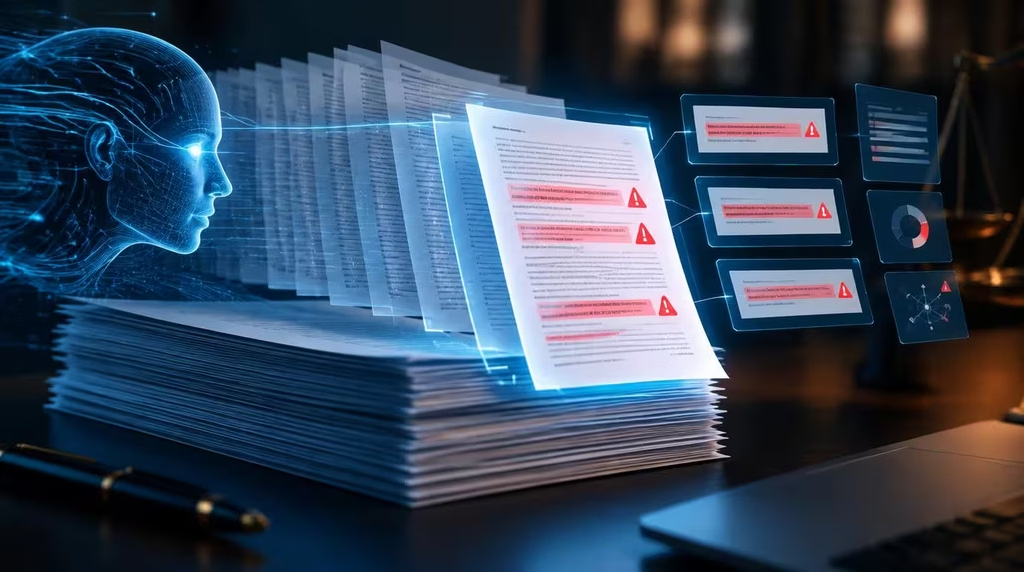
Most individuals succumb to “contract fatigue,” skimming the text briefly before signing blindly and praying nothing goes wrong. But today, conducting a rigorous AI contract review acts like an analytical X-ray machine. Advanced large language models do not merely scan text; they parse liability structures, uncover silent rights waivers, and translate intimidating legalese into conversational English in under two minutes.
Why Modern AI Changes the Legal Playing Field
Historically, conducting a thorough document audit required hiring specialized legal counsel at hourly rates exceeding $400. While AI does not substitute for licensed attorney advice in high-stakes litigation, it democratizes foundational literacy. Models like Claude 3.5 Sonnet and GPT-4o possess context windows exceeding 128,000 tokens—capable of ingesting entire commercial leases and multi-vendor service agreements in a single prompt.
According to analytical reporting from the American Bar Association, automated clause analysis and semantic review are rapidly reshaping legal operations across corporate sectors. For independent freelancers, tenants, and small business founders, an initial AI audit levels the information asymmetry before any signature touches paper.
The 4 Sneakiest Contract Traps AI Uncovers in Seconds
When our team ran dozens of real-world freelance agreements and lease templates through our audit pipeline, the same abusive patterns emerged repeatedly:
1. Asymmetrical Termination Penalties
The client reserves the unilateral right to terminate the contract “at will with 24 hours notice,” while you are penalized 60 days of retained fees if you exit early. AI instantly flags one-sided liquidated damages clauses and balances termination reciprocity.
2. Silent Perpetual IP Assignment
A seemingly innocent graphic design or coding agreement might contain a clause assigning “all inventions, concepts, and intellectual property conceived during the term”—including personal projects developed on weekends. A targeted prompt highlights these overreaching ownership grabs immediately.
3. The Phantom Full-Time Contractor Trap
Many remote companies hire international freelancers to avoid payroll taxes while imposing strict employee hours, mandatory tool surveillance, and exclusivity covenants without offering benefits or paid leave. An AI scan evaluates whether your contract creates uncompensated misclassification risks.
4. Vampire Auto-Renewal and Evergreen Clauses
Enterprise SaaS agreements and commercial office leases often mandate that non-renewal notices must be delivered via certified physical mail in an arbitrary 5-day window six months prior to expiry. The AI flags these evergreen traps and outputs the exact calendar deadlines you must track.
Field-Tested Prompts for AI Contract Review
To extract surgical insights rather than vague summaries, copy and adapt these four specialized prompts from our editorial library:
Prompt 1: The General Risk and Abuse Scanner
Act as a seasoned corporate legal counsel specializing in contract dispute resolution.
Review the attached agreement from the perspective of protecting [ME / MY SMALL AGENCY].
1. Identify the top 5 highest-risk clauses, indemnification traps, and one-sided liabilities.
2. Highlight any non-standard or unusually aggressive language compared to standard industry norms.
3. For each flagged item, cite the exact clause number, explain the real-world financial risk in plain English, and provide balanced replacement wording.

Here is the contract text:
[Paste text or attach document]
Prompt 2: The Legalese-to-English Coffee Chat Translator
Translate Clause [X.X] into conversational, everyday English as if explaining it to a close friend over coffee.
Explain:
- What am I actually agreeing to do?
- What am I giving up?
- What is the worst-case scenario if things go wrong?
Prompt 3: The Residential and Commercial Lease Auditor
Audit this lease agreement specifically for tenant protection:
1. Identify all hidden fees, utility pass-throughs, and maintenance responsibilities shifted onto the tenant.
2. Detail the exact security deposit return timeline and required move-out conditions.
3. Check for any clauses restricting visitors, home offices, or privacy rights.
4. Flag any penalty fees that exceed statutory maximums.
Prompt 4: The Diplomatic Counter-Proposal Generator
I want to negotiate the 3 clauses flagged above without sounding confrontational or threatening the business relationship.
Draft a friendly, highly professional email to the other party:
- Emphasize mutual partnership and excitement about the collaboration.
- Request reasonable revisions to the 3 clauses using diplomatic, collaborative phrasing.
- Provide the exact suggested redline wording for each clause.
Privacy First: How to Audit Contracts Without Cloud Data Leaks
Legal agreements frequently contain sensitive personal data: Social Security numbers, bank account routing details, home addresses, and confidential trade secrets. Uploading this data carelessly to a public chatbot introduces massive compliance vulnerabilities.
Follow our three golden privacy rules:
- Sanitize Names and Financials: Replace party names with placeholders like [Company Alpha] and [Contractor John Doe]. Redact exact bank details and physical addresses before pasting.
- Turn Off Training History: Ensure model training is disabled in your user settings. For detailed instructions on securing your sessions, check our full breakdown on OpenAI Privacy Settings & Data Policy.
- Consider Local Offline LLMs: For highly sensitive IP or non-disclosure agreements, run offline open-weights models like Llama 3.3 or Mistral locally using Ollama or LM Studio.
The 5-Step Pre-Signing Verification Checklist
Before you commit your electronic signature to any binding contract, execute this final verification checklist:
| Checklist Step | Verification Objective | AI Verification Tool |
|---|---|---|
| 1. Deliverables & Milestones | Are scope boundaries, revision limits, and deadlines unambiguous? | Prompt 1 (Risk Scanner) |
| 2. Payment Terms & Grace Periods | Is Net-30 clearly defined, including interest on late invoices? | Prompt 2 (Plain English) |
| 3. Mutual Termination | Can either party exit under equivalent, balanced terms? | Prompt 1 (Risk Scanner) |
| 4. Governing Law & Jurisdiction | Is the dispute venue located in a realistic, affordable forum? | Prompt 2 (Plain English) |
| 5. Counter-Proposal Review | Are requested changes communicated with calm diplomatic tact? | Prompt 4 (Redline Drafter) |
To take your practical workflow further, explore our hands-on guide on Claude vs ChatGPT for long-form legal and technical writing.
Frequently Asked Questions
Does an AI contract review have legal standing in a court of law?
No. Large language models provide informational analysis and reading comprehension assistance, not licensed legal representation. For multi-million-dollar transactions, patent transfers, or active litigation, always retain qualified legal counsel.
Can AI models process scanned paper contracts or photo PDFs?
Yes. Multimodal LLMs like GPT-4o and Claude 3.5 Sonnet feature advanced Optical Character Recognition (OCR). You can upload high-resolution images or flattened PDFs, and the vision models will extract the fine print accurately.
What if the opposing party refuses to alter abusive clauses?
A refusal to negotiate basic reciprocity is itself a valuable signal. When a party insists on retaining unilateral penalties, you possess clear visibility into future relationship friction before getting legally trapped.
Take Control of Your Fine Print Today
Signing blindly is no longer acceptable in an era where AI can demystify complex agreements in minutes. Never let intimidating legal jargon bully you into accepting unfair terms. Have you ever caught a bizarre or punitive clause in an agreement using AI? Share your negotiation stories and questions in the comments below!