


If you have ever attempted to draft a multi-chapter non-fiction book, an intricate technical whitepaper, or a complex narrative essay using artificial intelligence, you have likely run into the dreaded “context wall.” Early in the conversation, the chatbot is brilliant, witty, and obedient. But by chapter four, the prose turns robotic, repetitive clichés creep in (“In the ever-evolving landscape…”), and characters or arguments introduced twenty minutes ago vanish into thin air.
In the high-stakes showdown of Claude vs ChatGPT for writing, creators are no longer asking who can write a 3-paragraph marketing email faster. The battleground has shifted to long-form coherence: stylistic nuance, subtext retention, emotional rhythm, and the ability to maintain consistent narrative voice across tens of thousands of words.
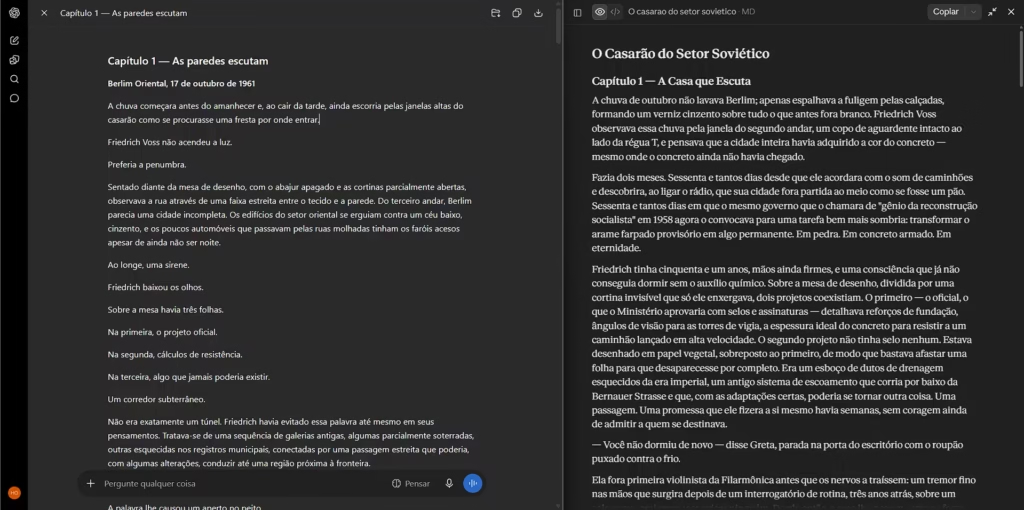
The Stress-Test: The 1961 East Berlin Experiment
To move beyond marketing benchmarks, our editorial team subjected Anthropic’s flagship model and OpenAI’s latest architecture to an unforgiving literary benchmark: writing a historically grounded, multi-scene Cold War thriller set during the sudden construction of the Berlin Wall in August 1961.
Both models received identical instructions: a 1,200-word historical brief, four nuanced characters with conflicting political motivations, strict prohibitions against modern vocabulary and generic Hollywood tropes, and an open prompt to deliver a continuous 2,500-word opening chapter. Here is how both systems performed under deep creative pressure.
ChatGPT: The Relentless Action Engine
OpenAI’s GPT-4o approaches long-form drafting like an elite commercial screenwriter. Its pacing is rapid, its transitions are punchy, and its plot momentum never flags. When generating high-velocity dialogue, scene changes, or complex technical procedures, ChatGPT rarely loses momentum.
However, when scrutinized for deep literary craft, certain algorithmic habits surface:
- Rhetorical Tropes: It frequently defaults to dramatic triad sentences (“He felt the cold, the silence, and the fear”) and cinematic melodrama that can feel formulaic over extended chapters.
- Premature Moral Summaries: ChatGPT has a persistent tendency to end paragraphs with tidy reflective aphorisms, explaining what the character learned rather than letting the scene breathe naturally.
- Structural Velocity: Where ChatGPT shines is sheer throughput: generating outlines, scene beats, and functional structural scaffolding with blistering speed.
Claude: The Master of Subtext and Psychological Prose
Anthropic’s Claude 3.5 Sonnet handles prose like a seasoned literary novelist. Where other models rush toward conflict, Claude understands sensory restraint, physical texture, and psychological subtext. In our Cold War test, Claude described the damp smell of wet mortar and the awkward clinking of military thermoses before any gun was drawn.
According to technical evaluations published by Anthropic Research, Claude’s training emphasizes natural voice, conversational restraint, and resistance to sycophancy. Key literary advantages include:
- Zero Cliché Reflex: Claude avoids robotic transition phrases like “Furthermore,” “In summary,” or “It is crucial to note” without requiring aggressive negative prompting.
- Persistent Character Voice: It retains subtle dialect quirks and personality traits across dozens of interaction turns without drifting into caricatures.
- The Artifacts Advantage: The dedicated split-screen Artifacts window allows writers to maintain a live, editable manuscript on the right while brainstorming character motives on the left.
Context Degradation: Why Needle-in-a-Haystack Benchmarks Deceive
Many tech enthusiasts look at context window size (128k vs 200k tokens) and assume the model with the larger number automatically writes better books. But synthetic “Needle-in-a-Haystack” retrieval tests—where a single fact is buried inside a mountain of text—do not reflect the reality of creative writing.
Writing requires active attention integration. The model must hold emotional arcs, character motivations, and stylistic constraints in working memory simultaneously. Around 40,000 tokens of dialogue, ChatGPT often flattens its vocabulary and reverts to generic helpful assistant tone. Claude 3.5 Sonnet displays remarkable resistance to this “context drift,” remembering sensory details established three scenes prior with startling precision.
The Master Style Emulation Prompt for Long-Form Prose
To eliminate robotic syntax in either model, deploy this battle-tested master system prompt before drafting your next chapter:
You are an uncompromising literary editor and narrative stylist co-authoring a long-form work with me.
Follow these mandatory prose rules:
1. SENSORY GROUNDING: Anchor every scene in concrete physical textures (sounds, temperatures, smells) before introducing dialogue.
2. BAN ROBOTIC TRANSITIONS: Never use "Furthermore", "In conclusion", "Moreover", or "Little did they know".
3. SHOW, DON'T EXPLAIN: Never end a section with a moral reflection or tidy summary explaining what characters felt. Let actions carry weight.
4. CADENCE VARIATION: Mix 5-word staccato sentences with expansive, multi-clause rhythmic descriptions.
5. PRESERVE SUBTEXT: In dialogue, characters must speak around their true intentions rather than bluntly stating them.

Here is the scene premise:
[Insert scene beats]
Head-to-Head Comparison: Claude vs ChatGPT for Writing
Evaluating both platforms across the core disciplines of long-form composition:
| Writing Discipline | ChatGPT (GPT-4o) | Claude (3.5 Sonnet) | Winner |
|---|---|---|---|
| Prose Quality & Nuance | Clean, functional, slightly corporate. | Rich, rhythmic, organic, literary. | Claude |
| Context Endurance (100k+ tokens) | Good memory, but style flattens out. | Exceptional recall of subtle early details. | Claude |
| Brainstorming & Plot Beats | Fast, endless variations, punchy. | Thoughtful, analytical, deliberate. | ChatGPT |
| Editing & Structural Surgery | Executes rigid instructions accurately. | Maintains voice while cutting fluff. | Tie |
| Research & Fact-Checking | Live web browsing, rapid citation. | Deep source synthesis, but static cutoff. | ChatGPT |
The Hybrid Workflow: How Pro Authors Combine Both
Professional authors and seasoned essayists rarely lock themselves into a single ecosystem. The most lethal productivity workflow leverages the complementary strengths of both engines:
- Phase 1: Architecture & Research (ChatGPT): Use GPT-4o’s real-time web access and lateral speed to map out 20 alternative plot trajectories, historical timelines, and chapter structures.
- Phase 2: Knowledge Grounding (NotebookLM): Index your research sources in a grounded environment as detailed in our guide on how to Build a Second Brain with AI.
- Phase 3: Deep Drafting & Voice (Claude): Take the winning outline into Claude 3.5 Sonnet Projects. Upload your personal style guides to draft immersive prose with natural cadences.
- Phase 4: The Devil’s Advocate Edit: Cross-examine the draft using our proven technique from Unstuck with AI: The 5-Step System, having each model identify plot holes in the other’s output.
Frequently Asked Questions
Which tool is cheaper for writing full-length books?
Both OpenAI and Anthropic offer consumer subscriptions at $20/month. For API-based workflows, Claude 3.5 Sonnet offers prompt caching, which reduces cost by up to 90% when re-feeding massive manuscript context windows over iterative writing sessions.
Why does ChatGPT frequently break into short, dramatic sentences?
Reinforcement Learning from Human Feedback (RLHF) rewards ChatGPT for clarity and immediate readability on mobile screens. Over long essays, this training bias manifests as short, repetitive declarative sentences unless explicitly counterbalanced in your system prompt.
Can Claude write non-fiction and business books as well as fiction?
Exceptionally well. In business case studies and technical whitepapers, Claude maintains a rigorous, academic tone that avoids the promotional hype common in other models.
The Verdict: Choosing Your Creative Co-Author
If your goal is rapid ideation, structural outlining, and dynamic plot variation, ChatGPT remains an astonishingly agile sparring partner. But if your standard is literary endurance—where sentences sing, subtext matters, and the writing feels undeniably human across 50,000 words—Claude 3.5 Sonnet stands as the undisputed champion of long-form prose. Which model powers your daily writing routine? Share your favorite prompts and battle stories in the comments below!