


We have all encountered it: that bland, homogenized, corporate voice that instantly gives away an unedited ChatGPT draft. The prose is filled with theatrical clichés: “In the fast-paced, ever-evolving landscape of today’s digital world…”, followed by excessive bullet points and concluding with a tidy, moralizing paragraph starting with “In conclusion, it is important to remember that…”
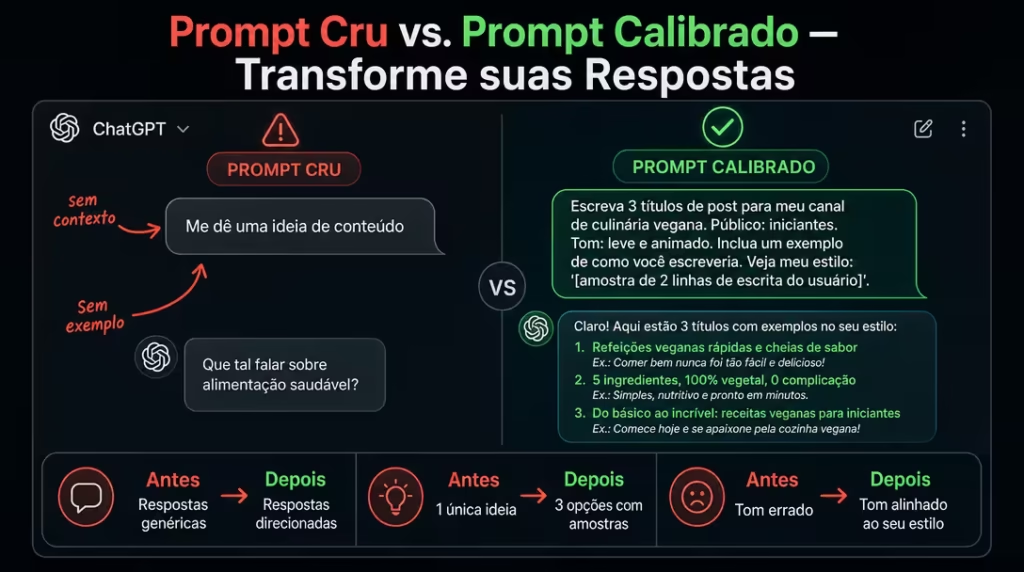
This automated tone feels artificial because large language models are trained through Reinforcement Learning from Human Feedback (RLHF) to prioritize broad agreeableness and polite neutrality. When you ask for a text without providing stylistic constraints, the model computes the mathematical average of internet prose. To break this default mediocrity and make AI write in your tone of voice, you must replace passive prompting with deliberate stylistic calibration.
The Mirror Test: What Actually Constitutes “Your Voice”?
Most writers struggle to define their own voice. If you tell an AI: “Write like me, make it casual and professional,” you will receive generic fluff because “casual” and “professional” are subjective abstractions. Stylistic voice is not a mood; it is an objective combination of quantifiable linguistic patterns:
- Sentence Length Variation (Cadence): Do you write short, punchy 5-word declarations? Or expansive, rhythmic multi-clause sentences?
- Sensory vs. Conceptual Diction: Do you ground arguments in tangible metaphors (plumbing, street food, coffee shops) or abstract corporate metrics?
- Humor and Irony: Is your tone understated, wry, dry, sarcastic, or enthusiastically optimistic?
- Direct Address: Do you speak directly to the reader (“you and I”) or adopt an authoritative third-person perspective?
The 3 Pillars of Algorithmic Tone Calibration
To train any modern model—whether Claude 3.5 Sonnet or ChatGPT—to mirror your writing style faithfully, implement this 3-pillar framework:
Pillar 1: Few-Shot In-Context Learning (The Gold Standard)
In machine learning theory, Few-Shot Prompting outperforms zero-shot descriptions by an order of magnitude. Instead of telling the AI how to write, show it three past articles or newsletters you have authored manually. The model’s attention mechanism analyzes the latent syntactic patterns and replicates them dynamically.
Pillar 2: The Negative Diction Blacklist
Language models possess strong default probabilities for specific transition words. Banning these explicitly in your prompt strips away 90% of the robotic feel instantly.

4 Battle-Tested Prompts to Clone Your Voice
Use these four specialized prompt architectures to extract and apply your voice across all drafting sessions:
Prompt 1: The Style Reverse-Engineer
I am going to paste 3 original articles written entirely by me below.
Analyze my writing style across these 5 dimensions:
1. Sentence length, rhythm, and cadence.
2. Vocabulary level and choice of idioms/analogies.
3. Tone of voice (irony, warmth, authority, vulnerability).
4. Structural habits (how I open sections, how I handle transitions).
5. What I NEVER do (habits I clearly avoid).
Synthesize your findings into a concise 150-word "Style Fingerprint" system prompt.

Here are my samples:
[Paste 3 samples]
Prompt 2: The Few-Shot Drafting Command
Adopt the Style Fingerprint derived above.
Draft a [newsletter / article / essay] on [TOPIC].
Mandatory Rules:
- BAN LIST: Never use "delve", "tapestry", "revolutionize", "beacon", "furthermore", "in conclusion".
- Cadence: Alternate between punchy single-line sentences and expansive narrative clauses.
- Opening: Start directly inside a vivid scene or provocative question. Never summarize what the article is about.
Prompt 3: The Robotic Text De-Blander
Rewrite the following paragraph to remove all robotic AI phrasing.
Make it sound like an honest conversation between two knowledgeable colleagues over coffee.
Cut the word count by 25%, eliminate all passive voice, and introduce natural human rhythm:
[Paste text]
Prompt 4: The Substack/Newsletter Voice Anchor
Write from the perspective of an authentic independent creator who values craft over corporate jargon.
Use occasional wry self-deprecation, concrete real-world metaphors, and personal vulnerability.
Avoid buzzwords. Speak directly to "you".
The Tone Analysis Matrix: Quantifying Your Natural Voice
To eliminate ambiguity when communicating with neural models, calibrate your style across four objective spectrums:
| Style Metric | Robotic AI Default | Calibrated Human Voice |
|---|---|---|
| Formality Spectrum | High; academic and corporate buzzwords | Conversational; direct peer-to-peer dialogue |
| Pacing & Cadence | Monotonous medium-length sentences | Dynamic variation; staccato punchlines |
| Emotional Warmth | Neutral, sterile, sycophantic praise | Honest, opinionated, wry, vulnerable |
| Analogy Grounding | Abstract (“synergy”, “catalyst”) | Physical (“rusty gears”, “espresso shots”) |
Custom GPTs vs. Claude Projects: Where to Anchor Your Style
Instead of pasting your tone guidelines into every chat session, lock them into persistent agent memory. In ChatGPT, create a dedicated Custom GPT equipped with your voice instructions and writing samples. In Anthropic, set up a dedicated Claude Project where your tone rules live inside the Project Knowledge base, ensuring every new document draft inherits your voice automatically without manual configuration.
Choosing the Right Model: Claude vs. ChatGPT for Voice
Your choice of foundational model heavily impacts stylistic flexibility. As we discovered in our in-depth benchmark on Claude vs ChatGPT for Long-Form Writing, Anthropic’s Claude 3.5 Sonnet requires far less negative prompting to produce warm, nuanced prose. ChatGPT excels at speed and outlines, but requires firm guardrails to prevent rhetorical melodrama.
The Final 10% Human Polish
No prompt—regardless of sophistication—replaces the human eye. The best writers treat AI as a generator of rough clay. Once the draft is generated, spend ten minutes applying the final human polish: reading sentences out loud to catch awkward pauses, injecting authentic personal anecdotes, and sharpening punchlines.
To take your practical workflow further, explore our hands-on guide on how to create shareable posts with AI while keeping your voice.
Frequently Asked Questions
Can AI replicate someone’s tone of voice perfectly?
It can replicate structural rhythm, vocabulary preferences, and cadence with 90% accuracy. The remaining 10% is your unique lived experience and worldview, which must always be supplied by you.
How many writing samples are needed to calibrate the model?
Three diverse samples of 500 to 1,000 words each (e.g., one opinion piece, one instructional guide, one personal story) are ideal. Providing too many samples can dilute specific stylistic quirks.
Can I save my voice permanently in ChatGPT Custom Instructions?
Yes. Save your synthesized “Style Fingerprint” into ChatGPT’s Custom Instructions under “How would you like ChatGPT to respond?” or configure a custom Anthropic Project with your style guide uploaded as reference documentation.
Make the Machine Speak Your Language
Artificial intelligence should amplify your voice, not drown it in corporate boilerplate. By extracting your style fingerprint and enforcing strict negative diction constraints, you can produce content at scale without losing the human soul that makes your audience listen. Have you tried calibrating your tone in Claude or ChatGPT? Share your favorite prompting tricks in the comments below!