
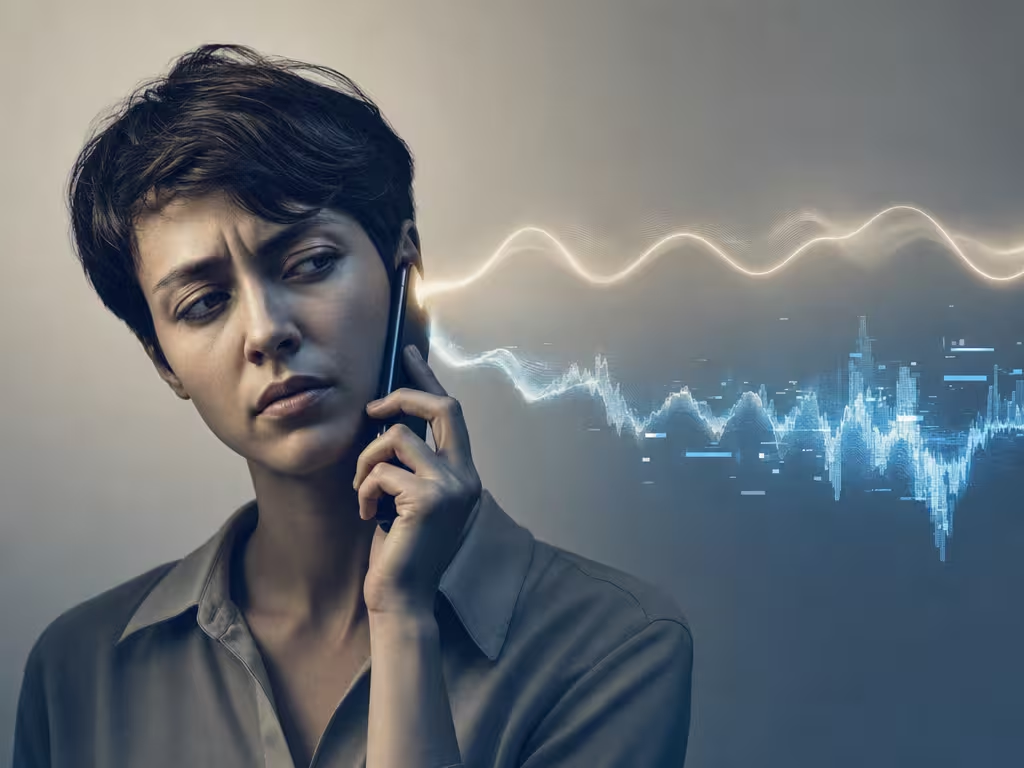
The telephone rings on a frantic Tuesday afternoon. You answer, and the voice on the other end is unmistakable: it is your teenage daughter, sobbing hysterically. She claims she was involved in a severe car accident, her phone battery is dying, and an aggressive tow truck driver or bail bondsman is demanding an immediate $3,000 electronic transfer to release her. The vocal cadence, the slight rasp, the panic in her throat—every acoustic detail sounds 100% genuine.
Except your daughter is sitting safely in her high school chemistry class. You have just been targeted by one of the fastest-growing cybersecurity threats on Earth: AI voice cloning scams. Powered by cheap, consumer-grade neural audio synthesis tools, cybercriminals no longer need expensive audio studios to impersonate loved ones. Three seconds of audio scraped from a public TikTok, Instagram Reel, or YouTube video is all it takes to generate an indistinguishable synthetic voice replica.
This synthetic audio revolution represents a profound shift in social engineering. While traditional phone scams relied on vague claims and gullibility, generative audio weaponizes the deep emotional trust between family members. To understand how visual deepfakes share the exact same underlying architecture, explore our detailed companion breakdown on how to spot deepfakes in video and audio.

How Criminals Clone a Human Voice in 30 Seconds
Historically, voice impersonation required professional impressionists or hours of clean studio recordings to train custom acoustic models. Today, generative audio diffusion models (such as ElevenLabs, Tortoise-TTS, and open-weights Whisper derivatives) operate through zero-shot voice cloning.
According to consumer fraud warnings issued by the Federal Trade Commission (FTC), fraudsters scrape public social media profiles for clips where a target speaks clearly. The neural algorithm extracts the speaker’s vocal timbre, formant resonance, and speech rhythm into a mathematical embedding vector. The scammer then types arbitrary text into a web interface, and the AI outputs the words in the victim’s voice in near real time.
Even more alarming is the rise of real-time voice-to-voice transformers. Using low-latency software, a criminal speaking with a heavy accent in Eastern Europe or Southeast Asia can talk directly into a headset, while the AI model morphs their voice on the fly into the voice of a college student in California—complete with realistic pitch inflection and breathing patterns.
5 Critical Red Flags During a Suspicious Emergency Call
While voice synthesis sounds remarkably convincing, synthetic audio calls exhibit distinctive acoustic and psychological red flags:
- 1. Extreme Emotional Urgency & Panic: Scammers deliberately engineer chaotic emotional states (sobbing, shouting, sirens in the background) to bypass your analytical prefrontal cortex and hide minor synthetic audio glitches.
- 2. Demands for Non-Reversible Payment Methods: The caller will insist on cryptocurrency, wire transfers, Zelle, Venmo, or retail gift cards. Legitimate hospital staff, attorneys, and law enforcement never demand gift cards or immediate peer-to-peer crypto deposits.
- 3. Background Static & Unnatural Pauses: Because scammers often type responses into text-to-speech generators while on the line, listen for awkward 2-second silences before the voice replies to simple conversational questions.
- 4. Refusal to Hang Up and Call Back: The caller will aggressively discourage you from hanging up to verify the emergency, claiming: “If you hang up, they will take my phone!” or “Stay on the line right now or something terrible happens!”
- 5. Micro-Robotic Phonation Glitches: Listen closely to breath sounds and plosive consonants (P, T, K). AI voices often produce subtle metallic clipping, overly flat intonations on prolonged vowels, or a complete absence of realistic lung aspiration.

The Family Safe-Word Protocol: Your Best Defense
Because biometric voice recognition can no longer be trusted over the telephone, cybersecurity experts recommend establishing a non-technical family security measure: The Secret Safe-Word Protocol.
Choose an arbitrary, non-obvious code word or phrase known only to immediate family members (e.g., “Pineapple Bicycle” or “Blue Horizon 1982”). Establish a strict family rule: if any family member calls from an unfamiliar number claiming an urgent kidnapping, hospital emergency, or arrest, the listener must ask: “What is our safe word?” If the caller stumbles, deflects, or makes excuses, you know with 100% certainty that the voice is synthetic.
Never write this word on a refrigerator sticky note or save it in an unencrypted shared note on your phone. Treat it like a cryptographic master password. If an actual crisis occurs, your loved one will state the word immediately without hesitation.
Emergency Action Steps if You Receive a Suspicious Call
If you find yourself on a frantic call that triggers suspicion, execute these four tactical steps immediately:
| Step | Action Required | Why It Neutralizes the Scam |
|---|---|---|
| 1. Take a 3-Second Breath | Slow your heart rate; acknowledge emotional manipulation. | Prevents panic-driven financial transactions. |
| 2. Ask a Personal Knowledge Question | Ask: “What was our childhood dog’s middle name?” | AI scrapers have social media data, not intimate family memories. |
| 3. Hang Up Immediately | End the call, regardless of threats. | Breaks the criminal’s psychological pressure loop. |
| 4. Direct Callback Verification | Call the loved one’s real number directly via cellular or FaceTime. | Instantly confirms their real physical safety. |
Preventive Social Media Hygiene
To reduce your attack surface and protect your family from automated voice scraping, adopt proactive digital hygiene measures:
- Lock Down Video Privacy Settings: Set personal TikTok, Instagram, and Facebook accounts to private, restricting video clips of your children and family members to verified friends.
- Be Wary of Anonymous “Audio Quiz” Calls: If you receive a spam call where a voice asks: “Hello, can you hear me clearly?”—never reply with “Yes.” Scammers record your voice answering affirmative prompts to authorize phone transactions and voice-signature systems.
- Educate Grandparents and Elderly Relatives: Seniors are disproportionately targeted because scammers assume they are less familiar with synthetic generative audio and more willing to wire retirement savings to rescue grandchildren.
- Protect Personal Cloud Data: Combine voice defenses with strong digital privacy practices. Learn how to secure your accounts in our guide on ChatGPT Privacy & Cloud Data Security.
The Death of Voice Biometrics in Modern Banking
For over a decade, major financial institutions promoted telephone voiceprints as a frictionless security feature, using slogans like “my voice is my password.” Generative AI has permanently broken this security model. Red-team researchers and investigative journalists have repeatedly bypassed commercial telephone banking authentication using synthetic voice clones created from three-minute YouTube recordings.
If your bank or brokerage allows voice-based account access or telephone wire authorization, call their customer service department today and request that voice-biometric authentication be disabled on your accounts. Demand multi-factor hardware security (such as FIDO2 security keys or authenticator apps) for all transactional authorizations.
Frequently Asked Questions
Can AI clone a voice from a 5-second WhatsApp audio message?
Yes. State-of-the-art neural zero-shot models require as little as three to five seconds of clear, uncompressed speech to replicate baseline acoustic resonance and cadence.
Can banks detect AI voice clones over telephone customer service lines?
Many major financial institutions are phasing out voice-biometric authentication (“My voice is my password”) because generative models have rendered acoustic biometrics unreliable. Always enable hardware 2-factor authentication (like YubiKey or authenticator apps) for sensitive bank accounts.
What should I do if I already sent money to an AI voice scammer?
Contact your bank’s fraud department immediately to request a wire recall. File an emergency report with your local police department and report the incident to the FBI’s Internet Crime Complaint Center (IC3.gov).
Trust, But Verify: The New Rule of the Digital Age
In a world where human audio and video can be fabricated in seconds, healthy skepticism is not paranoia—it is basic digital self-defense. Talk to your parents, children, and grandparents today about establishing a family safe word. A two-minute conversation tonight could save thousands of dollars and immense emotional heartbreak tomorrow. Have you or someone you know experienced a suspicious call like this? Share your stories and tips in the comments below!