

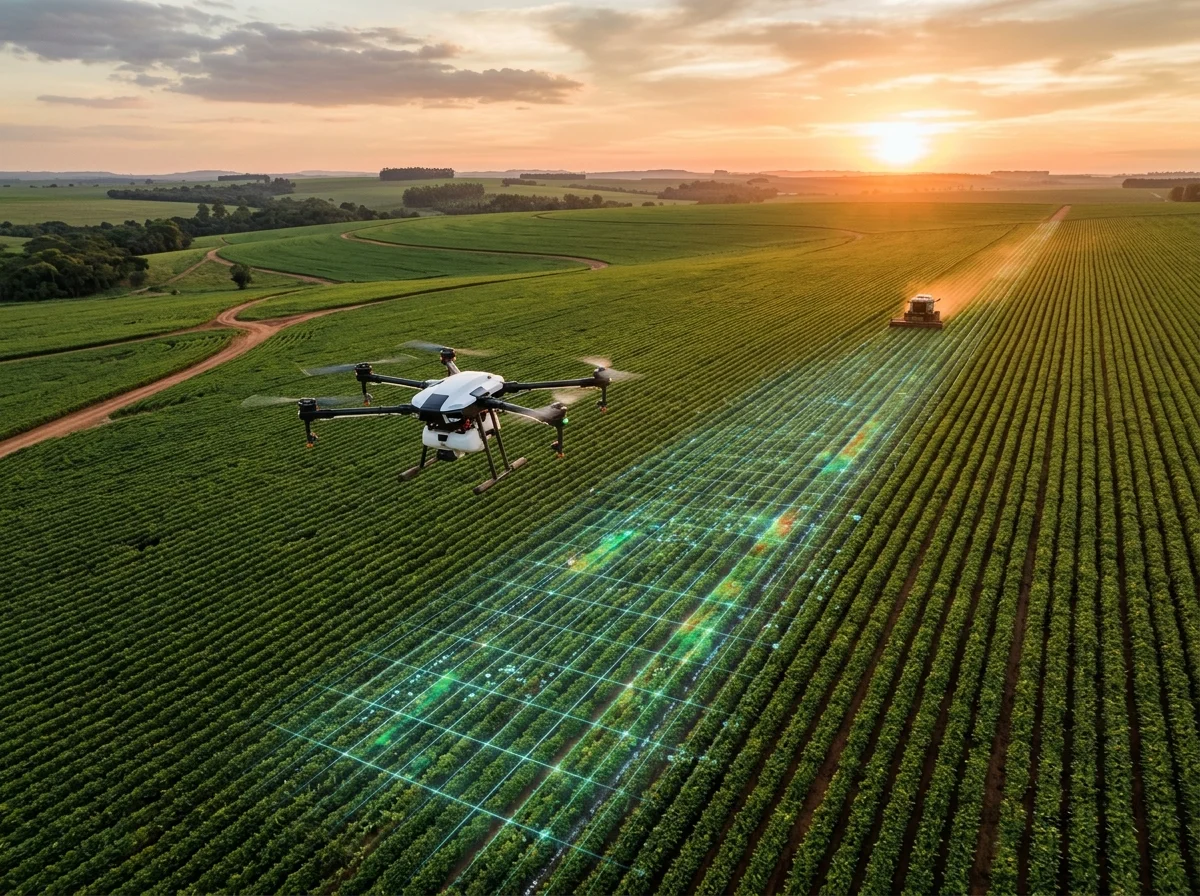
In the vast expanses of South America, AI in Brazilian agribusiness begins its daily shift long before the first glimmer of dawn touches the crop canopy.
It is 5:30 AM in the agricultural heartland of Mato Grosso. The sun has barely breached the rust-colored horizon, and while most people are still reaching for their morning coffee, a thirty-kilogram autonomous quadcopter lifts effortlessly from a solar charging docking station nestled inside an endless sea of soybeans. No operator stands nearby gripping an antenna-clad remote control: its precision flight path was calculated overnight by a machine learning algorithm cross-referencing soil hydration telemetry, predictive wind modeling, and multispectral satellite orbital imagery captured from 700 kilometers in space.
Cruising across agricultural parcels at forty kilometers per hour, the drone’s multispectral sensors accomplish what no human eye could ever detect: scanning crop foliage in non-visible wavelengths, identifying the microscopic spectral signature of Asian soybean rust on just four isolated leaves, and relaying pinpoint GPS coordinates in milliseconds to an autonomous tractor sprayer. Instead of blanketing two hundred hectares with indiscriminate chemicals, the targeted boom releases precisely three drops solely on the infected leaves.
If you still picture modern farming through the lens of manual plows and purely physical toil, prepare for a profound paradigm shift: tropical red clay has transformed into one of the most advanced applied computing proving grounds on Earth. Brazil is not merely an agricultural breadbasket feeding over a billion people worldwide; it has emerged as the planetary open-air laboratory where deep learning algorithms determine how humanity will sustain global food security over the coming decades.
From Intuition to Precision Data: The Silent Farming Revolution
For generations, agriculture relied almost entirely on empirical intuition. Farmers grabbed a handful of dirt, assessed soil moisture by touch, studied cloud formations, and calculated planting windows based on generational memory. That ancestral wisdom was instrumental in opening the challenging Cerrado savannas during the 1970s and 1980s, spearheaded by the pioneering agronomic research of the Brazilian Agricultural Research Corporation (Embrapa).
Yet modern agribusiness operating margins offer zero forgiveness for guesswork. Diesel fuel prices fluctuate wildly, synthetic fertilizers face geopolitical supply chain shocks, and climate windows are increasingly volatile amidst severe droughts and sudden floods. This is where artificial intelligence takes command: substituting guesswork with surgical, algorithmic precision.
On modern Brazilian mega-farms, every single square meter generates continuous gigabytes of operational telemetry. Root-level capacitive moisture probes, localized weather stations, tractor telemetry buses, and historical yield maps flood agricultural databases. But raw data without semantic interpretation is merely noise. Neural networks step in to connect the dots: advising farm managers exactly which seed cultivar will maximize yield in a specific micro-parcel and identifying the precise morning hour harvesting combines must roll out to minimize moisture loss.
The Four Architectural Layers of Modern Brazilian Agri-Tech
To grasp how this autonomous ecosystem operates without getting lost in technical jargon, we can divide the artificial intelligence infrastructure of the field into four interconnected operational layers:
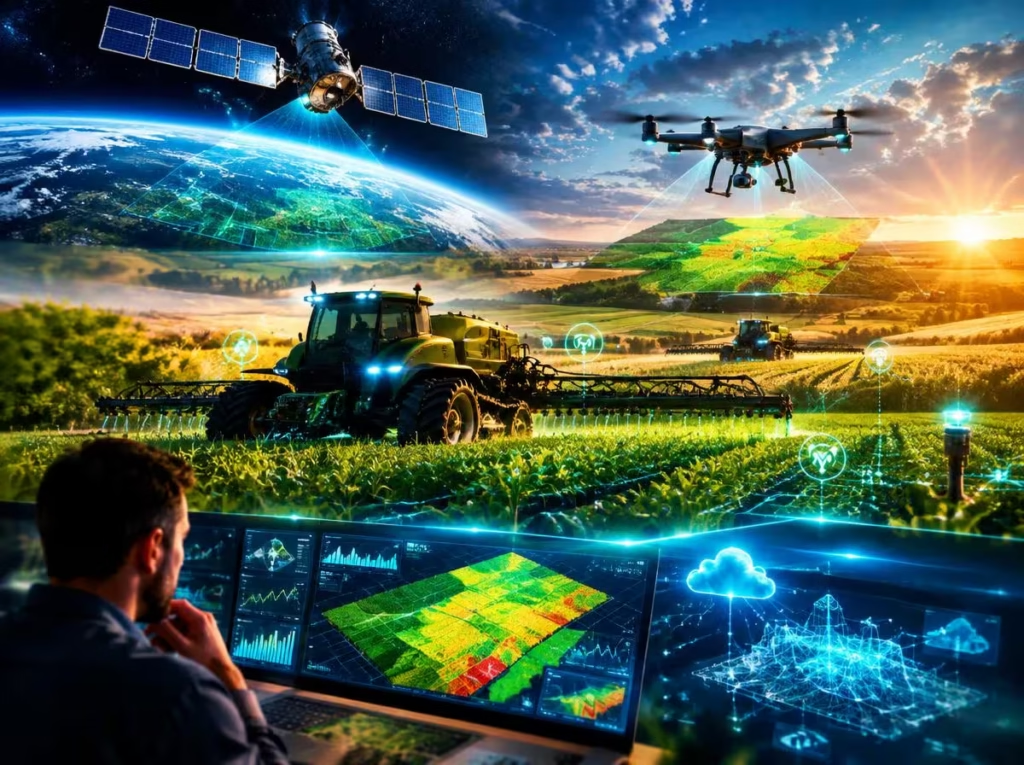
1. Orbital Satellites and Predictive Vegetation Indexing
High above the atmosphere, constellations of public and private imaging satellites—closely monitored by entities like the National Institute for Space Research (INPE)—photograph the national territory daily. Computer vision pipelines calculate Normalized Difference Vegetation Index (NDVI) values, auditing photosynthetic vigor week over week. If an underground water-stress patch begins to develop before foliage visibly wilts to the naked eye, the neural model triggers a proactive remediation alert.
2. Autonomous Drones and Microscopic Computer Vision
While orbital satellites capture macro topography, drones handle the sub-centimeter tactical layer. Outfitted with convolutional neural networks trained on millions of images of tropical pests, invasive caterpillars, and native Brazilian weeds, these unmanned aerial vehicles map infestations with millimeter precision. Tasks that once required agronomists to hike exhausting miles under blazing sun to inspect random sample leaves are now completed in minutes via autonomous aerial passes.
3. Autonomous Machinery and RTK Telemetry
The contemporary tractors, sprayers, and combine harvesters navigating fields across Goiás, Paraná, and Bahia share little resemblance with antique mechanical tractors. Governed by Real-Time Kinematic (RTK) GPS guidance with margins of error under two centimeters, these machines steer autonomously, modulating seeding depth according to soil fertility maps and adjusting chemical fertilizer rates gram by gram. The human operator inside the air-conditioned cabin functions far more as a mission supervisor than a steering driver.
4. Farm Digital Twins and Predictive Decision Engines
Every data stream converges into centralized farm management platforms, constructing a dynamic “digital twin” of the agricultural property. Similar to the decision modeling discussed when examining specialized frontier AI systems, growers simulate complex operational hypotheses: “If we accelerate harvest by four days to outrun an incoming cold front, what will our grain moisture ratio be, and how much will we save in industrial drying costs?” The predictive engine resolves the simulation in seconds.
Traditional Farming vs. AI-Driven Smart Agriculture
The contrast between legacy agricultural methods and AI-augmented precision farming centers on replacing blanket guesswork with individualized, plant-by-plant care:
| Cultivation Phase | Traditional Agricultural Practice | AI-Augmented Precision Agriculture |
|---|---|---|
| Pest & Disease Detection | Manual field walks and visual sampling; late identification after visible damage spreads. | Multispectral drone vision detecting fungal spores and micro-insects at microscopic onset. |
| Input & Chemical Application | Blanket broadcast spraying across hundreds of contiguous hectares. | Selective nozzle-by-nozzle micro-spraying: valves open and shut in milliseconds only over infected leaves. |
| Yield Forecasting | Historic multi-year averages and empirical calendar assumptions. | Continuous predictive meteorological modeling fused with satellite biomass radar tracking. |
| Environmental Footprint | Higher diesel and water consumption with heightened chemical runoff risks. | Up to 85% reduction in crop protection chemicals, reduced tractor hours, and preserved aquifers. |
The Green Payoff: Slashing Chemical Overhead While Safeguarding Ecosystems

A persistent misconception suggests that agricultural technology exists purely to maximize industrial output at the expense of environmental preservation. In the real-world application of artificial intelligence, the exact inverse is true: micro-precision is sustainability’s most formidable ally.
When an intelligent sprayer equipped with high-speed cameras and onboard neural inference shuts down 90 out of its 100 nozzles, directing herbicide exclusively onto a single invasive horseweed, the farm saves thousands of dollars in input overhead. Simultaneously, metric tons of synthetic chemicals are spared from entering topsoil, air currents, and river basins.
This automated verification model reinforces environmental compliance. Machine-logged digital traceability proves that harvested grain or livestock originated from properties with zero illegal deforestation, satisfying strict import mandates from European and Asian trade partners.
Real-World Bottlenecks: Confronting Rural Infrastructure Hurdles
Despite these technological marvels, it would be naive to assume every farm in Brazil operates like a Silicon Valley outpost. Scaling artificial intelligence across rural regions faces structural headwinds:
- The Rural Connectivity Desert: Machine learning algorithms demand reliable data flow. Historically, over 70% of Brazilian rural properties lacked adequate cellular broadband. While low-earth-orbit satellite internet (such as Starlink) and agricultural 5G towers are closing the gap, many machines must run full edge-computing hardware directly on tractor chassis, driving up machinery costs.
- Accessibility for Family Farmers: While multi-thousand-hectare farming conglomerates can easily invest in multi-million-dollar connected fleets, smaller family farms—which produce much of the domestic fresh produce and milk—depend on agricultural cooperatives and public extension services. True democratization requires lightweight mobile smartphone apps that diagnose crop health without requiring specialized hardware.
- The Scramble for Hybrid Agronomic Talent: The profile of agricultural labor has changed irrevocably. Rural operations now aggressively recruit agronomists who can write Python scripts, machinery operators trained in sensor calibration, and data analysts skilled in soil chemistry. The Brazilian interior is cultivating a thriving tech job market far from coastal metropolitan capitals.
From Farm to Table: Why Rural AI Directly Impacts Your Grocery Cart
Even if you live on the twenty-fifth floor of an urban apartment tower and have never set foot in an agricultural field, the AI revolution taking place across the countryside impacts your daily cost of living every time you step into a grocery store.
When harvest yields are defended against climate catastrophes through predictive neural algorithms, global commodity supplies remain resilient—preventing inflationary price shocks across cooking oils, bread, meat, and dairy. These quiet systems operate behind the scenes, upholding food security for a global population that has surpassed eight billion people.
Brazilian soil has always been naturally fertile. Now, enriched with silicon, embedded sensors, and advanced machine learning, it proves that the future of global food production is being decided where tropical biodiversity meets frontier code.
To take your practical workflow further, explore our hands-on guide on how real-time bioacoustic sensors and AI guard the Amazon rainforest.
Frequently Asked Questions (FAQ)
Will artificial intelligence eliminate agricultural jobs?
Rather than eliminating employment, AI upgrades agricultural roles. Dangerous, exhausting manual labor is being replaced by high-value technical positions, including autonomous fleet management, agricultural drone piloting, sensor maintenance, and agronomic data analysis. Rural demand for skilled technical professionals is at an all-time high.
Can smallholder farmers leverage AI today without massive capital?
Yes. While autonomous combines are capital-intensive, dozens of AgTech startups and free Embrapa tools run directly on standard smartphones. Mobile computer vision apps allow smallholders to photograph a damaged leaf and receive instant diagnoses of fungal diseases or mineral deficiencies on the spot.
Does AI-grown produce carry any health risks for consumers?
On the contrary, produce cultivated with precision AI is often cleaner and safer. Because computer vision enables micro-dosed chemical applications strictly where active pests exist, overall chemical volumes across crops drop significantly—dramatically reducing potential residues on consumer food.
Does Brazil train its own native agricultural AI models?
Yes, Brazil is a recognized world leader in tropical agronomic AI. Because tropical soils, pests, and equatorial weather patterns differ fundamentally from temperate northern-hemisphere conditions, imported algorithms frequently produce faulty predictions. Embrapa and Brazilian tech institutions have built native datasets and neural networks tailored specifically to tropical farming ecosystems.
The Future of Global Sustenance Is Written in Code
Tropical agriculture and computational intelligence have formed an indomitable partnership. As precision agriculture scales, sustainability and productivity no longer stand at odds.
Did you realize that Brazilian agriculture was leading applied AI innovation on this scale? Do you work in the sector or have questions about how these precision tools operate? Join the conversation and leave your thoughts in the comments below!