

If you spent any time on developer forums, Reddit, or tech Twitter over the past few months, you likely stumbled across some mind-bending clips: Mario leaping across the grim, brutal landscape of Elden Ring to stomp on colossal bosses; soldiers in Call of Duty executing skateboard grinds with the pinpoint physics of Skate 3; or an entire playable slice of Minecraft running smoothly through the back alleys of Grand Theft Auto. To most casual observers, it looked like just another viral internet meme — clever visual mods crafted by dedicated hobbyists with too much free time.
There was just one crucial detail almost everyone missed: none of that was a visual mod, and none of it was pre-rendered fan art. It was genuine native code. Low-level assembly and bytecode surgically reverse-engineered from closed binary executables, reconstructed from scratch by AI language models, and plugged straight into different game engines without the original studios ever sharing a single line of proprietary source code.
What started as a playful hackathon experiment inside gaming subreddits has ignited the opening tremors of an institutional earthquake. AI reverse engineering has broken out of academic labs and transformed into a brutally practical reality. In doing so, it has placed a massive question mark over the most lucrative business model in modern economic history: closed-source software, perpetual enterprise licensing, and the monthly SaaS subscriptions that anchor Silicon Valley’s trillion-dollar empires.
How the Software Economy Works Today: The Fortress of Closed Source
To understand why this technological shift is sending chills through executive suites at Adobe, Microsoft, and Nintendo, we need to examine the invisible plumbing that powers our digital world. At a fundamental level, virtually every piece of software on the planet belongs to one of two contrasting philosophies:
The first camp is open-source software. Here, the creators lay out the entire recipe in plain sight. Anyone with an internet connection can download the human-readable source code, inspect every variable, submit bug fixes, study the algorithmic decision trees, and fork the codebase to suit their own needs. The Linux kernel, which silently runs over 90% of the world’s cloud infrastructure and every Android smartphone, stands as the ultimate monument to this ethos.
The second camp — and the financial engine of the modern corporate tech stack — is closed-source (proprietary) software. This is the gated digital ecosystem where most professionals spend their daily lives: Adobe’s creative suite (Photoshop, Premiere, After Effects), commercial operating systems like Windows and macOS, triple-A console games, and heavyweight enterprise suites like ERPs and CRMs. When you purchase a software license or renew an expensive monthly Creative Cloud subscription, the publisher never gives you the original human-written code. You receive only a compiled binary executable, translated specifically for your computer’s processor to execute.
The boundary separating these two worlds rests upon a one-way technical gate called compilation. Human software engineers write instructions in readable, structured programming languages such as C++, Rust, Python, or Swift. A compiler then acts as a massive irreversible industrial press: it dismantles that logical prose and flattens it into an impenetrable stream of machine language — raw zeros and ones designed exclusively for silicon CPU cycles.
Once a program is compiled into a release binary, attempting to read it is like trying to reconstruct a living oak tree from a jar of fireplace ash. Variable names vanish, developer architectural notes are scrubbed, and logical loops are flattened into cryptographic memory jumps. For nearly half a century, this technical asymmetry served as the industry’s greatest invisible patent: even if someone acquired a copy of your binary file, figuring out how it was built was practically impossible without spending millions of dollars.

The Decompilation Nightmare: 7 Years to Rebuild a Single Nintendo Game
Attempting to reverse that one-way street and recover something resembling the original source code is known as decompilation. It is reverse engineering taken to the extreme: an engineer stares at disassembly dumps and machine hex codes, hypothesizing what high-level C or C++ logic could compile down into that exact sequence of machine instructions.
Historically, decompilation was an agonizing exercise in trial and error. A programmer would write a candidate function, compile it with the exact historical compiler flags, and compare the resulting binary byte-for-byte against the target file. If a single register was out of place, they had to start over. It was like solving a million-piece jigsaw puzzle in the dark.
One of the most famous decompilation achievements in computing history illustrates the sheer magnitude of this challenge: the full decompilation of Super Mario Galaxy for the Nintendo Wii. The project required an international coalition of 59 elite software engineers working for 7 continuous years. In practical terms, reverse-engineering the game’s codebase took significantly longer than Nintendo’s original development team took to design, build, and ship the entire title from scratch.
“Proprietary software was never protected solely by copyright law. Its ultimate moat was human time: nobody had centuries of spare engineering hours to decompile commercial binaries.”
— Security Researcher & Binary Analysis Engineer
That insurmountable barrier of human hours and mental fatigue is precisely what collapsed when modern frontier AI models entered the equation.
Why Artificial Intelligence Made Decompilation Shockingly Fast
To grasp why machine learning models excel so radically at binary reverse engineering, we must recognize that decompilation represents an AI model’s dream scenario: it is a deterministic problem with immediate, automated verification.
Unlike creative writing or subjective research tasks — where the definition of a “good” answer is open to interpretation — decompilation operates on an unyielding binary truth. The question posed to the model is purely computational: “Does this candidate C++ snippet, when compiled with GCC version 9 under -O2 optimization flags, match this targeted block of machine binary exactly?” The compiler acts as an instantaneous judge: either the binaries match 100%, or the compiler reports exact memory offsets and instruction mismatches.
This automated loop grants AI models three game-changing advantages over any human engineering squad:
- Relentless 24/7 Iteration: AI coding agents do not suffer from cognitive burnout, context-switching fatigue, or eye strain. They iterate continuously, evaluating thousands of function permutations through the night.
- Rapid Massively Parallel Hypothesis Testing: While a senior reverse-engineer might painstakingly test two or three memory hypotheses over an afternoon, cloud-scale AI clusters generate and benchmark thousands of candidate functions within minutes.
- Pattern Recognition Across Global Code Repositories: Having been trained on billions of lines of open-source and public code, modern models instinctively recognize compiler idioms, standard library signatures, memory allocation routines, and syscall patterns that would take human eyes days to decipher.
What once required years of institutional coordination can now be orchestrated by a single developer leveraging autonomous always-on AI agents in a matter of weeks. Nowhere has this tectonic shift been more evident than in an open-source initiative taking aim at digital design’s most entrenched monopoly.
The Adobe Case: Replicating Photoshop and Premiere in Weeks
For more than two decades, Adobe held an iron grip over creative professionals worldwide. Flagship applications like Photoshop, Illustrator, After Effects, and Premiere created an industry standard so deeply entrenched that proprietary file formats — notably `.psd` and `.prproj` — operated as insurmountable moats against independent competitors.
Yet over the past few months, an open-source initiative dubbed ArtCraft sent shockwaves through the creative community. Utilizing coordinated AI agents to reverse-engineer application behavior and system hooks, a decentralized group of developers began rebuilding Adobe’s flagship creative suite from scratch as free, cross-platform software.
The pace of development stunned seasoned software veterans. In little more than a week of AI-assisted engineering, the project’s Premiere alternative had already achieved roughly 80% feature parity with the commercial product. This included formidable low-level capabilities that typically require months of specialized systems engineering, such as hardware-accelerated encoding and decoding for H.264 and H.265 video codecs across Windows, Linux, and macOS.
The file compatibility achieved was startling: native projects authored in official Photoshop releases opened cleanly in the open-source replica, preserving layers, clipping masks, blending modes, and vector paths. The interface felt immediately familiar, even faithfully reproducing workflow mechanics like the Lumetri Color grading panel with virtually zero friction.
Under conventional software engineering practices, assembling an application suite of this caliber would demand tens of millions of dollars and multi-year roadmaps backed by hundreds of specialized developers. The fact that a distributed collective backed by frontier models achieved functional parity in a fraction of that time has put corporate legal teams on high alert.
What Is “Clean Room Design” and Why Does It Legally Change Everything?
When casual observers first witness an open-source tool cloning Photoshop in record time, their immediate assumption is that it must be blatant, illegal intellectual property theft. However, projects like ArtCraft anchor their work in one of the most rigorously defended legal precedents in technological history: the doctrine of Clean Room Design.
The clean room methodology originated in the early 1980s during a monumental legal clash between computing titan IBM and an ambitious startup named Phoenix Technologies. At the time, IBM dominated the personal computing landscape because it held the copyright to the PC’s BIOS — the essential firmware bridging hardware components to the operating system.
To produce the world’s first fully compatible IBM PC clone without violating copyright law, Phoenix conceived an ingenious institutional firewall divided into two hermetically sealed teams:
- The Dirty Room: A group of systems engineers decompiled and analyzed IBM’s BIOS binary. Rather than saving any of the proprietary assembly code, they authored a purely behavioral specification document: “When interrupt vector 10h is called with parameters A and B, the system must return screen coordinate C.”
- The Clean Room: An entirely separate team of engineers — individuals who had never seen IBM’s source code and had no access to the Dirty Room — were handed only the behavioral specification. They wrote a completely novel BIOS implementation from scratch until it satisfied every documented functional requirement.
Courts and legal scholars around the world established a cornerstone precedent: no copyright infringement occurred. Intellectual property law protects the specific creative expression of code (the exact phrasing written by the programmer), but it does not grant a monopoly over functional behavior, mathematical logic, or hardware interoperability. That pivotal ruling opened the floodgates for the entire modern PC hardware industry.
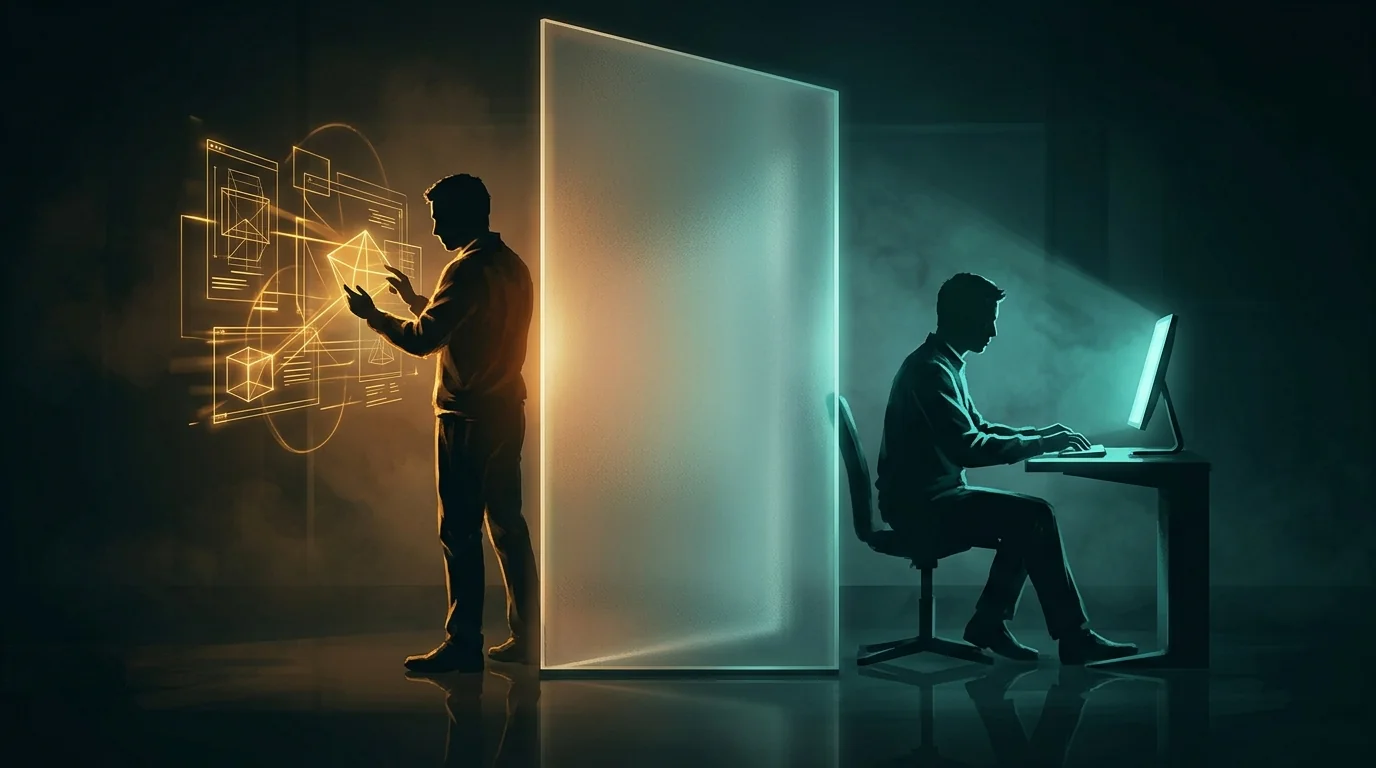
The tectonic shift in 2026 is that this two-room firewall can now be staffed entirely by two isolated instances of artificial intelligence. One model analyzes compiled software binaries and formulates rigorous behavioral specs; a second, isolated AI model — running in a sterile sandbox with zero knowledge of the original binary — writes clean, original Rust or C++ code from that specification. According to analysis from the MIT Technology Review and digital rights watchdogs like the Electronic Frontier Foundation (EFF), this automated pipeline compresses months of painstaking legal audits into mere hours of autonomous iteration.
AI and Open Source: The Uncomfortable Gray Zone of GPL Licensing
While AI reverse engineering presents an existential threat to closed-source software monopolies, it simultaneously introduces a profound ethical and philosophical dilemma to the open-source community itself.
For four decades, the free and open-source movement shielded its collective work using copyleft licenses, most notably the GNU General Public License (GPL). The core tenet of the GPL is reciprocity: anyone is welcome to study, modify, and redistribute the code, provided that any derivative work is also released under the exact same open terms, guaranteeing that community innovations remain public property.
This legal mechanism is what compels tech titans like Google to maintain open source trees for the Android operating system, since its core rests upon the Linux kernel. Independent, privacy-focused operating systems like GrapheneOS exist entirely because of this legal protection.
Yet developers are now grappling with an unsettling question: what happens when commercial entities deploy AI-driven clean room workflows against GPL codebases? An AI model can theoretically analyze a complex GPL library, generate an exhaustive behavioral breakdown, and prompt a clean-room instance to produce a functionally identical commercial replacement stripped of copyleft obligations. How international courts navigate this clash between legal technicalities and open-source solidarity will shape software licensing for generations to come.
What This Means for the Future of the Entire Software Economy
The union of AI decompilation and clean room methodologies brings the software sector to an irreversible crossroads. This is not about celebrating the decline of legacy software giants or advocating for copyright evasion; it is about acknowledging an undeniable reality: the moat built upon the obscurity of compiled binaries has permanently vanished.
Corporate giants will certainly mount aggressive legal defenses, targeting trademark infringements, algorithm patents, and visual trade dress (such as matching icon designs or UI button placements). Yet history demonstrates that legal battles cannot stem the tide of a foundational technological paradigm shift.
We have watched this exact transition reshape cultural industries before:
- The Film Industry: Hollywood once staggered movie release windows by up to twelve months between theatrical premieres in North America and overseas markets. When digital networks rendered artificial delays impossible, studios were forced to adopt global, simultaneous releases.
- The Music Industry: The era of selling bundled \$18 compact discs evaporated under peer-to-peer distribution. The industry survived by embracing universal on-demand streaming platforms that prioritize access and curation over static ownership.
The commercial software market is undergoing the exact same reinvention. Selling static desktop binaries that execute entirely on client hardware is becoming economically fragile. Value is shifting decisively toward capabilities that cannot be easily decompiled or synthesized on home computers: low-latency cloud compute, massive remote datacenter backends, managed enterprise security against global digital vulnerabilities, and real-time collaborative workflows.
Most importantly, we must remember a humbling reality: the generative models driving these reverse engineering breakthroughs today are, by definition, the weakest models we will ever use. As automated formal reasoning and autonomous agents continue their exponential climb, the gap between imagining software functionality and reconstructing it from scratch will shrink to mere seconds.
Frequently Asked Questions (FAQ)
Is reverse-engineering software considered illegal?
It depends heavily on context, intent, and jurisdiction. Across most major legal frameworks (including the United States, the European Union, and Brazil), reverse engineering for interoperability, security research, and vulnerability discovery is explicitly protected by law. Infringement occurs when proprietary source code is copied verbatim or when technological protection measures (like DRM) are breached for piracy rather than functional compatibility.
How does Clean Room Design legally shield developers from copyright claims?
Clean room design establishes an airtight separation between engineers who analyze a software’s external behavior and those who author the replacement codebase. Because the final programming team never accesses proprietary binaries or source files, the resulting software is legally recognized as an original, independent creative expression built from abstract behavioral specifications.
Will artificial intelligence completely destroy subscription software like Adobe Creative Cloud?
Not immediately. Mature enterprise software suites offer extensive customer support networks, legal compliance indemnification, integrated cloud assets, and hardware partnerships that grassroots open-source tools cannot replicate overnight. However, it will inevitably dismantle extortionate pricing models for static software tools that can be easily recreated by AI agents.
Is it safe to use open-source software cloned by AI models?
Transparent open-source projects hosted in public repositories undergo continuous scrutiny from the global developer community, offering high auditability. However, unofficial builds created without institutional oversight may lack automated security patching, regression testing, or formal file format stability. Exercising standard cybersecurity precautions remains essential for mission-critical production environments.
Why are modern AI models so much better at decompilation than human engineers?
Because binary decompilation is a closed-loop logical problem with automated ground-truth verification. Compilers act as instant, objective judges: the AI generates candidate code, the compiler determines if the resulting binary matches the target, and the model instantly refines its hypothesis based on exact error telemetry. This millisecond feedback loop vastly outperforms human capacity.
💬 What’s Your Take?
Do you think expensive software subscriptions are destined to collapse in the era of AI decompilation, or will enterprise tech titans successfully entrench themselves behind cloud services and legal moats? Have you tested any AI-reconstructed open-source software yet? Join the discussion and share your thoughts in the comments below! 👇