

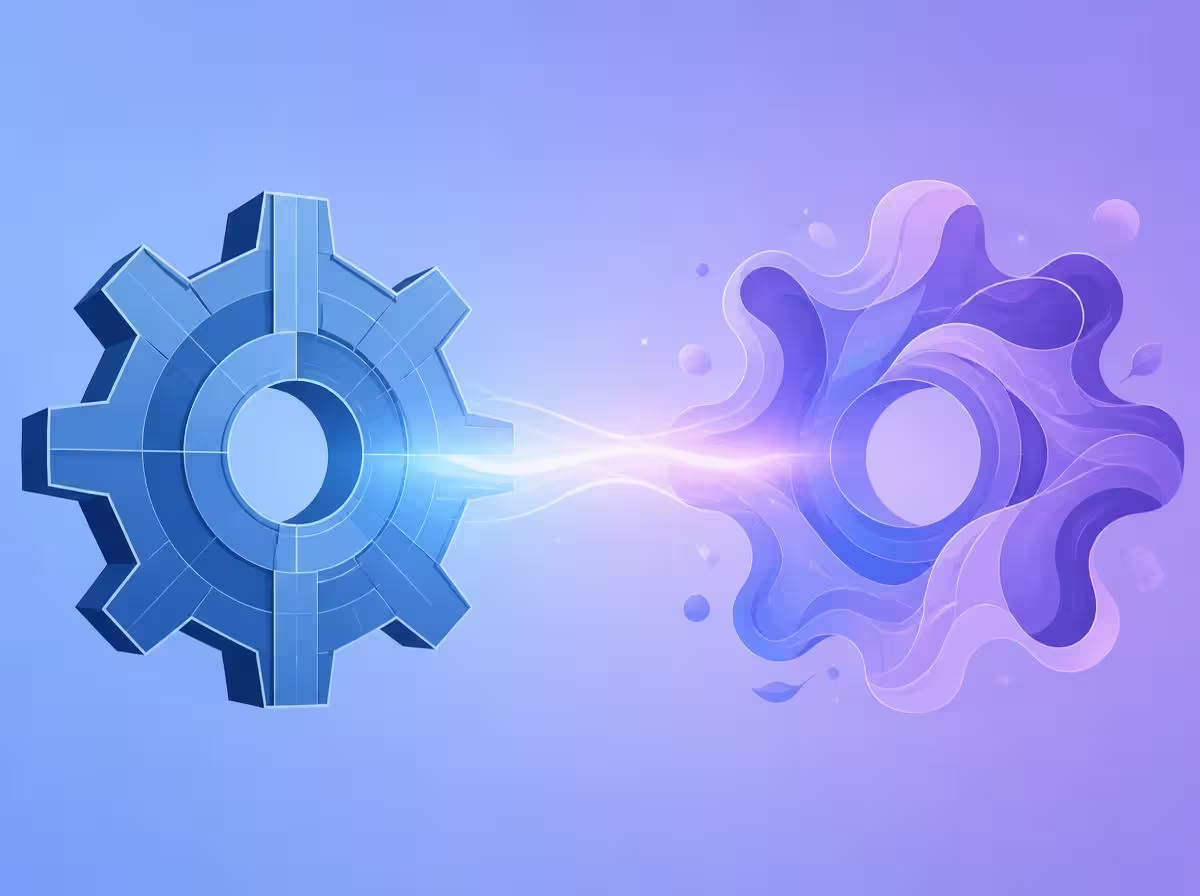
If you’ve noticed that the technology world can’t stop talking about artificial intelligence, you may have also noticed a confusing debate: generative AI vs traditional AI.
From movie recommendations on Netflix and spam filters in your inbox to viral chatbots like ChatGPT and Midjourney, both forms of intelligence are transforming our digital lives. Yet beneath the surface, they operate on completely different principles.
Understanding this boundary is critical. It clarifies why some AI systems excel at predicting numbers and catching fraud, while others can write Shakespearean poetry or compose photorealistic art on demand.
In this straightforward guide, we break down the fundamental differences in generative AI vs traditional AI, examine everyday examples you already interact with, and explain when each approach is the right tool for the job.
What Is Traditional AI: Analytical Precision and Rule Enforcement
Traditional AI (often categorized as analytical, predictive, or discriminative AI) is designed to evaluate existing data, recognize established patterns, and make deterministic decisions within predefined boundaries.
Crucially, traditional machine learning systems do not invent or synthesize original content. Instead, they process incoming inputs and output a concrete label, probability score, or classification. Their superpower is analytical speed, consistency, and filtering accuracy.
When Spotify curates your Discover Weekly playlist, traditional AI studies your listening history, compares it with millions of other users’ patterns, and selects existing tracks from its library that match your acoustic profile. It does not write new songs; it curates existing ones with extreme precision.
Other everyday examples include credit card fraud alerts that flag unusual transactions, smartphone facial unlock systems (Face ID), search engine ranking algorithms, and medical imaging classifiers that detect early-stage tumors.
What Is Generative AI: The Leap into Creative Synthesis
While traditional AI analyzes and classifies what already exists, generative artificial intelligence generates entirely new content—text, visual imagery, synthetic speech, video, or software code—in response to human instructions known as prompts.

Large language models like ChatGPT, Claude, and Google Gemini don’t merely look up pre-written articles in a database. Instead, they predict and generate the next most statistically coherent word, sentence, and paragraph sequentially based on patterns absorbed across billions of training documents.
Similarly, diffusion models like Midjourney and DALL-E synthesize original digital paintings, concept art, and photorealistic renders from pure mathematical noise, translating textual concepts into visual pixels.
Head-to-Head Comparison: Generative AI vs Traditional AI
To make the structural distinctions crystal clear, here is a direct architectural breakdown across key dimensions:
| Core Attribute | Traditional AI | Generative AI |
|---|---|---|
| Primary Objective | Analyze, classify, predict, or optimize | Create novel text, images, audio, or code |
| Nature of Output | Pre-existing category, score, or filtered decision | Original, synthetically generated artifact |
| Core Technique | Regression, decision trees, classic neural networks | Transformer architectures, diffusion models, GANs |
| Creative Variability | Zero; prioritizes deterministic consistency | High; produces varied, novel combinations |
| Everyday Example | Spam filters, GPS ETA routing, Face ID | ChatGPT, Gemini, Midjourney, GitHub Copilot |
How Both Technologies Work Together in Modern Systems
It is tempting to view generative models as a replacement for traditional systems, but the reality is that the most powerful modern platforms combine both approaches in hybrid pipelines.

In modern enterprise software, traditional AI often functions as the analytical gatekeeper, while generative AI acts as the creative communicator.
For instance, in customer service, a traditional classifier analyzes an incoming email, identifies sentiment, and routes it to the correct department. A generative assistant then drafts a personalized, empathetic response for a human agent to review and send in seconds.
As documented in industry analysis by IBM Think on AI Architecture, organizations achieve the highest ROI when deploying traditional models for high-precision analytical tasks and generative models for communication, content acceleration, and exploratory brainstorming.
To dive deeper into related technologies and sharpen your digital skills, explore our detailed guides on what is machine learning and ready-to-use AI prompts.
Frequently Asked Questions (FAQ)
Will generative AI completely replace traditional AI?
No. Traditional AI remains vastly superior, faster, and far cheaper for deterministic tasks like calculating loan default probabilities, detecting credit card fraud, and optimizing warehouse logistics where creative hallucinations cannot be tolerated.
Which type of AI requires more computing power?
Generative AI generally requires significantly more computing resources. Training multi-billion-parameter foundation models like GPT-4 or Claude requires massive server clusters equipped with thousands of specialized GPUs running for months.
Can a beginner easily use both types of AI tools?
Yes. You already use traditional AI effortlessly through your smartphone camera, streaming apps, and navigation tools. Generative AI is equally accessible via intuitive chat interfaces like ChatGPT and Gemini without any coding knowledge.
Which type of AI technology do you rely on more in your daily personal and professional routine? Have you noticed this distinction in the tools you use? Share your thoughts in the comments below!