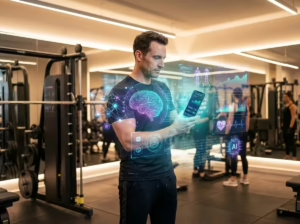

When discussing invisible ai, the average person still pictures a chatbot interface: a blank text box where you type questions to ChatGPT, generate Midjourney art, or ask Claude to summarize a PDF. We have been conditioned to believe that AI is something you consciously open in a web browser.
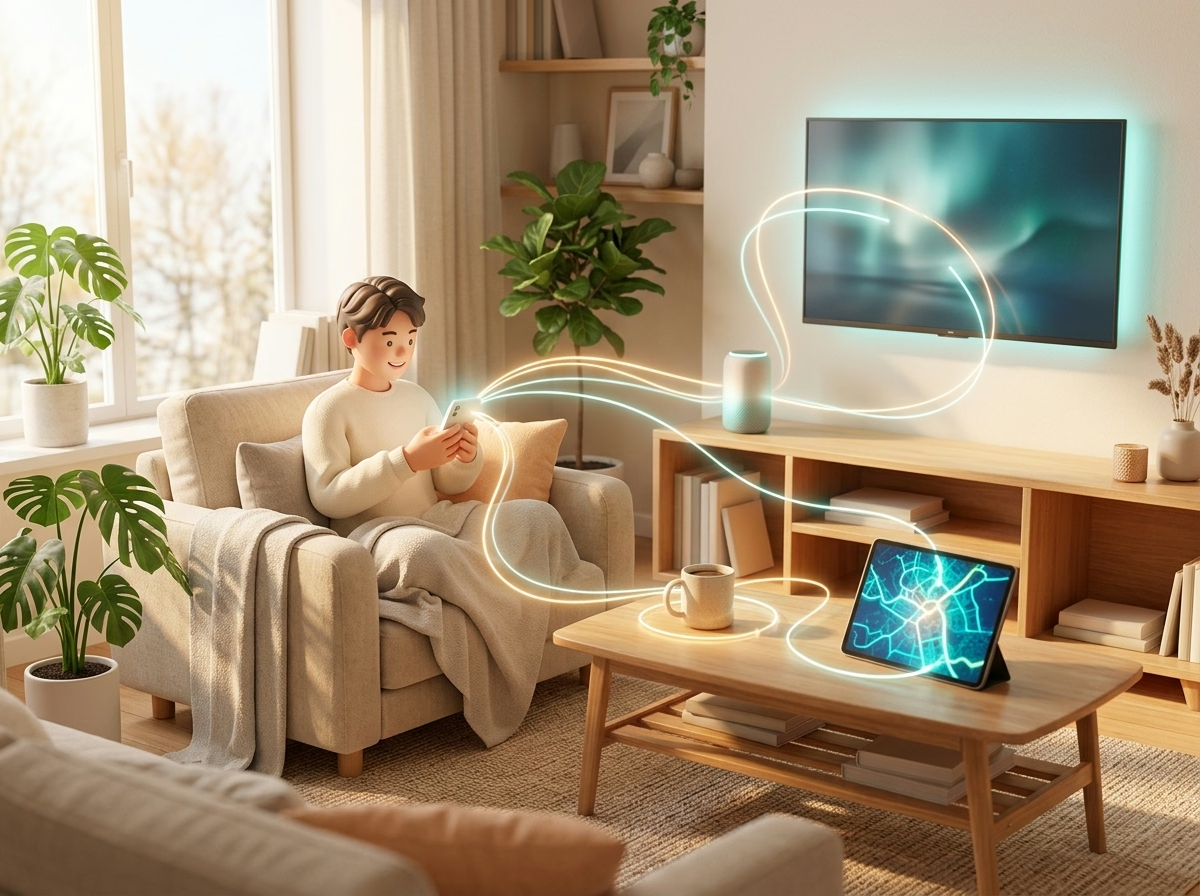
The most transformative, ubiquitous artificial intelligence on the planet is completely silent. It does not boast an animated avatar, it never asks you for a prompt, and it never demands your applause. It is invisible AI—hundreds of embedded machine learning models operating silently beneath the glass surface of your smartphone, running background checks on your credit card transactions, and dynamically routing fiber-optic internet traffic.
The Philosophy of Calm Technology: Why Great AI Disappears
In the late 1990s, legendary Xerox PARC researchers Mark Weiser and John Seely Brown formulated the doctrine of “Calm Technology”. They predicted that the most profound technological innovations are those that disappear into the fabric of everyday life until they are indistinguishable from magic or routine physics.
Nobody wakes up in the morning and marvels at the electrical grid alternating at 60 Hertz; you simply flip a light switch. Invisible AI has crossed that exact threshold. By embedding specialized neural processing units (NPUs) directly into consumer chipsets, technology companies have made machine intelligence as ambient and frictionless as indoor plumbing.
6 Everyday Examples Where Invisible AI Runs Your Routine
- 1. Computational Photography: When you snap a portrait on your iPhone or Galaxy device, you are not capturing raw optical light. In the 50 milliseconds after you press the shutter, an array of convolutional neural networks analyzes skin texture, separates hair follicles from background blur, merges multiple exposure brackets, and synthesizes an idealized image.
- 2. Real-Time Banking Fraud Detection: When you tap your card at a coffee shop in São Paulo or New York, an anomaly-detection neural network evaluates over 2,000 risk parameters in under 200 milliseconds (your geographic velocity, spending habits, merchant category, and device telemetry) before approving the transaction.
- 3. Predictive Traffic Routing: Navigation platforms like Google Maps and Waze do not rely on static speed limits; graph neural networks ingest anonymous telemetry from millions of mobile devices simultaneously to forecast bottleneck slowdowns fifteen minutes before they physically materialize.
- 4. Acoustic Noise Cancellation: Modern wireless earbuds utilize deep neural networks trained on thousands of environmental sound signatures to isolate human vocal cords from subway roar and wind shear in real time.
- 5. Autonomous Email Filtering: Machine learning classifiers process billions of inbound emails daily, filtering malicious phishing attacks and categorizing newsletters with 99.9% precision without requiring manual rules.
- 6. Hyper-Personalized Media Recommendation: Streaming platforms (Spotify, Netflix, TikTok) utilize matrix factorization and collaborative filtering to map your subconscious taste vectors, predicting tracks you will enjoy based on listening cadence and skip rates.

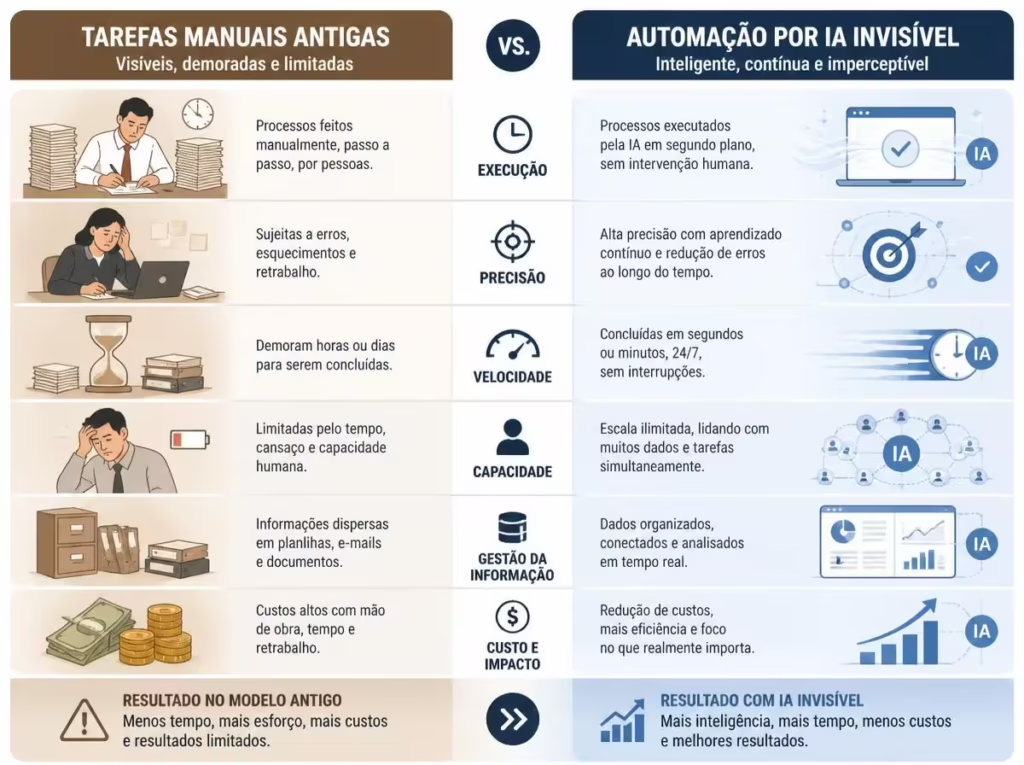
Traditional Software vs. Invisible AI: A Direct Comparison
| Dimension | Traditional Deterministic Software | Ambient Invisible AI |
|---|---|---|
| Operation Mode | Explicit if-then hardcoded rules | Probabilistic neural pattern recognition |
| User Friction | Demands constant user clicks & inputs | Executes silently in the background |
| Adaptability | Static until a developer updates the code | Continuously refines models based on behavioral telemetry |
| Error Profile | Predictable hard crashes or bug codes | Subtle algorithmic hallucinations or edge-case drift |
Discover subtle automation strategies in our tutorial on automating spreadsheets with AI.
For foundational scientific studies on background machine learning, explore Nature Machine Intelligence.
To take your practical workflow further, explore our hands-on guide on what artificial general intelligence (AGI) means for the future.
Frequently Asked Questions
Does invisible AI drain excessive smartphone battery?
Quite the opposite. Modern smartphone chips incorporate dedicated Neural Processing Units (NPUs) specifically designed to perform matrix multiplications at extreme energy efficiency, consuming up to 90% less power than standard CPUs for the same tasks.
Can you disable invisible AI features on personal devices?
While you can turn off specific features (like cloud analytics or personalized ad tracking), ambient on-device AI—such as computational camera processing, predictive text keyboarding, and battery health management—is hardcoded into modern operating systems.
Is on-device invisible AI safer for personal privacy than cloud chatbots?
Yes. On-device models process biometric data, photo recognition, and voice triggers locally within secure hardware enclaves without transmitting unencrypted data to remote third-party corporate servers.
💬 The Ambient Future
Which invisible AI feature in your daily routine could you no longer live without: your camera’s night mode, instant fraud protection, or smart noise cancellation? Join the discussion below! 👇