


Have you ever bought an acclaimed non-fiction bestseller, devoured the first three chapters over an inspired weekend, and then realized three months later that the book was still gathering dust on your bedside table, stuck on page 84? Or worse: you powered through all three hundred pages, highlighted dozens of passages with yellow ink, and yet when you needed to apply that wisdom in a high-stakes strategy meeting six weeks later, your mind drew a complete blank. That universal frustration has a clinical name: the illusion of passive competence.
In this era of digital acceleration, we have been conditioned to believe that reading faster equates to reading smarter. Dozen-minute summary apps promise to distill complex economic treatises or classic philosophy into bite-sized snacks. In reality, what you ingest are dehydrated platitudes that evaporate from your working memory within forty-eight hours. The decisive edge separating top-tier operators, researchers, and creators has never been raw eye speed across paper; it is the deliberate ability to internalize an author’s logical architecture and connect those insights directly to your working projects. That is precisely where reading with AI transforms the game.
Generative artificial intelligence was never meant to outsource your intellectual curiosity or read on your behalf. The truly transformative role of modern large language models is serving as an untiring Socratic sparring partner: an intellectual assistant that extracts core mental models from your highlights, stress-tests the author’s claims, probes your counterarguments, and weaves everything into an interconnected second brain workflow with AI. In this practical guide, you will master the exact methodology to bridge calm analog reading with high-velocity AI processing, discover tested prompts for note mining, and select the dedicated hardware necessary to read for hours without screen exhaustion.
The Highlight Trap: Why Skim-Reading on Glowing Screens Destroys Retention
Cognitive neuroscience has spent decades studying how light-emitting screens (smartphones, iPads, and computer monitors) degrade deep reading comprehension compared to reflective surfaces. Landmark research led by neuroscientist Maryanne Wolf, author of ‘Reader, Come Home’, demonstrates that reading on back-lit LED screens instinctively triggers ‘skimming mode’. This is an evolutionary survival reflex: direct blue-light bombardment and constant alert anticipation train our ocular muscles to hop across words in search of quick dopamine hits.
When you attempt to read a dense essay or technical PDF on a phone or desktop screen, digital eye strain sets in before you reach the end of chapter one. Your eyes’ ciliary micro-muscles undergo continuous micro-spasms against aggressive refresh rates and glaring luminance. Furthermore, highlighting digital text with your fingertip generates a false sense of cognitive security: your brain tricks itself into believing it has ‘mastered’ the insight simply because the text turned yellow, without investing any metabolic effort into neural consolidation.
If you have already established a distraction-free physical workspace with an ergonomic AI desk setup, deep reading demands its own protected sensory sanctuary. High-density knowledge requires cognitive quietude, zero notification badges, and a surface that cooperates with human visual biology.
⭐ EDITOR’S PICK • DEEP WORK & READING

Kindle Paperwhite 16 GB (6.8″ Glare-Free Display with Adjustable Warm Light)
Reading dense non-fiction on a phone or tablet is an uphill battle: blue-light emission fatigues your retinas within thirty minutes and app alerts shatter deep concentration. The Kindle Paperwhite features a 300 ppi glare-free e-ink screen that reads like real printed paper under bright sunlight, delivers soothing warm amber backlighting for night reading, and automatically syncs your highlights to the cloud for seamless AI processing.
Separating your reading sanctuary from your primary communication device shatters the cycle of chronic interruptions. Electronic ink (e-ink) reflects ambient room light exactly like traditional printed paper, enabling you to read uninterrupted for hours under afternoon sunshine or in bed using warm amber backlighting without retinal fatigue. Most importantly, every sentence you underline during deep focus is captured silently in your cloud library, waiting to be ingested into your artificial intelligence ecosystem.
The 3-Stage Pipeline: From Deep Focus to Networked Intelligence
The magic of reading with AI unfolds when you build a frictionless bridge between closing your e-reader and opening your daily workspace. Instead of letting hundreds of digital highlights sit abandoned in an unorganized folder, you implement an active three-stage knowledge pipeline:
- Stage 1: Intentional Reading and Critical Highlighting (Human Curation): As you read on your e-reader, underline strictly the structural pillars — core axioms, counterintuitive data points, and foundational metaphors. Never highlight entire pages; isolate the spine of the argument.
- Stage 2: Centralized Highlight Export: Your underlined passages sync automatically into clean Markdown (.md) or text files using direct integrations (such as native cloud export tools or automated sync utilities like Readwise).
- Stage 3: AI-Powered Synthesis and Socratic Probing (Active Elaboration): Raw highlights are fed into ChatGPT or Claude through structured prompts that distill the excerpts into actionable mental models inside tools like Obsidian, Notion, or Logseq.
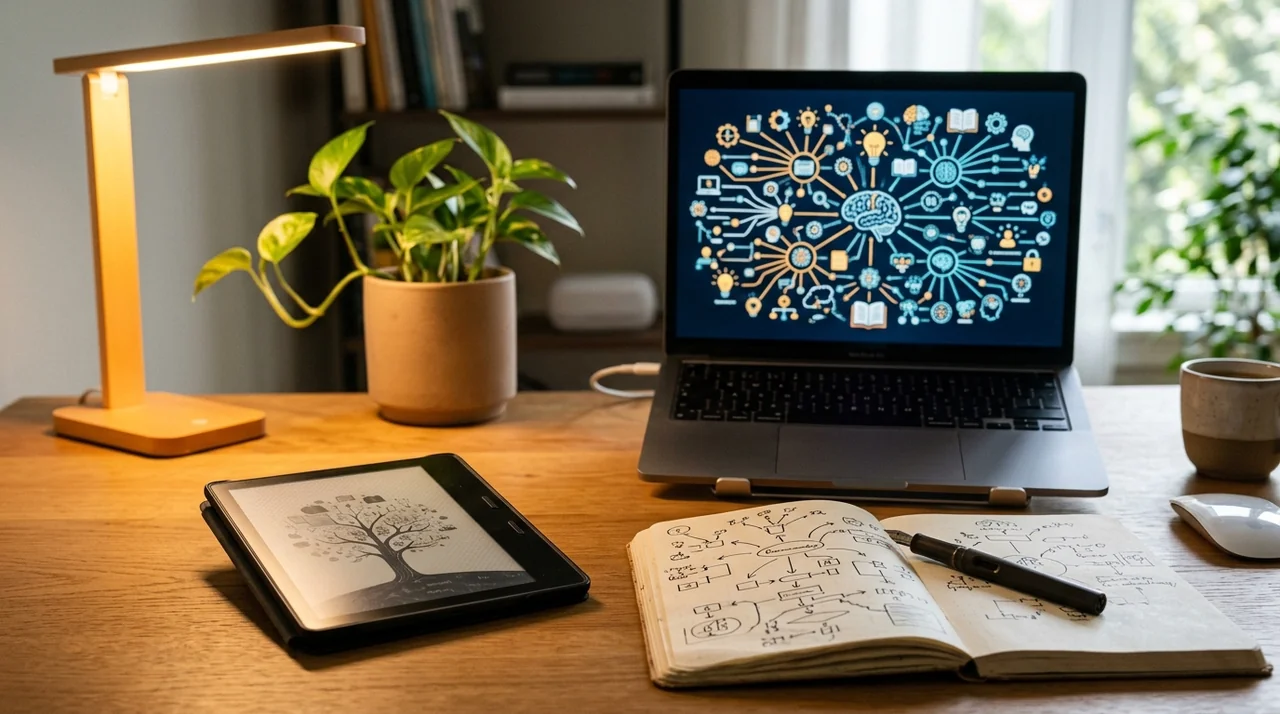
This methodology draws inspiration from the legendary Zettelkasten knowledge management framework, championed by sociologists and codified in the official Obsidian documentation. By converting every quote into an ‘atomic note’ annotated with your own thoughts, a book ceases to be a dormant static block: it becomes an active building block ready to connect with books you read six months ago.
Advanced Prompts: Turning Your AI Client into a Master Socratic Tutor
The worst way to use artificial intelligence for studying is typing a vague prompt like: ‘Summarize the book Thinking, Fast and Slow’. The model will dump ten superficial bullet points readily available on Wikipedia. The authentic leverage of reading with AI materializes when you feed the model your personal curated highlights and instruct it to act as an exacting academic interlocutor.
Here are three refined prompting templates ready to copy, customize, and execute inside ChatGPT or Claude:
Prompt 1: Mental Model & Atomic Note Synthesizer (Zettelkasten Standard)
Paste your exported book highlights to produce permanent networked notes for your personal knowledge base:
Act as a senior knowledge management architect specializing in the Zettelkasten method and Second Brain principles.

Below are the raw highlights and personal margin notes I gathered while reading "[Insert Book Title]" by [Author Name]:

[PASTE YOUR RAW HIGHLIGHTS HERE]

Please process this material and deliver a structured analytical breakdown:
1. The Central Thesis of the book in a single dense, jargon-free paragraph.
2. The Top 3 to 5 Core Mental Models or Operating Principles argued by the author across these excerpts.
3. For each identified mental model:
   - Conceptual title.
   - Core mechanism (how and why it functions).
   - Practical real-world application (in business, high-stakes decision making, or daily workflows).
   - Boundary condition or critique (where this theory fails or meets its limitations).
4. Format everything in clean Markdown with headers, bullet points, and tags ready to import into Obsidian/Notion.
Prompt 2: The Socratic Challenger (Active Recall & Deep Retention)
Adapted from the acclaimed Feynman study technique with AI, this prompt forces your brain to retrieve and defend what you just learned:
You are a rigorous university professor and master of the Socratic method.

I have just completed the chapter on [Insert Book Topic or Core Concept].

Your mission is NOT to lecture me or provide ready-made answers. Your goal is to examine me rigorously to evaluate whether I truly understand the underlying mechanics or am merely reciting buzzwords.

Protocol:
1. Pose ONE challenging situational case question at a time where I must apply the core concept to resolve a complex dilemma.
2. Wait for my response before proceeding.
3. Critically grade my reply, pointing out exactly what was sound and exposing where my reasoning was shallow, vague, or flawed.
4. Escalate with a more challenging follow-up inquiry based on my answer.

Begin now with your first case question on the specified topic.
Prompt 3: The Cross-Pollinator (Synthesizing Conflicting Authors)
Uncover hidden conceptual bridges and friction points between separate books in your library:
Act as an interdisciplinary philosopher and comparative systems analyst.

I am analyzing the contrasting ideas of two authors from my reading library:
- Author/Book A: [e.g., Nassim Nicholas Taleb in 'Antifragile' - concepts of volatility, optionality, and convexity]
- Author/Book B: [e.g., James Clear in 'Atomic Habits' - concepts of compounding micro-iterations and environmental cues]

Please perform a rigorous comparative synthesis addressing:
1. Where do these two frameworks fundamentally align regarding human systems and decision-making?
2. Where do their models collide in direct contradiction or irreconcilable tension?
3. How can I integrate the strongest elements of both into a singular daily operational framework?
4. Suggest 3 original thesis ideas or essay topics born exclusively from the friction between these two works.
The Living Archive: Banishing Intellectual Amnesia for Good
What distinguishes standout industry leaders from average operators is rarely the quantity of credentials hanging on their walls; it is the speed and precision with which they pull foundational references into the exact crucible of a crisis or strategic decision. When you operationalize reading with AI, past books stop fading into misty recollections and become an active, searchable intelligence engine.
Imagine you are architecting a complex product launch or looking for actionable strategies to unlock stalled creative projects. Instead of staring at an intimidating blank document or searching generic web advice, you query your personal repository: ‘Cross-reference my Kindle highlights from the last four books on behavioral economics with Client X’s proposal and uncover three psychological leverage points’.
In seconds, your AI copilot combs through notes synthesized from your own deep reading sessions, weaving an authentic, tailored solution grounded in months of thoughtful study. You are not outsourcing your intellect; you are amplifying long-term biological memory into an evergreen competitive edge.
Frequently Asked Questions About AI Reading Workflows and E-readers
Do AI-generated book summaries eliminate the need to read full books?
No. Raw summaries deliver bare facts, but discard the narrative rhythm, counterintuitive case studies, and emotional texture that make human memory anchor concepts permanently. AI is not designed to spare you from reading; its true power is helping you synthesize and retain what you actually read with unmatched depth.
How do I export my Kindle highlights to my computer easily?
Amazon automatically maintains all your book highlights at ‘read.amazon.com/notebook’. From that hub, you can copy passages directly or install free community plugins for Obsidian and Notion that synchronize your highlights into organized Markdown files with a single click.
Is a dedicated Kindle e-reader genuinely better than an iPad or tablet for reading?
For deep non-fiction immersion, unquestionably yes. Tablets rely on bright LCD or OLED screens that project blue light directly into your retinas, creating eye strain and disrupting sleep architecture when used at night. Furthermore, notification temptations constantly fragment focus. The Kindle utilizes electronic ink (e-ink), which causes zero eye strain, reads flawlessly in bright sunlight, and features battery life measured in weeks.
Can I upload entire book PDFs into ChatGPT to ask questions?
Yes. Cutting-edge models like ChatGPT (GPT-4o), Claude, and Google Gemini support long context windows that easily swallow full PDF manuscripts. However, you achieve the highest cognitive retention when you feed the model your personal highlighted passages and specific analytical questions rather than treating the AI as an unread file repository.
The True ROI: Reading Less for Vanity, Retaining Far More for Life
In a culture obsessed with hollow bragging metrics like ‘reading fifty books a year’, the most rebellious move you can make is slowing down your ocular pace while accelerating your comprehension depth. Reading ten foundational books with complete presence, highlighting with intention on an eye-friendly display, and mining every insight through artificial intelligence delivers exponentially more value than skimming dozens of volumes without retaining a single concept.
Modern technology has finally gifted us the ideal balance: the quiet solitude of an analog-like screen to lose yourself in thought, combined with computational intelligence to make those ideas permanent. Adjust your warm backlighting, pour your coffee, and make your next book an enduring cornerstone of your intellectual life.
How do you currently capture and retain insights from your reading? Do you still struggle with book amnesia or do you already use an AI note-taking pipeline? Share your workflow and favorite tools in the comments below!