

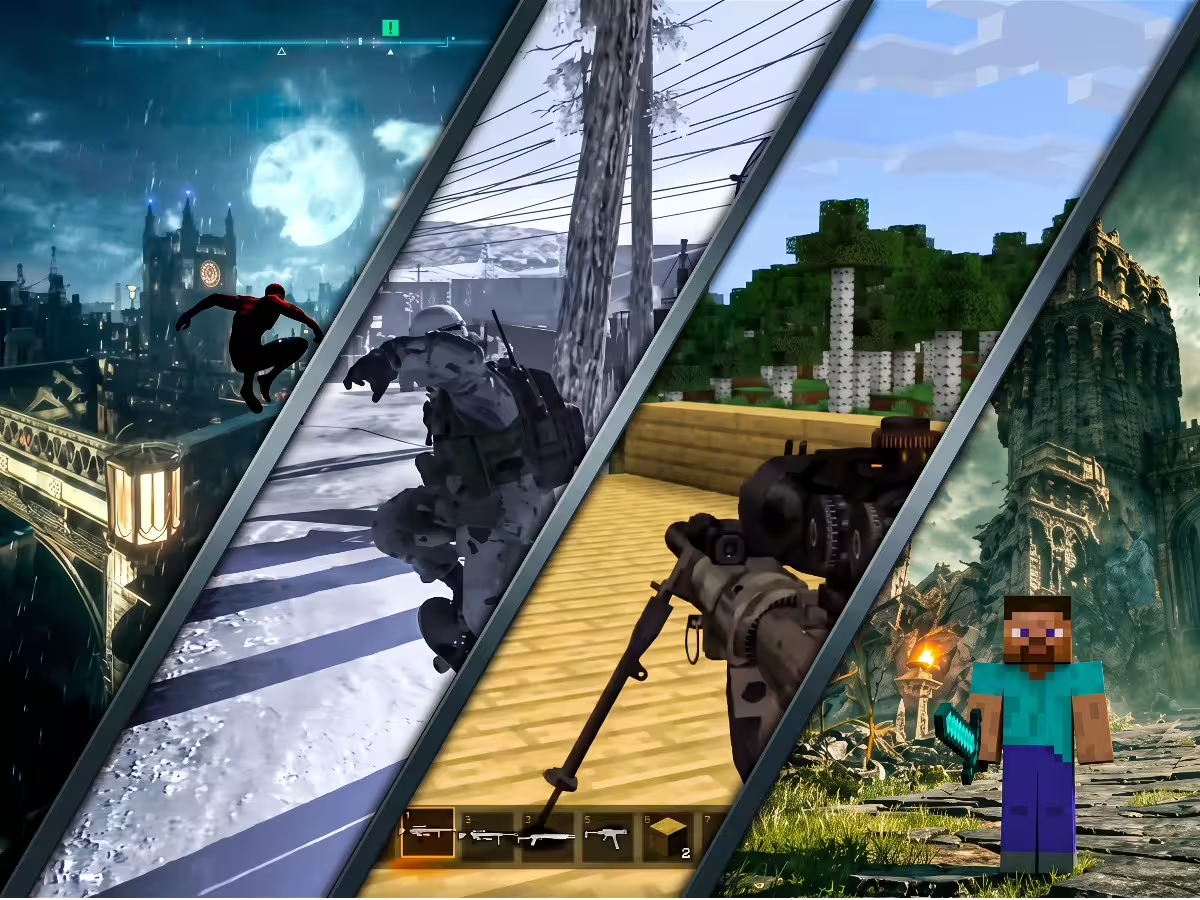
Picture the scene: the dark, oppressive Gotham City skyline is pierced by the pale glow of a full moon. Instead of a bat-winged silhouette gliding between gray gargoyles, the figure freefalling between the skyscrapers of Miagani Island is Spider-Man. He extends his arm, fires a webline at the concrete facade of the Elliot Memorial hospital, feels the cable tension with realistic momentum, arcs into a flawless swing, and propels himself into the horizon, wall-running sideways across the glass exterior of a corporate high-rise.
This is not a cinematic CGI trailer or a fan animation rendered in Blender. It is genuine, real-time gameplay running on a standard gaming PC. More importantly, it is not a basic cosmetic skin swapped onto Batman’s skeleton. It represents the authentic physics engine, original motion-captured animations, and vector traversal calculations of Marvel’s Spider-Man Remastered operating natively inside Batman: Arkham Knight.
This technical feat, which took gaming subreddits by storm and flooded social media with jaw-dropping demonstrations, is known as ArkWeb. Engineered by developer and modder luki-1, the project signals a historic turning point in the PC modding scene: the moment artificial intelligence began demolishing the walled gardens of proprietary game engines, allowing rival, closed-source game architectures to communicate with one another.
AI Game Mods: Moving Beyond “Hollow Skins” in 2026
Anyone who has followed PC gaming over the past two decades is accustomed to wild crossover mods. Ever since the classic era of Grand Theft Auto: San Andreas through modern hits like Elden Ring and God of War, replacing 3D character models has been standard modding fare. Players could throw Shrek into Nordic battles or dress CJ in Iron Man’s suit.
Yet, traditional mods shared an unavoidable structural ceiling: they were purely cosmetic. The outer shell looked different, but the mechanical soul of the character remained locked to the host game. If you placed Spider-Man into a conventional Arkham Knight mod, he would still glide with an invisible cape, launch a mechanical batclaw to grapple ledges, and deliver heavy, ground-pounding punches because the underlying physics loop was still Batman’s engine.
Achieving a true mechanical transplant — ensuring that kinetic pendulum physics, web tension, point-launch catapults, and vertical wall-runs functioned in a completely foreign world — previously required rewriting the physics simulation from scratch or acquiring the proprietary source code of both Insomniac Games and Rocksteady Studios. Because major studios guard their commercial code under lock and key, such crossovers were deemed impossible. Until now.
The official demonstration video above highlights the fluid fidelity of this breakthrough: the hero not only moves seamlessly across Gotham, but his web-attachment system accurately identifies the collision geometry of buildings modeled by Rocksteady. The webline tensions dynamically with genuine angular momentum, unlocking aerial traversal maneuvers never envisioned in Arkham Knight’s original codebase.
The Domino Effect: From Leon Kennedy to Doomfist in Elden Ring
Spider-Man’s arrival in Gotham sparked an unprecedented gold rush among game modders worldwide. What originated as a standalone proof of concept quickly ignited a viral cross-engine modding movement that has dismantled long-standing genre barriers.
One of the most striking examples drops Leon S. Kennedy, straight from Resident Evil 4, directly into the punishing world of Elden Ring. This is far more than Capcom’s iconic leather jacket and haircut: the entire third-person over-the-shoulder gunplay, tactical laser-sight aiming, authentic camera framing, and real-time firearm inventory were transplanted directly into FromSoftware’s proprietary engine.
Watching towering medieval knights and grotesque demigods fall to 9mm handguns and tactical shotguns — complete with Capcom’s authentic green HUD ammo counter — proves that the technical gulf between grimdark fantasy soulslikes and modern survival horror shooters has officially dissolved.
The community pushed the envelope even further by bringing to life what many gamers jokingly dubbed “the ultimate crossover prophecy”: transplanting the full first-person arsenal and kinetic combat toolkit of Doomfist, the hero from Overwatch, to deliver devastating rocket punches directly against Elden Ring’s legendary boss encounters in Crumbling Farum Azula.
In the clip above, Blizzard’s first-person hero-shooter HUD — complete with ability cooldown timers, the 525-HP health bar, cybernetic gauntlet ammo indicators, and centered crosshair — interfaces seamlessly with FromSoftware’s hitboxes and stagger mechanics. Charged rocket punches launch bosses into gothic stone pillars with the exact physics impulse and kinetic feedback of Overwatch.
Dual-Engine Architecture: Running Two Games Simultaneously
The architecture that powers modern AI game mods does not attempt to reinvent the wheel or re-engineer complex physics algorithms from scratch. Instead, it relies on an advanced software architecture known as parallel execution via shared memory (inspired by early cross-game experiments like SkyCraft, which bridged Skyrim and Minecraft).
To an outside observer, this looks like digital wizardry. Under the hood, however, it is governed by a strict division of labor between two active processes running in operating system memory:
- The Guest Process (e.g., Marvel’s Spider-Man or Overwatch): The origin game runs invisibly in background RAM. It does not draw a desktop window or render pixels to the monitor. Its sole purpose is reading gamepad analog inputs, computing dynamic physics, managing ability cooldowns, and broadcasting animation skeleton matrices every millisecond.
- The Host Process (e.g., Batman: Arkham Knight or Elden Ring): The destination game acts as the visual stage. It renders the sprawling 3D world, volumetric weather, atmospheric lighting, and supplies the physical colliders where the action occurs.
- The Shared Memory Bridge: Injected dynamic link libraries (custom
.dllbinaries) establish an ultra-low-latency inter-process communication pipe, transferring camera viewports, collision states, and velocity vectors back and forth with near-zero latency.
For Spider-Man to anchor webs in Gotham or Leon to fire rounds at a boss in Limgrave, the mod constantly scans the static collision geometry of the environment in real time and streams those bounding boxes into the guest engine. When players pull the trigger, the webline or ballistic projectile collides with concrete exactly where the wall exists in 3D space.
How Machine Learning Powers Modern AI Game Mods
If the theoretical concept of bridging two games has existed for years, why has this breakthrough occurred so suddenly? The explanation comes down to an ancient software bottleneck: human complexity and reverse engineering time.
Interfacing two proprietary binaries requires grueling decompilation and assembly analysis. As explored in our deep dive on AI reverse engineering in the software market, sifting through stripped C++ machine code, tracing pointer tables, and decoding memory offsets traditionally demanded years of dedicated manual labor using specialized disassemblers like IDA Pro and Ghidra.
With modern large language models and autonomous coding agents, the paradigm has shifted dramatically:
- Rapid Memory Offset Discovery: AI models analyze binary symbol tables and RTTI structures in seconds, pinpointing the exact virtual memory addresses that hold player coordinates, camera orientation matrices, and physics vectors.
- Automated Glue Code Generation: Translating coordinate frames between incompatible game engines (such as Unreal’s Z-up orientation measured in centimeters versus Insomniac’s Y-up orientation measured in meters) requires continuous matrix transformations. AI generates, tests, and refines these bridge routines in minutes.
- Autonomous Setup Agents: ArkWeb’s documentation is engineered specifically for autonomous AI agents (such as Claude Code and Cursor). Instead of human modders wrestling with Visual Studio build tools, C++ toolchains, and Python dependencies, an agent configures the entire development environment autonomously from a single prompt.
// Autonomous AI agent prompt recommended in the official mod repository:
Download https://github.com/luki-1/ArkWeb to this directory, follow instructions in AGENTS.md, build ArkWeb for my system, and guide me through my first gameplay session.
Cultural Shockwaves and the Industry Dilemma: Streamers Sound the Alarm
The speed and scope of this cross-engine revolution caught content creators and industry analysts completely off guard. Witnessing flagship gaming franchises merged without publisher authorization has opened an urgent cultural and legal conversation across the gaming ecosystem.
Reacting live to the rapid emergence of cross-engine AI game mods, Spanish streaming icon IlloJuan summarized the community’s sheer astonishment and voiced the brewing regulatory tensions:
IlloJuan highlighted the unprecedented ease unlocked by AI: “Out of nowhere, people have started mixing entire video games as easily as downloading an Excel spreadsheet.” He followed with a sharp prediction regarding corporate retaliation: if AI grants players the power to remap, merge, and rebuild any intellectual property without technical barriers, publishers will inevitably move to restrict, regulate, and lock down memory access to protect their commercial ecosystems.
The Hardware Toll: Why Hybrid Engines Demand Heavy Performance
Beneath the visual spectacle lies a steep computational overhead. Running two full-scale commercial game engines in parallel doubles the demands placed on memory bandwidth and CPU scheduling.
While multiple CPU cores continuously resolve the physics loop and collision boundaries of the guest engine in background RAM, the graphics card must render dense 3D geometries, post-processing pipelines, and volumetric effects without micro-stuttering. In this landscape, modern neural rendering advancements such as the NVIDIA DLSS 5 update provide vital headroom by decoupling framerates from raw rasterization loads.
In a gaming market shaped by expensive graphics cards fueled by the AI boom, these ambitious experiments demonstrate that high-performance PC hardware remains the undisputed proving ground for pushing interactive entertainment into uncharted territory.
The Future of Gaming: Toward an Open, Decentralized Multiverse?
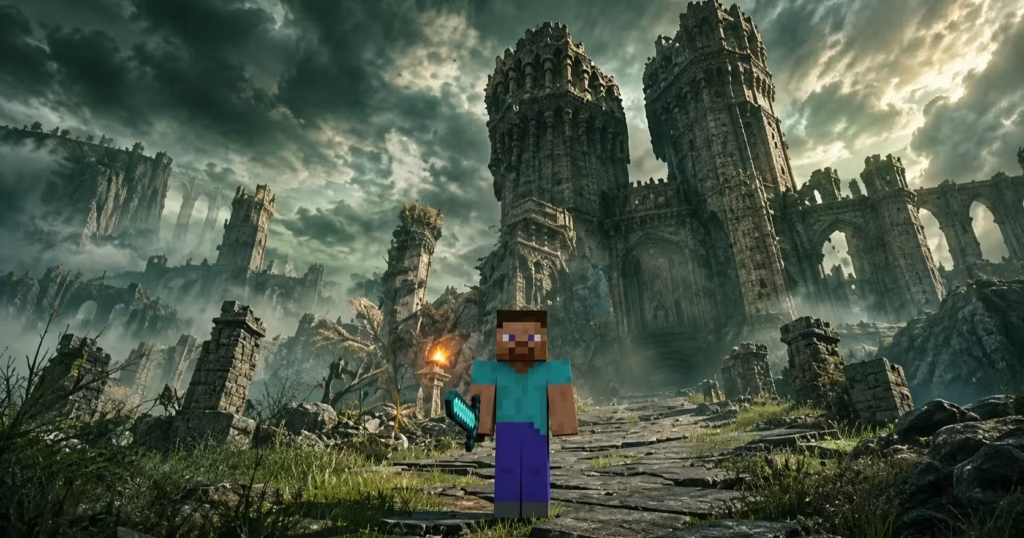
The viral breakthroughs achieved by these AI game mods are early milestones in a much deeper transformation in a much deeper transformation. As language models and system-level translation layers mature, the concept of a video game as an immutable, isolated silo is dissolving.
“We are transitioning from an era where modding meant tweaking local static assets to an era of live engine interoperability, where systems from entirely different studios can exchange physics, lighting, and controls in real time through artificial intelligence.”
— Lukas B. (luki-1), creator of ArkWeb
Consider lightsaber combat from Star Wars Jedi operating inside the open world of Cyberpunk 2077, or the fluid wall-running traversal of Titanfall 2 powering modern tactical shooters. Open-source repositories like ArkWeb on GitHub and active discussions on the r/pcmasterrace Reddit community have established the blueprint.
Publisher debates over copyright and digital rights management are inevitable. But for a global community driven by interactive freedom, the trajectory is clear: when proprietary code becomes readable by artificial intelligence, no game engine remains an island.
Frequently Asked Questions (FAQ)
1. What are AI-assisted cross-engine game mods?
Modern AI game mods are community-developed modifications that leverage artificial intelligence for rapid reverse engineering, enabling the transplantation of genuine physics, combat mechanics, and animations from one commercial game directly into another via parallel execution and shared memory.
2. What are the most prominent examples of this trend today?
Standout examples include ArkWeb (bringing full Marvel’s Spider-Man traversal physics into Batman: Arkham Knight), Leon Kennedy from Resident Evil 4 featuring third-person gunplay and laser aiming in Elden Ring, and Doomfist from Overwatch delivering first-person kinetic combat against soulslike demigods.
3. Do players need to own both legitimate games for these mods to work?
Yes. Because the mod executes both game engines simultaneously in background memory, players must have legitimate, licensed copies of both titles installed locally on their PC (such as via Steam). The mod only provides the connection bridge and process injection code.
4. Why do these cross-engine mods require high-end hardware?
The host system’s CPU must calculate two complete game simulation loops at once — handling physics and animation state machines in the background — while the GPU renders high-fidelity geometry, lighting, and volumetric assets in the foreground.
What do you think of this AI-powered revolution in PC modding? Which character and mechanics would you love to see transplanted into your favorite game world? Share your thoughts in the comments below!