
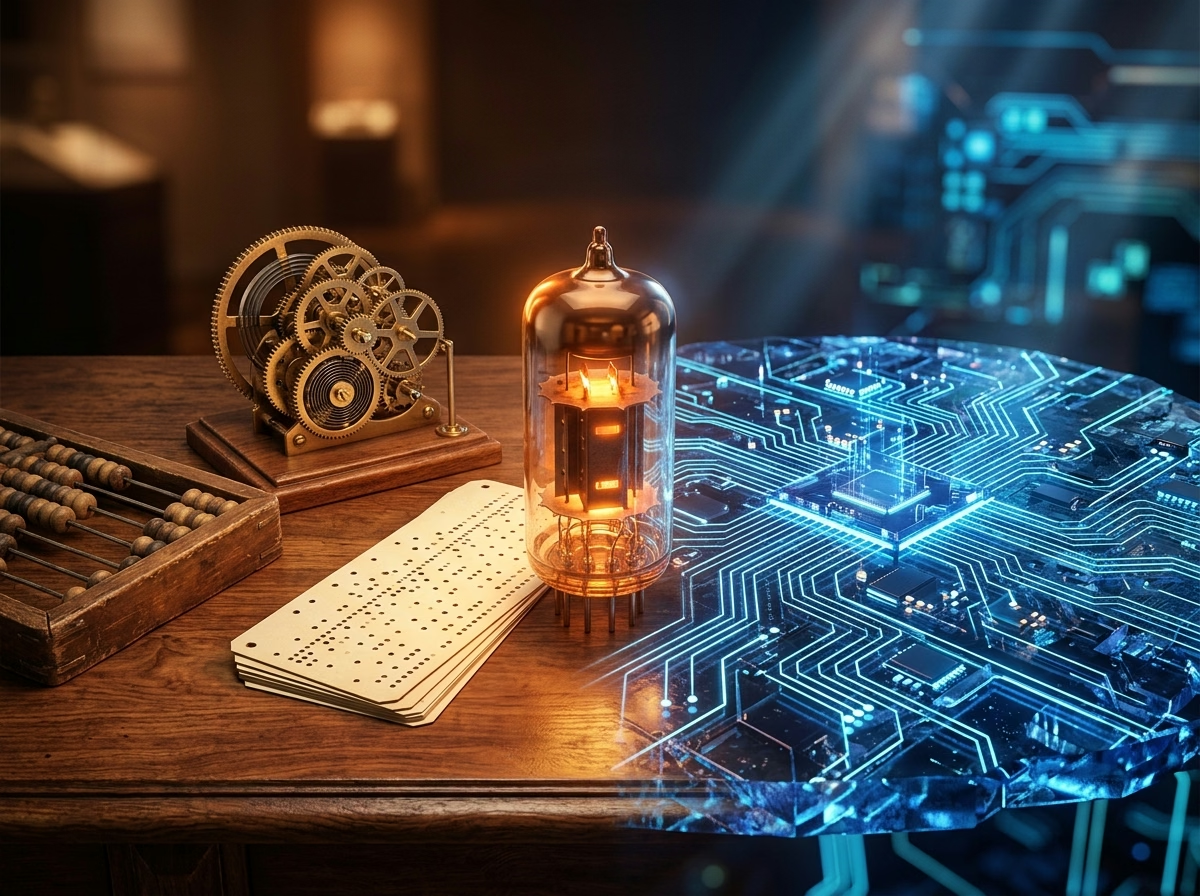
Understanding the modern history of computing reveals that the supercomputers in our pockets are the culmination of centuries of intellectual grit, beginning long before microchips existed. Yet the modern digital era is the culmination of a magnificent, centuries-long human quest to automate thought itself.
The history of computing is not merely a dry timeline of silicon and circuit boards. It is a thrilling intellectual adventure spanning mechanical brass gears, textile looms, wartime cryptography, corporate empires, and visionary mathematical geniuses who conceived modern software long before electricity even powered our cities.
Milestones in the History of Computing: When Computers Were Human
Before the mid-20th century, the word “computer” was not a machine sitting on a desk; it was a job title. Teams of mathematicians, overwhelmingly women, spent twelve-hour days calculating navigational tables, artillery trajectories, and astronomical ephemerides by hand with quill and ink.
Human arithmetic, however, is notoriously prone to fatigue. In the early 19th century, British polymath Charles Babbage grew so exasperated with typographical calculation errors that he famously cried out: “I wish to God these calculations had been executed by steam!”
Babbage designed the Difference Engine and later the revolutionary Analytical Engine—a mechanical leviathan driven by steam power, cogs, and punched cards borrowed directly from Jacquard textile looms. The machine was designed with a separate “mill” (processor) and “store” (memory), establishing the architectural blueprint of all modern computers.
Ada Lovelace: The Poet of the First Algorithm
While Babbage obsessed over brass metallurgy and mechanical tolerances, it was a brilliant young mathematician named Ada Lovelace who recognized the true metaphysical power of computation. While translating a French treatise on Babbage’s engine, Lovelace authored extensive interpretive notes that exceeded the original text threefold.
Within those notes, Lovelace wrote the world’s very first computer program: a step-by-step algorithm designed to calculate Bernoulli numbers. More critically, she articulated what she termed “poetical science”. While Babbage saw only an arithmetic calculator, Lovelace foresaw that if the engine could manipulate symbols according to mathematical rules, it could compose music, create visual art, and model the universe. She became the spiritual prophet of modern generative software.
World War II and the Birth of the Electronic Computer
The transition from mechanical clockwork to high-speed electronics was catalyzed by the existential crucible of the Second World War. At Bletchley Park in England, Alan Turing and his team engineered the electromechanical Bombe to crack the Nazi Enigma cipher. Simultaneously, British engineer Tommy Flowers built Colossus—the world’s first programmable electronic digital computer—utilizing thousands of glowing thermionic vacuum tubes.
Across the Atlantic in 1945, the University of Pennsylvania unveiled ENIAC (Electronic Numerical Integrator and Computer). Occupying 1,800 square feet, weighing 30 tons, and consuming enough electricity to dim nearby streetlights, ENIAC could calculate 5,000 addition operations per second. The electronic age had officially begun.
The Silicon Miracle: From Room-Sized Giants to Microchips
Vacuum tubes were hot, fragile, and burnt out every few hours. The revolution that transformed computing into an everyday consumer tool was the invention of the solid-state transistor at Bell Labs in 1947 by John Bardeen, Walter Brattain, and William Shockley.
By replacing glass bulbs with microscopic silicon switches, engineers compressed entire circuits onto integrated silicon dies. In 1971, Intel introduced the 4004—the first commercial single-chip microprocessor. It packed 2,300 transistors on a sliver of silicon smaller than a fingernail, matching the computational throughput of the monolithic ENIAC.
Closing the Circle: From Mechanical Gears to Neural Networks
From the Apple II and IBM PC in the late 1970s to the graphical interface, the World Wide Web, and cloud hyperscalers, computing steadily conquered external human tasks. In 2026, we stand at the threshold of the ultimate milestone envisioned by Alan Turing in his legendary 1950 paper “Computing Machinery and Intelligence”: machines that learn, adapt, and reason organically.
Generative models like ChatGPT and specialized agentic architectures do not represent a break from this history; they are the direct mathematical descendants of Lovelace’s algorithms, Turing’s state machines, and von Neumann’s stored-program architecture. The gears of Babbage have simply been rewritten in silicon and neural vectors.
Learn how modern algorithms evolved from basic logic in our guide on what is artificial intelligence.
For original artifacts and historical documentation, explore the Computer History Museum.
To take your practical workflow further, explore our hands-on guide on what machine learning is and how computing evolved.
Frequently Asked Questions
Who is considered the true “Father of the Computer”?
Charles Babbage is recognized as the father of mechanical computing for conceptualizing the processor and memory architecture, while Alan Turing is considered the father of modern computer science and theoretical artificial intelligence.
Where does the software term “bug” actually come from?
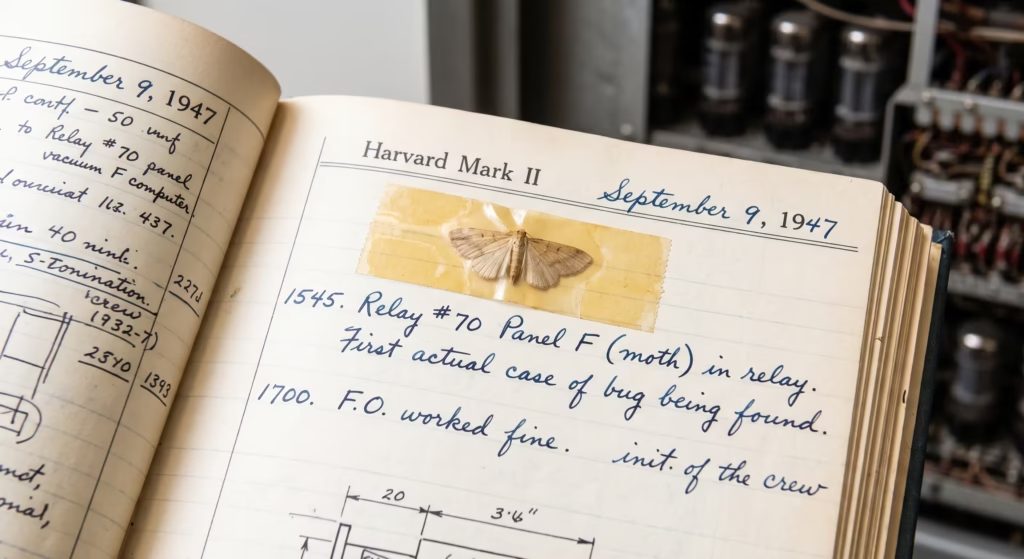
While the term was used in mechanical engineering earlier, computer pioneer Grace Hopper popularized it in 1947 when her team extracted a real moth trapped inside a relay of the Harvard Mark II electromechanical computer, taping it into the logbook with the note: “First actual case of bug being found.”
What is Moore’s Law and does it still hold true today?
Formulated by Intel co-founder Gordon Moore in 1965, it observed that the number of transistors on a microchip doubles roughly every two years. While physical atomic limits are slowing traditional silicon scaling, advanced 3D packaging and AI-specific accelerator architectures continue driving computational capacity forward.
💬 What Fascinates You Most About Computing History?
Which technological leap blows your mind more: Ada Lovelace writing software before computers existed, or modern AI agents generating complete applications in seconds? Share your thoughts below! 👇