


The deep interplay between linguistics and artificial intelligence proves that the true foundation of modern neural models is human language structure rather than raw numbers alone. We imagine massive data centers crammed with tensor processing units and billions of mathematical calculations executing per microsecond.
Yet behind that silicon curtain lies a profound scientific truth that computer science spent six decades overlooking: the true foundation of modern artificial intelligence is not pure mathematics—it is human linguistics.
For more than half a century, software engineers attempted to teach computers to understand our world by feeding them rigid logic trees and encyclopedic databases. That brute-force approach hit a catastrophic dead end. The breakthrough that sparked the generative AI boom occurred only when researchers stopped treating language as a technical database and began treating it as a dynamic, living cognitive architecture.

Why Linguistics and Artificial Intelligence Are Inseparable in Modern Computing
Traditional computer code demands mathematical precision: a single misplaced semicolon crashes an entire program. Human communication, by contrast, thrives upon ambiguity, irony, metaphor, and unwritten cultural assumptions.
Consider the classic linguistic challenge of polysemy and homonyms. When an American says “the bank refused my loan” versus “we sat on the river bank”, a human infant instantly discerns financial institutions from muddy riverbanks based purely on environmental context. For classical rule-based algorithms, this linguistic fluidity was an insurmountable wall.
To overcome this barrier, machine learning borrowed a foundational principle formulated by the British linguist J.R. Firth in 1957: “You shall know a word by the company it keeps.” Instead of hand-coding dictionary definitions, modern neural networks learn the meaning of words by calculating statistical co-occurrences across trillions of sentences.
The Mathematics of Meaning: Words as Multi-Dimensional Vectors
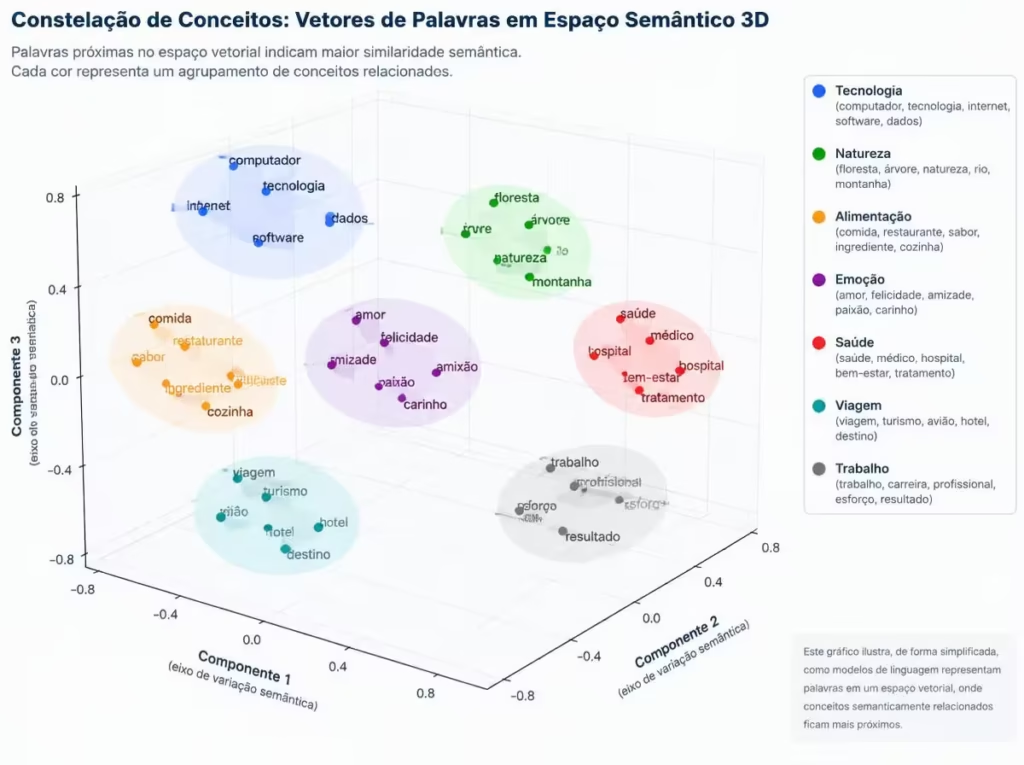
How does a silicon chip read poetry? Through a mathematical concept known as word embeddings. Every word, sub-word, or token is mapped into a vector space containing thousands of geometric dimensions.
In this semantic space, words that share conceptual traits cluster together. If you subtract the vector for “man” from the vector for “king” and add the vector for “woman”, the resulting coordinate lands with astonishing precision next to “queen”. Artificial intelligence does not “memorize” language—it navigates an intricate geometric landscape of human ideas.
The Three Linguistic Layers Driving Generative AI
To produce human-like discourse, large language models operate across three classical linguistic tiers:
- 1. Syntax (The Structural Puzzle): Syntax dictates grammatical order and sentence construction. Transformers utilize self-attention mechanisms to track syntactic relationships across long paragraphs, understanding which subject connects to which distant verb.
- 2. Semantics (The Core Message): Semantics decodes the literal meaning of statements. It ensures that an AI comprehends the fundamental truth of a sentence regardless of active or passive voice phrasing.
- 3. Pragmatics (Invisible Context): The highest linguistic frontier. Pragmatics determines what is meant beyond what is literally said. If a boss asks: “Do you have a watch?”, they are not inquiring about jewelry ownership—they are pragmatically asking what time it is. Modern frontier models succeed because attention heads capture subtle contextual cues.
How Linguistic Mastery Turns You into a Prompt Engineering Pro
Understanding linguistics demystifies prompt engineering. When casual users struggle to get quality output from an LLM, it is rarely a technical limitation; it is usually a linguistic failure of pragmatic framing.
By providing explicit communicative personas, clarifying the intended audience, and defining pragmatic goals (e.g., “Write a persuasive memo for skeptical executives adopting a firm yet empathetic tone”), you guide the model’s self-attention vectors straight toward the exact semantic neighborhood you require. Words remain humanity’s most powerful programming language.
To see how linguistic clarity translates into persuasive copy, read our guide on how to write emails with AI.
For research on computational syntax and semantic embeddings, consult the MIT Computational Linguistics Laboratory.
To take your practical workflow further, explore our hands-on guide on how the Feynman technique with AI accelerates learning.
Frequently Asked Questions
Does artificial intelligence truly “understand” the language it generates?
From a biological standpoint, no. LLMs do not possess subjective conscious experience or biological intent. However, functionally and structurally, their mathematical representation of semantic relationships closely mirrors cognitive associative networks in the human brain.
What is a “token” in AI linguistics?
A token is the atomic unit of text that an AI processes. In English, a token is typically about four characters or roughly three-quarters of a word. Common words equal single tokens, while rare terms are split into smaller morphological chunks.
Why do computational linguists remain critical to AI research labs?
Linguists evaluate benchmark datasets, diagnose systemic algorithmic bias, design red-teaming scenarios, and guide tokenizer design to ensure fair representation across low-resource languages.
💬 What Do You Think?
Do you view large language models as sophisticated statistical parrots, or does their mastery of syntax and semantics signify the dawn of synthetic reasoning? Share your thoughts below! 👇