
In tech company marketing videos, artificial intelligence is portrayed as an ethereal, disembodied miracle of pure mathematics. Slick animations show glowing blue lines of code, server racks humming under liquid cooling, and algorithms seemingly “learning” from the cosmos through sheer computational brilliance. We are led to believe that intelligence emerged spontaneously from silicon.
The reality is vastly more grounded, human, and morally complex. Behind every fluent sentence generated by ChatGPT, every pedestrian avoided by an autonomous vehicle, and every toxic hate-speech post blocked on social feeds stands an invisible global proletariat: millions of human data annotators, RLHF human feedback evaluators, and content moderators. Investigating the humans behind AI reveals the hidden foundation of human labor that makes the machine age possible.

Ghost Work: Who Are the Millions Powering the Machine?
In her landmark sociological study Ghost Work, anthropologist Mary L. Gray documented how the modern digital economy relies on a massive, distributed shadow workforce. In artificial intelligence development, this labor falls into three distinct tiers:
1. Visual Labelers: The Eyes of Autonomous Systems
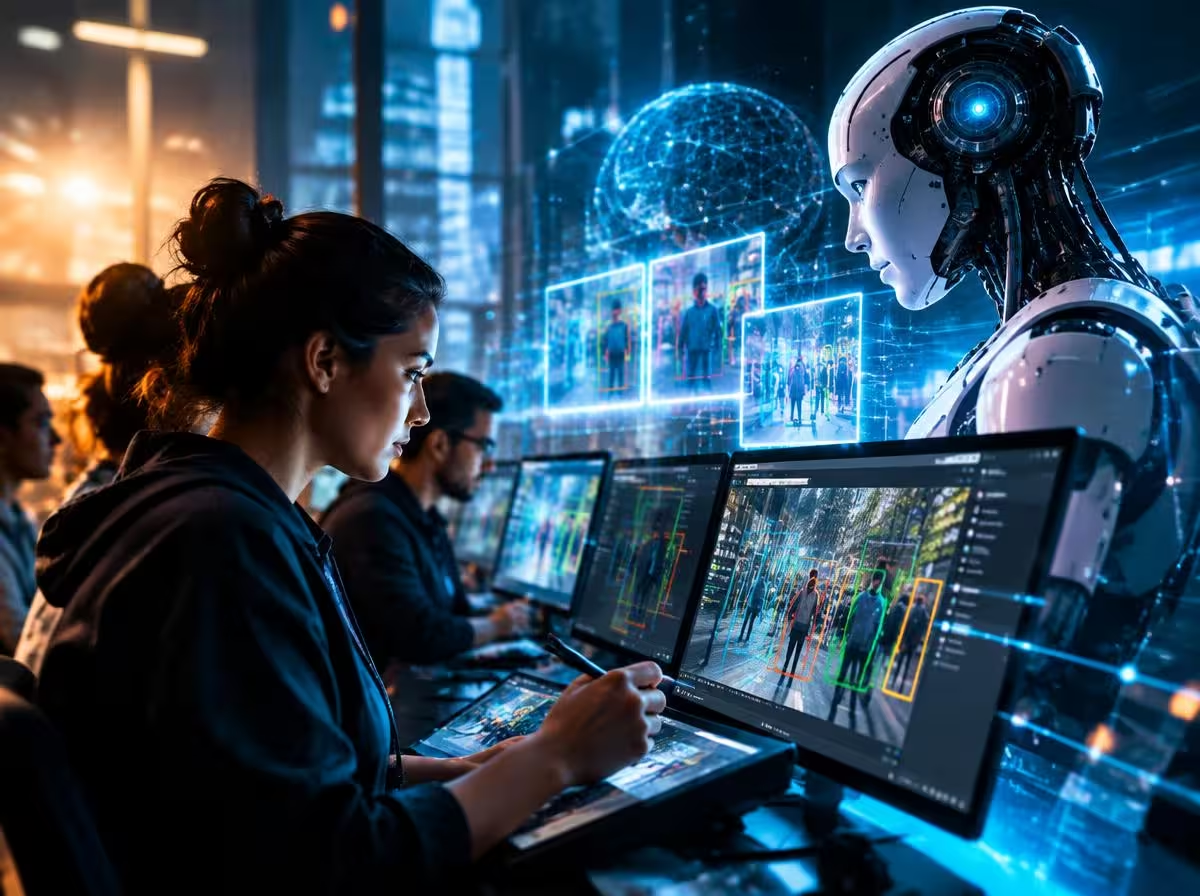
Before a self-driving car can recognize a cyclist at dusk, human annotators in Kenya, the Philippines, and Colombia had to manually draw millions of bounding boxes around bicycle wheels, pedestrian shadows, and rain-blurred stop signs frame by frame across billions of video hours.
2. RLHF Evaluators: The Behavioral Tutors
Pre-trained language models are chaotic text predictors capable of generating venomous, offensive rants. To turn raw weights into helpful assistants, companies employ human trainers in Reinforcement Learning from Human Feedback (RLHF). These workers compare alternative AI responses, ranking which is more helpful, factual, and polite, sculpting the model’s moral posture through hundreds of thousands of comparison turns.
3. The Trauma Shield: Content Moderators
To teach AI safety classifiers what not to generate, human content moderators must review the absolute darkest corners of the internet—filtering extreme violence, abuse, and hate speech so that consumer chatbots refuse harmful requests. As reported in investigative exposés by Time Magazine, this grueling work often causes severe psychological trauma to workers paid mere dollars per hour.
The 18th-Century Mechanical Turk: History Rhyming Again
In 1770, Wolfgang von Kempelen amazed European royal courts with “The Mechanical Turk”—a life-sized wooden mannequin seated at a chessboard that could defeat human nobles. Spectators believed it was an autonomous mechanical clockwork genius. In reality, a master human chess player was cramped inside the wooden cabinet, manipulating the magnets and gears.
Modern AI is the ultimate 21st-century Mechanical Turk. While algorithms perform genuine mathematical inference, their common sense, ethical guardrails, and nuanced cultural understanding are painstaking human imprints rented at micro-task piece rates across the Global South.

Ethical Crossroads: Opportunity vs. Digital Exploitation
The global data annotation supply chain sits at a complex ethical intersection. On one hand, platforms like Remotasks, Scale AI, and Sama provide vital income in developing economies where local job opportunities are scarce. For university students in Nairobi or software developers in Manila, data annotation can pay above local minimum wages.
On the other hand, workers face severe precariousness: algorithmic account bans with zero appeal mechanisms, fluctuating piece-rate pay, zero healthcare or mental health counseling, and vast wealth asymmetry compared to the multi-trillion-dollar valuations of the tech giants they train.
Global Data Annotation Hubs: The Geopolitics of Clickwork
The geography of artificial intelligence training reflects historical global labor flows. While the intellectual property, model weights, and multi-billion-dollar market valuations are concentrated in Silicon Valley, London, and Beijing, the operational cognitive assembly line spans developing economies across four continents:
| Global Hub | Primary Annotation Specialty | Estimated Workforce | Economic Context |
|---|---|---|---|
| Nairobi & Dadaab (Kenya) | English conversational RLHF, safety moderation | 15,000+ workers | High youth unemployment; strong English fluency |
| Manila & Cebu (Philippines) | Autonomous driving bounding boxes, e-commerce tags | 40,000+ workers | Mature BPO infrastructure; rapid turnaround |
| Caracas & Maracaibo (Venezuela) | Micro-task categorization, image classification | 25,000+ workers | Cryptocurrency & dollarized payouts hedge local inflation |
| Bangalore & Hyderabad (India) | Advanced coding verification, STEM mathematical proofs | 50,000+ workers | High-density engineering and computer science graduates |
The Shift to Domain Specialists: Doctors, Lawyers & Coders
As foundation models master basic conversational syntax, the nature of data annotation is shifting rapidly from low-wage clickwork to high-compensated domain expertise. To train the next generation of reasoning models, frontier labs now hire board-certified medical doctors to review complex surgical differentials, patent attorneys to evaluate licensing disputes, and competitive programmers to construct mathematical verification proofs. What began as an invisible gig economy is transforming into a specialized global knowledge guild.
Can AI Train Itself Without Us? The Synthetic Data Debate
Leading research labs are racing to replace human feedback with RLAIF (Reinforcement Learning from AI Feedback) and synthetic data generation. However, models trained purely on other models’ outputs often suffer from “Model Collapse”—a mathematical degradation where edge cases and linguistic nuances flatten into repetitive gibberish.
Human judgment remains the vital anchor of reality. Just as machine learning models require human linguistic grounding, as we explored in our linguistic deep dive on What Is AGI & How General Intelligence Works, authentic cognition requires human lived experience to remain anchored in truth.
Frequently Asked Questions
Can anyone work as an AI data annotator from home?
Yes. Platforms like Scale AI (Outlier), Appen, and DataAnnotation recruit globally. Today, platforms increasingly seek domain specialists: doctors to evaluate medical AI, lawyers for contract review, and bilingual poets to refine creative writing.
Do human trainers have access to my personal chatbot conversations?
If you leave model training enabled in your consumer accounts, anonymized conversation snippets may be reviewed by human annotators for quality control. Learn how to secure your data in our guide on ChatGPT Privacy Settings.
Why can’t autonomous vehicles learn purely from simulated video?
Simulators struggle to model the infinite chaotic edge cases of the physical world: a child chasing a rolling ball from behind a parked truck, a plastic bag blown across a highway, or non-verbal gestures from traffic police. These nuances require human discernment.
Honoring the Human Soul in the Machine
The next time you prompt a chatbot and receive a compassionate, lucid, and perfectly formatted answer, remember that you are not speaking to pure mathematics. You are speaking to the distilled collective wisdom, judgment, and emotional labor of millions of human beings scattered across every continent. Technology is never just hardware and code—it is an unbroken human tapestry. What are your thoughts on the human workforce powering modern AI? Share your perspective in the comments below!