
Legend has it that Nobel Prize-winning physicist Richard Feynman—who famously unlocked the deep enigmas of quantum electrodynamics with the same playful ease he brought to playing bongo drums—held an uncompromising litmus test for true mastery: if you cannot explain a concept in simple language to a college freshman, you do not understand it at all. There was no hiding behind Latin jargon, dense mathematical equations, or pompous academic vocabulary. To Feynman, excessive complexity was almost always a polite disguise for hidden ignorance.
Nearly all of us have walked into the trap known as the illusion of competence. You purchase a dense book on personal finance, spend three hours highlighting half the paragraphs in neon yellow, watch two lectures on YouTube, and fall asleep with the reassuring feeling that you mastered the material. But the very next day, when a colleague over lunch asks you how that system actually works, you stammer, grasp for words, and hit a wall: you recognized the words on the page, but you never actually learned. This is precisely where pairing the Feynman Technique with AI transforms your intellectual retention.
Historically, putting Feynman’s framework into practice demanded a rare and expensive resource: a real, remarkably patient person willing to sit across the table, listen to your clumsy explanations, and gently point out where your logic sprang a leak. Most people ended up mumbling to their reflection in a bathroom mirror or abandoning the exercise entirely. With contemporary large language models, you finally carry an indefatigable Socratic mentor in your pocket. In this comprehensive guide, you will discover how to operationalize the Feynman Technique with AI into an accelerated retention engine, allowing you to absorb complex disciplines up to three times faster without rote memorization or cognitive burnout.
The Illusion of Competence: Why the Feynman Technique with AI Destroys Passive Study
Before unpacking our prompting toolkit, we must diagnose why the vast majority of people study ineffective ways. From grade school onward, traditional education conditions us to favor passive consumption: rereading the same chapters, highlighting endless sentences, and skimming static summaries. Extensive cognitive research published by the American Psychological Association demonstrates that passive review produces a deceptive cognitive signal known as recognition bias.
When your eyes glide over a passage you read five minutes ago, your brain triggers a comforting sensation of familiarity: “Oh, I know this!”. But familiarity is fundamentally distinct from durable recall. Knowing where a chess piece sits on the board does not mean you know how to win a tournament. Genuine learning only occurs under cognitive friction—when you are forced to retrieve information from long-term memory, reconstruct its architecture in your own voice, and communicate it clearly to the world.
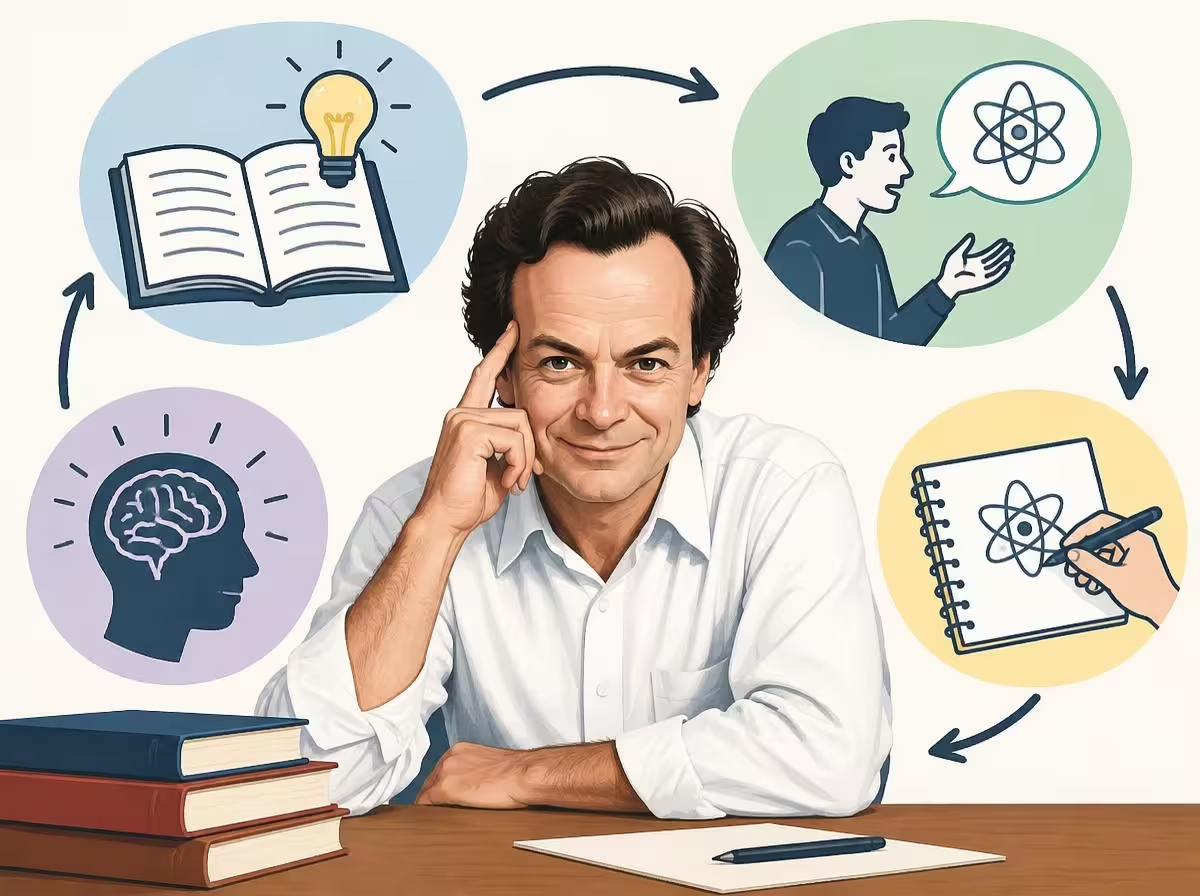
Richard Feynman’s genius was codifying this active retrieval into a clean, repeatable four-stage cycle. By marrying this battle-tested methodology with modern generative models, you eliminate the loneliness and friction of solitary study. As we discussed in our guide on what artificial intelligence actually is, the transformative breakthrough does not lie in outsourcing your thinking to an algorithm, but in using the model as a relentless whetstone to sharpen your own intellect.
The Four Classic Pillars of the Feynman Framework
The classic architecture developed by Feynman owes its enduring power to its elegant simplicity, as thoroughly documented by learning analysts at Farnam Street’s mental models. The system rests upon four continuous motions:
- Step 1 — Choose the Concept: Pinpoint an explicit, manageable topic rather than attempting to conquer an entire field at once (e.g., “how central bank interest rates drive inflation” or “object inheritance in modern programming”).
- Step 2 — Teach It to a 10-Year-Old: Draft an explanation on a clean sheet of paper using only everyday language and tangible analogies, strictly forbidding yourself from leaning on technical jargon.
- Step 3 — Identify Knowledge Gaps: The exact moment you hesitate, use a pretentious phrase to cover up confusion, or struggle to connect cause and effect, you have uncovered your true blind spot.
- Step 4 — Review, Simplify, and Re-anchor: Return to primary source material solely to repair that specific conceptual fracture, refining your metaphor until any layperson understands it immediately.
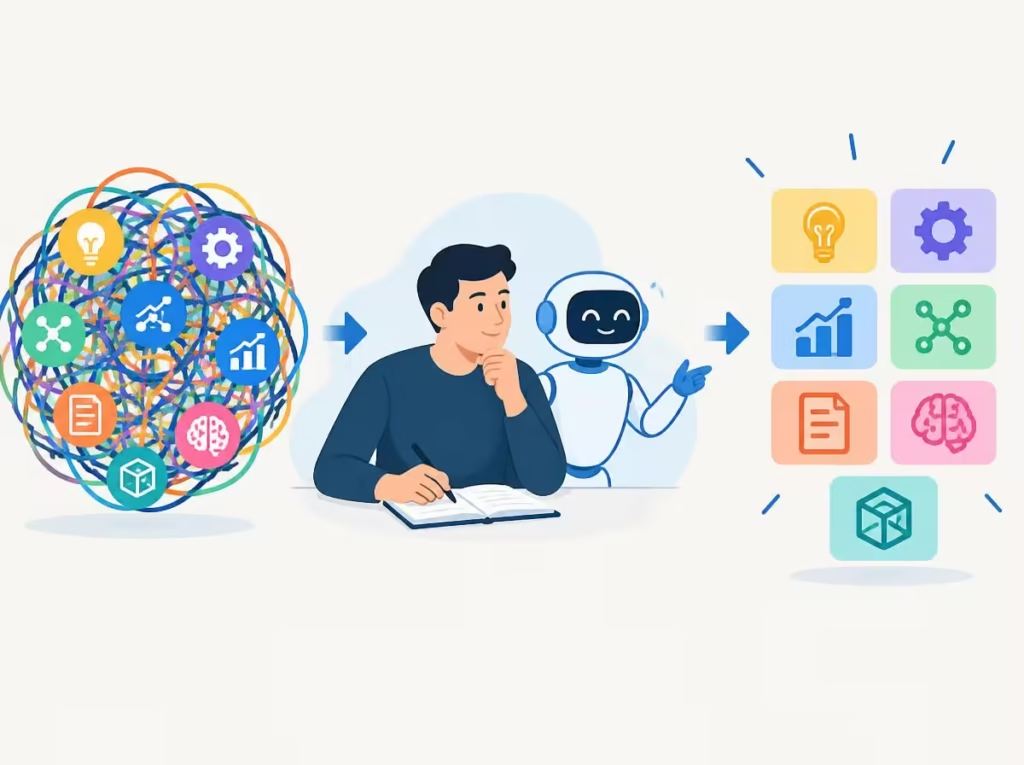
Historically, the hardest hurdle lived inside Step 3. If you study alone in your home office at 11:00 PM, how can you objectively determine whether your analogy holds water or whether you are merely telling yourself a cozy bedtime story to preserve your ego? That exact friction is where the Feynman Technique with AI becomes your ultimate competitive advantage.
Step 1 in Practice: Deconstructing Intimidating Concepts with AI
To launch the Feynman Technique with AI, your first objective is dismantling initial intimidation. Whenever we encounter a sophisticated new subject—be it monetary policy, neural transformer architectures, public-key cryptography, or corporate tax law—our default impulse is drowning ourselves in 200-page textbooks. This instantly saturates working memory.
Rather than requesting a generic summary, you will prompt the model to adopt the persona of a world-class educational communicator, requiring it to translate the core mechanism into relatable real-world analogies before introducing any formal terminology. Deploy this precise prompt:
Adopt the persona of an Expert Educator and master practitioner of the Feynman Technique.
I want to deeply understand the following concept: [insert topic here].

Non-negotiable guidelines:
1. Explain this concept as if I were an intelligent but complete beginner (like a 10-year-old or an executive from an unrelated industry).
2. Do not use technical jargon without first anchoring it with a vivid, everyday analogy.
3. Provide an intuitive mental model illustrating the central mechanism.

At the conclusion of your explanation:
- Summarize the fundamental core insight in exactly 3 short sentences.
- Highlight the single most common misconception people make when trying to learn this.
Notice the deliberate design of this command: it forbids the model from serving as a sterile encyclopedia. By requiring a tactile metaphor (such as comparing corporate cash flow to a water tank with open valves and variable pipe pressure), your brain establishes an immediate cognitive anchor. This sets the stage for the pivotal second phase: putting yourself directly into the teacher’s chair.
Step 2 in Practice: The Socratic Stress Test and Blind Spot Hunter
Here is where the true leverage of the Feynman Technique with AI kicks into gear. Once you absorb the initial lay explanation, close your research browser tabs, open a clean document, and type out your personal explanation of the concept in your own voice. Type out your hesitations, your raw analogies, and your natural phrasing.
Once your paragraph is written, you do not ask for superficial praise. You instruct ChatGPT or Claude to act as a rigorous academic examiner specifically instructed to hunt down conceptual flaws. Send your draft alongside this targeted directive:
Act as a kind but intellectually rigorous Socratic Examiner. I just studied [insert topic] and drafted my own explanation in my own words below.

My explanation:
"[paste your draft explanation here]"

Your task:
1. Honestly evaluate whether my explanation is conceptually sound or contains subtle inaccuracies.
2. Point out anywhere I used buzzwords or vague phrasing to mask a lack of genuine understanding.
3. Identify my single greatest blind spot or omitted variable.
4. Ask two provocative Socratic questions to test whether I truly grasp the underlying cause-and-effect or merely memorized the surface.
The feedback loop here is extraordinary. The AI will respond with pinpoint critique: “Your analogy worked nicely up to this junction, but when describing asset liquidity, you conflated immediate availability with yield. What would happen to your system if…”. This interactive sparring session faithfully recreates having a personal MIT research fellow sitting across your kitchen table.

Step 3 in Practice: Generating Unforgettable Analogies
Feynman famously remarked that true understanding grants you the flexibility to reconstruct an idea across entirely different domains. If you can only discuss compound interest through spreadsheet formulas, your grasp remains brittle. But if you can illuminate that same concept using garden compost, highway traffic, or snowball physics, the insight has become part of your permanent cognitive architecture.
Often, learners stall during the Feynman Technique with AI because individual creative imagination runs dry. This is where models serve as brilliant analogy engines. Use this specialized prompt:
I am studying [insert concept] using the Feynman Technique, but I am struggling to build an intuitive mental model that permanently cements this process in my memory.

Create 3 completely distinct real-world analogies to explain this exact mechanism:
- Analogy 1: Grounded in culinary arts, restaurant kitchens, or baking.
- Analogy 2: Grounded in automotive mechanics, city traffic flow, or plumbing.
- Analogy 3: Grounded in competitive sports, distance running, or team strategy.

For each analogy, detail:
- What each real-world element corresponds to in the underlying theory.
- The exact boundaries where the analogy breaks down (where the comparison ceases to be accurate).
The second requirement—defining where the metaphor breaks down—provides an advanced lesson in critical thinking. No analogy maps 100% to reality. Understanding where an analogy holds and where it diverges is the ultimate hallmark of a true subject-matter authority.
Step 4 in Practice: Active Simulation to Fortify Memory Retention
The fourth and culminating pillar of the Feynman Technique with AI is cementing conceptual breakthroughs into long-term memory through active retrieval and spaced challenge. Closing your laptop and hoping your brain magically absorbs the lesson via osmosis is wishful thinking. Durable neural pathways only consolidate when challenged by applied problem-solving.
This seamlessly interfaces with digital knowledge management. If you build knowledge bases using tools like Notion or Obsidian, archiving notes without active testing creates digital clutter. To genuinely test your retention, apply this closing assessment prompt:
Act as a Professional Exam Creator and Specialist in Active Retrieval Practice.
Based on the topic [insert topic] we just deconstructed, design a retention challenge:

1. Formulate 3 open-ended scenario questions requiring me to apply the concept to a messy real-world dilemma (no simple definition or trivia questions).
2. Design a hypothetical scenario where an amateur misapplied this concept, asking me to diagnose the root failure.
3. Do not provide the answer key yet. Withhold solutions until I submit my written responses, then grade each one with detailed feedback, highlighting strengths and surgical corrections.
Withholding the answer key prevents you from succumbing to the temptation of peeking prematurely. You are placed in the arena of active recall. Upon submitting your answers and receiving tailored diagnostic feedback within seconds, the learning loop snaps closed with surgical precision.
Three Critical Pitfalls When Applying the Feynman Technique with AI
While artificial intelligence represents the most patient mentor ever conceived, subtle traps can derail your learning trajectory if you remain unaware while applying the Feynman Technique with AI. Guard against these three classic errors:
1. Letting the AI do all the explaining: If you merely read elegant analogies produced by ChatGPT and think “Wow, that was such a clear explanation!”, you have returned square one of passive consumption. The Feynman methodology demands that you endure the cognitive strain of formulating explanations in your own words before seeking feedback.
2. Accepting hallucinations without cross-verification: Language models are eager to please and occasionally invent citations or affirm flawed reasoning to sound agreeable. Whenever you study high-stakes disciplines like legal procedure, engineering tolerances, or medical dosages, keep verified primary source texts within reach.
3. Confusing simplification with superficiality: Simplifying does not mean ignoring critical nuances; it means building a foundation so rock-solid that sophisticated details find an intuitive home. If an analogy glosses over the fundamental cause of a phenomenon, it is merely poetic distraction, not true comprehension.
🧠 Deep Focus and High-Retention Toolkit: The Feynman Technique thrives in an environment free of digital interruption. To create an impenetrable focus bubble during intensive study sessions, active noise-canceling headphones block office chatter and domestic distractions. Pairing high-yield AI prompting with analog pen-and-paper drafting accelerates retention, turning fleeting insights into permanent intellectual assets.
To take your practical workflow further, explore our hands-on guide on how to use AI to study faster and retain more.
Frequently Asked Questions About the Feynman Technique with AI
Which AI model works best for the Feynman Technique?
Both OpenAI’s flagship reasoning models and Anthropic’s Claude deliver exceptional pedagogical results. Claude often stands out for a remarkably nuanced, empathetic Socratic tone when probing assumptions, whereas ChatGPT excels at lightning-fast scenario generation and practical examination rubrics.
Can I use this method to learn programming and mathematics?
Absolutely. In software engineering, paste a complex script you recently authored and instruct the model: “Explain the execution flow of these functions as if I were a head chef managing kitchen stations.” In mathematics, asking AI to reveal the geometric or physical intuition behind abstract formulas transforms dry symbols into intuitive mental models.
How much time should I dedicate to each Feynman study block?
A focused block of 25 to 40 minutes is ideal: 10 minutes to review primary material, 10 minutes to draft your simple explanation, 10 minutes to debate blind spots with the AI, and the final 10 minutes for active testing. This structured cadence delivers peak retention without causing mental fatigue.
Genuine Knowledge Is What No One Can Take Away from You
Richard Feynman frequently reminded his students that the first principle of science is not to fool yourself—and you are the easiest person to fool. In an era dominated by information overload, algorithmic feeds, and superficial courses promising instant expertise, your ultimate competitive moat is not how many browser tabs you keep open, but the depth of what you genuinely understand well enough to teach.
By incorporating the Feynman Technique with AI into your personal development routine, you stop collecting passive summaries and become an independent thinker. You learn faster, communicate with commanding authority, and cultivate a crisp clarity of mind that shines through in meetings, client calls, and critical decisions. Open your conversational AI platform, select that intimidating topic you always avoided, and run your first test: you will be astonished at how quickly dense complexity dissolves into crystalline clarity.
Join the Discussion!
What is that one challenging skill you have always wanted to master? Have you tried placing an AI in the student’s chair to test your own explanations? Share your favorite study habits and learning strategies in the comments below! 👇