

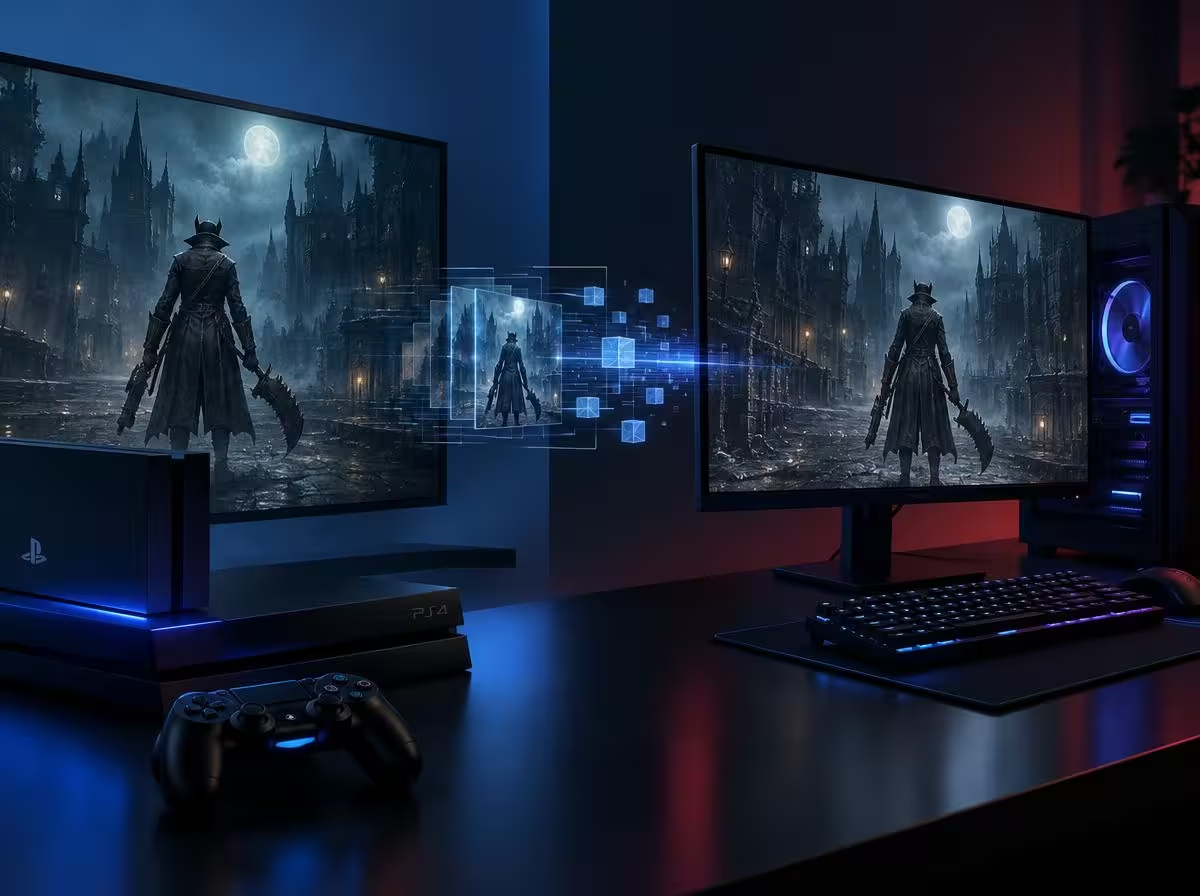
The rise of game recompilation with AI is triggering the most radical and technically exciting revolution in PC gaming since the birth of early console emulators in the late 1990s.
For decades, players dreaming of revisiting legendary games locked on obsolete hardware—or finally experiencing masterpieces like Bloodborne, God of War III, and Silent Hills (P.T.) on modern computers—had to accept a painful compromise: traditional system emulation.
Emulating a console means forcing modern PC processors to pretend, instruction by clock cycle, that they are completely different architectures. The inevitable cost has always been excessive CPU load, stuttering frame times, and high barriers to achieving smooth gameplay.
Today, that status quo is shattering. Powered by intelligent coding assistants and machine learning models, community-driven reverse engineering allows independent developers to take console binaries and reconstruct them as standalone native PC executables—delivering unlocked 120 FPS, 4K resolution, and deep mod support without any heavy emulator running in the background.
What Is Game Recompilation with AI and Why It Outperforms Emulation
To grasp why this technical shift is turning heads across gaming communities, we must untangle two distinct disciplines often confused in discussion threads: emulation and static recompilation (or source decompilation).
In standard emulation, software builds a real-time translation bridge. Every time the game issues a draw call or plays an audio sample, the emulator intercepts that hardware command, translates it to Windows or Linux conventions, and executes it on the fly. It is analogous to reading a book in Japanese while a translator whispers each translated sentence into your ear: functional, but inherently slow and computationally exhausting.
By contrast, creating native PC ports using artificial intelligence fundamentally changes the workflow. Rather than translating machine code dynamically during gameplay, reverse engineers rebuild the entire binary beforehand using static recompilation techniques. The resulting output is a true Windows executable (.exe) optimized to communicate directly with modern GPUs and multicore processors.
“Emulation attempts to replicate the cage in which the game was originally confined. Recompilation shatters the cage, allowing the codebase to breathe with the full force of modern PC hardware.”
— Reverse Engineering Community Manifesto
The practical benefits for everyday gamers are transformative:
- Raw Performance with Zero Overhead: Games run smoothly even on lightweight laptops and handheld PCs like the Steam Deck and ASUS ROG Ally, eliminating the battery drain of heavy emulator wrappers.
- Unlocked High Frame Rates: Titles originally hardcoded to 30 FPS on vintage consoles can decouple their internal physics engines to run at 60, 120, or uncapped refresh rates.
- Modern Display Standards: Instant compatibility with 21:9 ultrawide aspect ratios, true HDR tone mapping, and AI upscaling algorithms like NVIDIA DLSS, AMD FSR, and Intel XeSS.
- Frictionless Modding Ecosystems: Because the project compiles directly into standard PC binaries, modders can inject high-resolution 4K textures, spatial audio overhauls, ray tracing, and custom multiplayer netcode.
How AI Code Assistants Accelerate Low-Level Reverse Engineering
If static recompilation provides such an obvious performance leap, why hasn’t it been the standard practice all along? The hurdle has always been sheer human complexity. Manually decompiling a proprietary console title—translating millions of lines of raw machine assembly (MIPS, PowerPC, or custom x86) into readable, functional C++—regularly required teams of veteran engineers dedicating five to ten continuous years.
This is precisely where modern machine learning assistants rewrite the timetable. Advanced large language models specialized in code generation act as superhuman co-pilots for independent developers decompiling legacy architectures.
When fed cryptic disassembly dumps, AI assistants can infer variable types, identify math routines, suggest clean modern C++ syntax for obsolete hardware interrupts, and map legacy audio calls directly to modern APIs like Vulkan or DirectX 12. As explored in our deep dive on how AI reverse engineering is reshaping modern software development, complex binary analysis that once consumed months of manual labor can now be processed in a fraction of the time.
However, veteran programmers emphasize that AI is an assistant, not an automated magic wand. Unsupervised code generation often yields “slopcomps”—ports riddled with subtle memory leaks, logic desyncs, and broken edge cases that are painful to debug. The highest quality recompilations emerge when skilled human architects leverage AI for rapid analysis while maintaining strict code review standards.
From Bloodborne and God of War 3 to P.T.: The Most Groundbreaking Community Projects
The speed of this movement is visible in the caliber of projects emerging across multiple console generations:
The most iconic milestone remains Bloodborne. While Sony keeps FromSoftware’s masterpiece locked to PlayStation 4 at an uneven 30 FPS since 2015, the open-source community combined breakthroughs from shadPS4 with native PC loader layers (such as bbport and bbhost). Because the PS4 already runs on x86-64 silicon similar to desktop computers, developers successfully replaced proprietary OS system libraries with Windows equivalents. The result? The gothic nightmare of Yharnam running at well over 100 FPS in native 4K on PC, complete with custom lighting mods and zero emulation overhead.
Another breathtaking milestone rocking the gaming community is the native PC port of God of War III Remastered. Built under the open-source gow3_pc initiative, this monumental PlayStation classic—previously constrained by heavy PS3 architectural emulation—now runs natively on Windows and Linux. By taking the PS4 version’s x86-64 binaries and hooking them into an ultra-lean runtime derived from the open-source shadPS4 project, Kratos scales Mount Olympus at 60 to 120+ FPS in native 4K, with full ultrawide monitor support and instantaneous control responsiveness—requiring only that users supply legitimate files from their own copy of the game.
Equally historic is the native port of Silent Hills: P.T., Hideo Kojima’s legendary psychological horror teaser purged from the PlayStation Network by Konami. Rather than rebuilding the demo in Unreal Engine, developers reverse engineered the compiled PKG binary, recreating its logic in clean C++ powered by a Vulkan renderer. Anyone possessing verified package files can experience the original hallway loop on PC and Steam Deck with real-time ray tracing and high refresh rates.
The catalog of community-preserved classics is growing every week:
- Fable II: Lionhead Studios’ beloved RPG, trapped on the Xbox 360 for nearly two decades, has entered active static recompilation research from PowerPC to C++, alongside remarkable milestones on the Xenia emulator.
- The N64Recomp Era: Masterpieces like The Legend of Zelda: Majora’s Mask and Banjo-Kazooie received native PC ports within days, unlocking gyro aiming, ultra-high resolutions, and unlocked refresh rates.
- PlayStation 2 and Handhelds: Cult favorites such as Dragon Ball Z: Budokai 3, Castlevania: Symphony of the Night, Mario Kart Wii, and Mega Man X ports demonstrate that no console era is out of reach.
- Browser-Based Ports: Low-level recompilation tools have even compiled PES 6 (Pro Evolution Soccer) into WebAssembly, running seamlessly inside web browsers with zero installation.
This technical liberation directly fuels player creativity. As examined in our feature on how AI-powered mods are transforming gameplay mechanics and characters, community members do not merely want to preserve past titles—they want to expand, customize, and immortalize them.
The Legal Maze and Historical Game Preservation
With these technical triumphs comes the unavoidable legal dilemma: where does static recompilation stand regarding copyright law and intellectual property?
Historically, the reverse engineering community has shielded itself using rigorous clean-room design methodologies. Projects distribute open-source tools, decompiled wrappers, and build scripts. Zero copyrighted game assets, audio files, textures, or 3D models are ever included by developers. To assemble a playable native PC executable, the end user must provide their own legitimately acquired game dump or retail disc files.
From a legal perspective, this separation establishes crucial protection against DMCA takedown requests. Reverse engineering code strictly for interoperability and preservation is widely defended by organizations such as the Video Game History Foundation and protected across international legal jurisdictions. Nevertheless, gray areas persist, particularly when projects touch proprietary decryption keys or leaked development repositories.
Beyond legal debates, this movement highlights an undeniable void in publisher stewardship. Why do major entertainment conglomerates let acclaimed classics gather dust on abandoned platforms rather than distributing modern remasters on Steam or GOG? While commercial publishers frequently treat historical titles as disposable catalog entries, passionate fan communities equipped with artificial intelligence are ensuring video game heritage remains playable for generations to come.
Frequently Asked Questions (FAQ)
What is game recompilation with AI and how does it work?
Game recompilation involves taking compiled console binary code and translating or rebuilding it into native machine code for another platform like the PC. Assisted by AI code analysis, developers generate a standalone executable (.exe) that communicates directly with modern hardware—delivering unlocked 60+ FPS, ultrawide resolutions, and effortless mod support without emulation bottlenecks.
How does artificial intelligence assist in creating PC ports?
Artificial intelligence functions as an accelerated programming co-pilot. It helps reverse engineers interpret dense assembly instructions, maps legacy console APIs to modern graphical frameworks like Vulkan or DirectX 12, and automates repetitive decompilation tasks, cutting years of manual coding into weeks.
Is playing or recompiling a console port on PC illegal?
Reverse engineering software for interoperability and hardware compatibility is legal in many jurisdictions, provided it does not rely on stolen or leaked source code. Most community projects publish only open-source conversion utilities, requiring users to extract required assets from their own legitimate copies of the original games.
Do you believe community-crafted native ports will eventually replace traditional console emulators on PC? Which classic title do you most want to see running at 120 FPS on your machine? Share your thoughts in the comments below!