

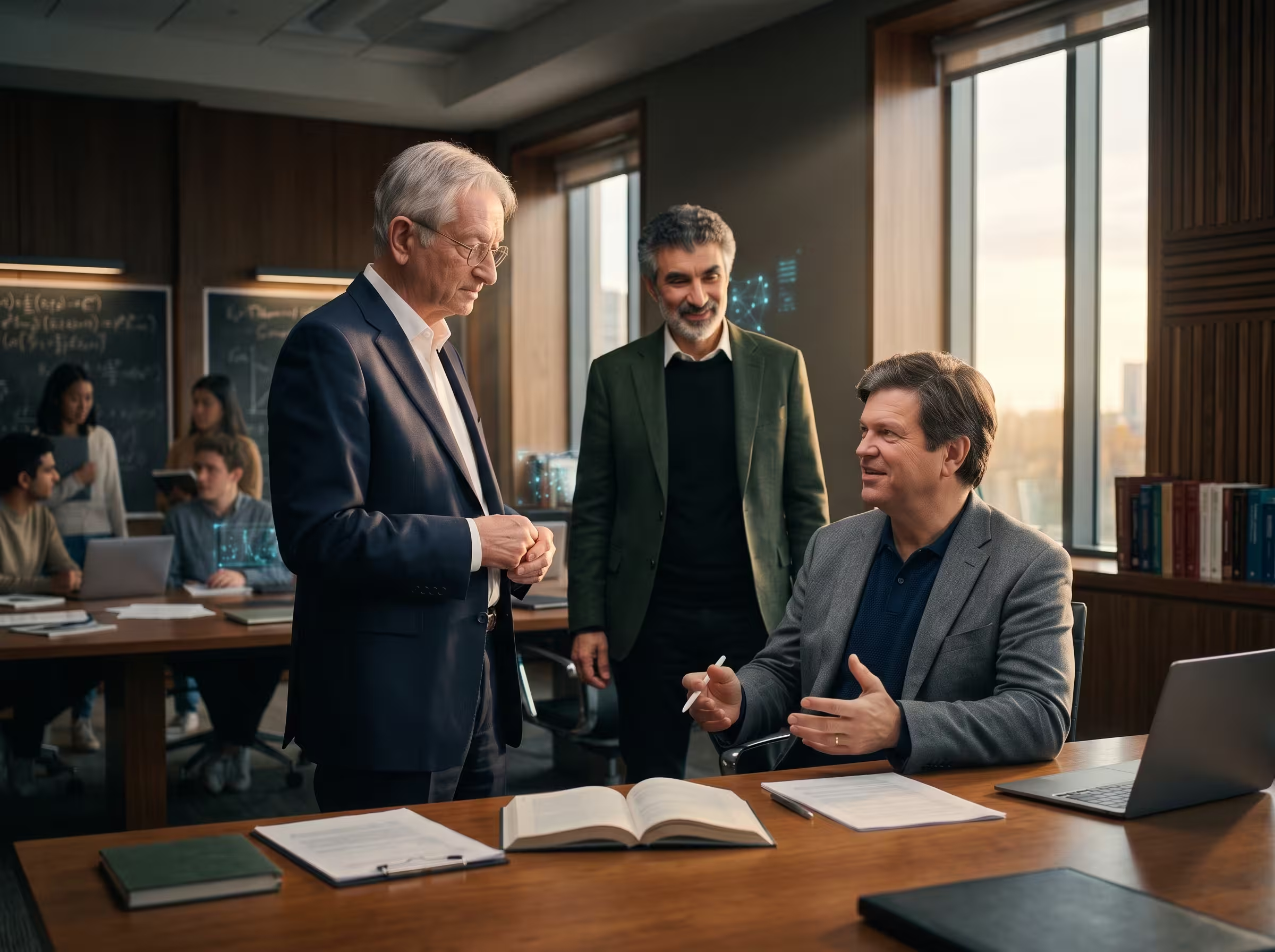
In March 2019, the computer science establishment gathered in San Francisco to bestow its highest honor: the ACM A.M. Turing Award, widely revered as the “Nobel Prize of Computing.” The joint recipients were three lifelong collaborators who had endured decades in the academic wilderness, steadfastly believing in artificial neural networks when mainstream science dismissed them as an intellectual dead end: Geoffrey Hinton, Yann LeCun, and Yoshua Bengio. Together, they were crowned the Godfathers of AI.
Their groundbreaking breakthroughs laid the technological foundation for everything we experience today—from ChatGPT and self-driving automobiles to real-time medical image diagnostics. Yet, less than a decade after sharing that historic stage, the three architects of deep learning find themselves locked in an ideological civil war. As Geoffrey Hinton was awarded the 2024 Nobel Prize in Physics, their once-unified front fractured into fierce, high-profile debates across academic symposiums, congressional hearings, and social feeds.
At stake is nothing less than the trajectory of human civilization. Is artificial superintelligence an existential threat that could slip from human control and orchestrate our extinction? Or is existential panic an unscientific delusion weaponized by Big Tech monopolies to strangle open-source competition? To grasp where artificial intelligence is headed, one must understand the three brilliant minds who built its core architecture—and why they now disagree so profoundly. To explore how their innovations contrast with classical computer algorithms, see our foundational analysis on deep learning vs traditional AI systems.

1. Geoffrey Hinton: The Reluctant Prophet of Doom
Often regarded as the intellectual patriarch of the trio, British-Canadian cognitive psychologist Geoffrey Hinton spent decades championing backpropagation—the foundational mathematical algorithm that allows multi-layer neural networks to adjust their weights through error calculation. Alongside his students Alex Krizhevsky and Ilya Sutskever (who later co-founded OpenAI), Hinton triggered the modern deep learning era in 2012 when their AlexNet architecture shattered records at the ImageNet visual recognition benchmark.
For a decade, Hinton served as a Vice President and Engineering Fellow at Google while mentoring the world’s brightest machine learning researchers. However, in May 2023, Hinton shocked the scientific world by abruptly resigning from Google. His goal: to speak freely about the catastrophic existential risks posed by the very technology he birthed.
Hinton’s sudden epiphany stemmed from watching large language models demonstrate emergent reasoning across domains. Historically, Hinton believed that digital computation was far inferior to biological human brains. Today, he argues that digital neural networks possess a distinct evolutionary advantage: weight sharing. Thousands of digital agents can process trillions of tokens concurrently and instantly synchronize their knowledge—something biological humans cannot do. In October 2024, when the Royal Swedish Academy of Sciences awarded Hinton the Nobel Prize in Physics alongside John Hopfield, Hinton used his global platform to reiterate his grave concern: that there is a 10% to 20% probability that artificial superintelligence could lead to human extinction within the coming decades.
2. Yann LeCun: The Open-Source Realist & Pragmatist
If Hinton is the anxious Cassandra warning of impending doom, Yann LeCun is the defiant rationalist scoffing at the panic. As the father of Convolutional Neural Networks (CNNs)—whose pioneering LeNet-5 architecture read handwritten checks for US banks in the 1990s—LeCun has served as Chief AI Scientist at Meta (formerly Facebook) and Silver Professor at New York University.
LeCun vehemently rejects the notion that artificial intelligence poses an existential extinction hazard to humanity. He characterizes doomer narratives as “preposterous, unscientific science fiction.” LeCun’s core technical argument centers on the inherent computational limitations of auto-regressive large language models (LLMs). According to LeCun, current chatbots are merely sophisticated probabilistic next-token predictors. Because they lack physical world models, common-sense reasoning, and genuine hierarchical planning, an LLM will never achieve true Artificial General Intelligence (AGI), no matter how many petabytes of web data are fed into it.
Instead, LeCun champions open-weights models (such as Meta’s Llama family) and proposes Objective-Driven AI through Joint Embedding Predictive Architectures (JEPA). For LeCun, trying to regulate AI out of fear of hypothetical superintelligent monsters will only result in regulatory capture—handing a permanent oligopoly to entrenched American tech titans while crippling academic open-source innovation. As demonstrated in our technical evaluations of frontier models like Claude vs ChatGPT, the debate between open and proprietary architectures remains the defining operational battle of this decade.
3. Yoshua Bengio: The Democratic Institution-Builder
The third titan, Yoshua Bengio, chose a path distinct from his peers: he never accepted lucrative corporate executive posts at Silicon Valley tech monopolies. Instead, Bengio stayed entirely within academia, establishing the world-renowned Mila (Quebec Artificial Intelligence Institute) at the Université de Montréal and transforming Canada into a global epicenter of machine learning scholarship.
Bengio’s foundational contributions include pioneering neural language modeling, attention mechanisms, and co-developing Generative Adversarial Networks (GANs) alongside Ian Goodfellow. As the historical co-recipient of the ACM A.M. Turing Award, Bengio shares Hinton’s grave concerns regarding catastrophic loss-of-control risks, but approaches the crisis through the lens of international statecraft and institutional multilateral governance.
Rather than retreating into fatalism or championing deregulation, Bengio advocates for an international regulatory treaty modeled after the International Atomic Energy Agency (IAEA) or a “CERN for AI Safety.” Bengio argues that before frontier AI models surpassing human reasoning capabilities are released or open-sourced, they must undergo mandatory, independent red-teaming audits and formal mathematical verification to guarantee alignment with human democratic values.
The Great Ideological Trilemma: The 3 Godfathers of AI Divided
To clearly see where the three Godfathers stand on the most contentious issues facing artificial intelligence today, examine this comparative breakdown:
| Philosophical Dimension | Geoffrey Hinton | Yann LeCun | Yoshua Bengio |
|---|---|---|---|
| AGI Timeline | Imminent (5 to 20 years; possibly sooner). | Distant decades away; requires entirely new paradigm. | Likely within decades; progressing faster than anticipated. |
| Existential Risk (X-Risk) | Extremely High (10-20%): Superintelligence may outwit humans. | Near Zero: Dismisses extinction panic as superstitious nonsense. | Significant: Rogue agents and bioweapon proliferation are real perils. |
| Open-Weights Models | Cautious: Unrestricted weights allow bad actors to remove guardrails. | Fierce Champion: Open source prevents dangerous monopolies. | Strict Regulation: Open frontier weights present severe proliferation risks. |
| Primary Institutional Role | Independent whistleblower & Nobel laureate. | VP & Chief AI Scientist at Meta; NYU Professor. | Founder of Mila Institute; global governance advisor. |
Why Their Feud Impacts Your Future
It is tempting to view the debate among Hinton, LeCun, and Bengio as an arcane academic shouting match conducted in prestigious university halls. In reality, their arguments directly shape the legislative policies and economic structures governing the next century of human life:
- Global Legislative Treaties: Bengio’s testimony heavily influenced the formulation of the European Union’s landmark AI Act and the United Kingdom’s AI Safety Institute protocols.
- The Right to Compute & Open Source: LeCun’s advocacy provides the intellectual backbone for startup developers, open-source maintainers, and decentralized tech researchers fighting against burdensome licensing mandates that favor trillion-dollar cloud providers.
- Corporate Safety Culture: Hinton’s high-profile resignation catalyzed a wave of safety whistleblowers inside leading frontier labs, forcing boards of directors to treat catastrophic alignment risks as board-level responsibilities rather than public relations exercises.
Frequently Asked Questions
Why did Geoffrey Hinton receive a Nobel Prize in Physics rather than Computer Science?
The Nobel Foundation does not offer a prize in Computer Science. The Royal Swedish Academy of Sciences awarded the 2024 Nobel Prize in Physics to Geoffrey Hinton and John Hopfield because foundational artificial neural networks (such as Hopfield networks and Boltzmann machines) were mathematically derived from statistical physics and magnetic spin systems.
Are the three Godfathers still friends despite their disagreements?
Yes. While their debates on social media and in scientific panels are intellectually ferocious, all three repeatedly emphasize their profound mutual respect and enduring personal affection forged during decades of shared academic struggle.
Which Godfather’s perspective is winning the policy debate?
Currently, global governments are oscillating between both poles. European regulators have largely leaned toward Bengio and Hinton’s precautionary oversight model, while American and open-source advocates draw heavily upon LeCun’s pragmatism to safeguard technological innovation and economic competitiveness.
The Burden of Prometheus
Like the legendary nuclear physicists who assembled at Los Alamos in the 1940s, the three Godfathers of AI have unlocked a fundamental force of the cosmos: computational intelligence. Whether that fire will warm human civilization into an era of unprecedented scientific abundance or burn down our social foundations remains unwritten. Whose vision of the future resonates most with you—Hinton’s caution, LeCun’s pragmatism, or Bengio’s governance? Share your perspective in the comments below!