

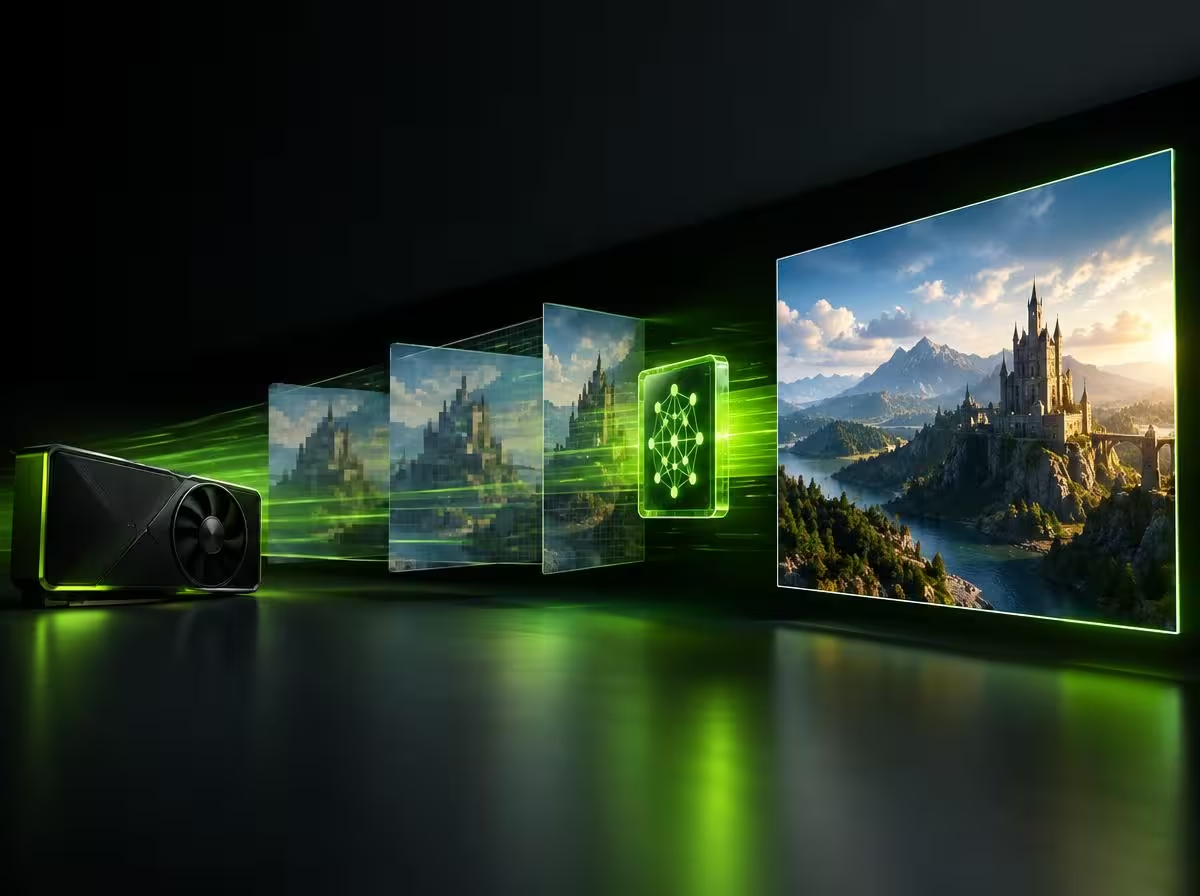
If you have followed PC gaming hardware over the past two decades, you know the historical cadence of graphics progression followed a predictable, brute-force script: every two years, chipmakers introduced a smaller semiconductor node, thermal design power climbed by fifty watts, and enthusiasts squeezed a modest 15% to 25% rasterization uplift out of sheer silicon mass. Throughout 2026, however, NVIDIA has aggressively rewritten those physical boundaries. The modern graphics revolution is no longer forged in heavy copper heatsinks—it is accelerating at the speed of applied artificial intelligence.
Less than sixty days after the commercial introduction of DLSS 5, the semiconductor leader stunned the hardware community by rolling out an official, system-level software release via the NVIDIA App that effectively doubles the technology’s operational efficiency. This is not an unverified GitHub community hook or a cosmetic post-processing filter. The comprehensive nvidia dlss 5 update shrinks the neural model by 24%, slashes 4K video memory (VRAM) consumption by up to 20%, and halves GPU compute overhead, delivering immediate real-world frame rate leaps exceeding 30% in demanding titles.
For PC gamers who invested in mainstream graphics cards like the GeForce RTX 5060 or RTX 5060 Ti and worried about longevity at 1440p resolutions, this architectural breakthrough fundamentally extends hardware lifecycles. In this definitive technical breakdown, we examine the neural distillation engineering behind the patch, analyze comparative benchmark estimates across current GPUs, guide you step-by-step through enabling the new experimental “Preset C” multiframe mode, and address the broader industry implications of our growing algorithmic dependence.
The Relentless Roadmap: How the NVIDIA DLSS 5 Update Doubled Processing Efficiency
To appreciate the velocity of this technological leap, one must examine the compressed engineering cadence NVIDIA established throughout 2026. While driver updates historically delivered minor bug fixes and game-ready day-one profiles, the current year transformed into a quarterly barrage of foundational neural upgrades:
- January 2026: Launch of the 2nd-generation Transformer neural network for image reconstruction, permanently replacing residual legacy heuristic interpolation methods.
- March 2026: Rollout of Dynamic Multiframe Generation, enabling synthetic generation of multiple consecutive visual frames guided by bidirectional neural motion vectors.
- August 2026: Architectural overhaul of the Ray Reconstruction pipeline, eliminating temporal ghosting in global illumination while preserving razor-sharp geometric edges.
- September 2026: First-wave commercial deployment of DLSS 5, headlining major sports franchises like NBA 2K26.
- October 2026: The technical distillation patch that prunes model weights, frees system VRAM, and introduces the experimental Multiframe Preset C.
The breakthrough achieved in this October update centers on neural network distillation. Rather than requiring Tensor Cores to execute heavy weight matrices for every synthesized frame, NVIDIA’s deep learning team compressed the active parameter count down to roughly 118 million parameters—a dramatic 24% reduction in footprint. Crucially, the neural network learned to infer identical photorealistic illumination and textural detail using far fewer matrix multiplications per render cycle.
The immediate beneficiary of this algorithmic pruning is graphic memory allocation. At native 4K (3840×2160), where memory saturation routinely caused severe micro-stuttering on 12 GB and 16 GB GPUs, the refined model lowers VRAM requirements by up to 20%. Demanding game engines that previously monopolized 15 GB of video memory now operate comfortably within a 12 GB envelope, preventing catastrophic frame drops caused by system RAM spillover.
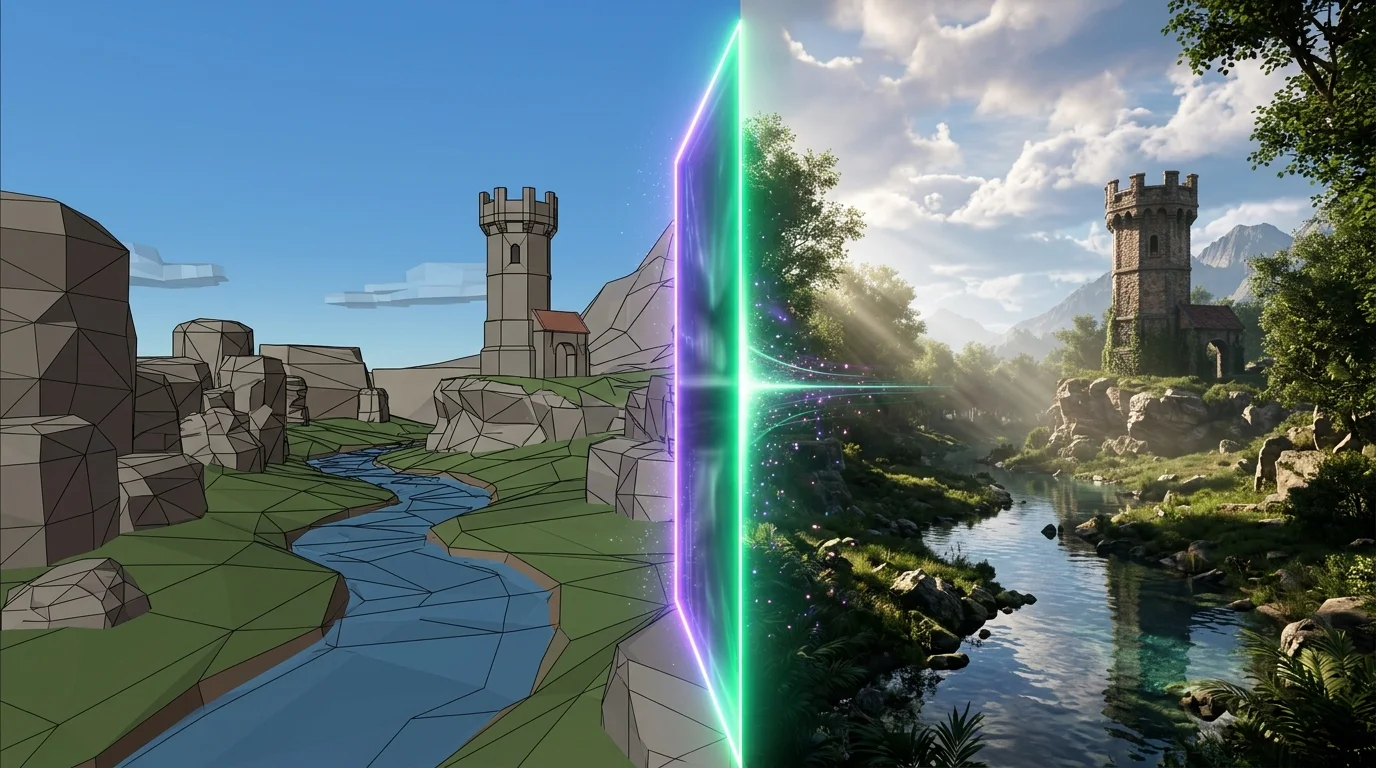
Real-World Benchmark Gains: Estimated FPS Table Across GPUs
A vital distinction emphasized by hardware engineers is what “doubling performance” actually signifies. NVIDIA doubled the execution efficiency of the neural model across hardware Tensor Cores, rather than magically multiplying final display FPS by 200%. Where a GPU previously expended 4 milliseconds generating an intermediate neural frame, it now completes the task in under 2 milliseconds. Reclaiming those compute cycles frees substantial GPU headroom for the native rasterization engine, culminating in a solid 29% to 30% net FPS uplift in real gameplay.
To quantify how this efficiency gains manifest in practice, we compiled benchmark estimates from one of modern gaming’s most hardware-intensive benchmarks—Hogwarts Legacy—tracking metrics prior to and immediately following the DLSS 5 optimization patch:
| Graphics Card | Target Resolution | Baseline FPS | Estimated DLSS 5 FPS (+30%) |
|---|---|---|---|
| GeForce RTX 5060 | Full HD (1080p) | ~50 FPS | ~65 FPS (Fluid 60+ baseline locked) |
| GeForce RTX 5060 | Quad HD (1440p) | ~40 FPS | ~52-54 FPS (Smooth 50+ threshold) |
| GeForce RTX 5060 Ti | Full HD (1080p) | ~60 FPS | ~75-78 FPS (High-refresh headroom) |
| GeForce RTX 5060 Ti | Quad HD (1440p) | ~48-52 FPS | ~65-70 FPS (Stable competitive refresh) |
| GeForce RTX 5070 | Quad HD (1440p) | ~60 FPS | ~78-82 FPS (Enthusiast-grade fluidity) |
| GeForce RTX 5050 | Full HD (1080p) | ~30-34 FPS | Uncertain (Under NVIDIA evaluation) |
The outlook for the budget-tier RTX 5050 warrants careful scrutiny. Operating on an entry-level memory bus with truncated Tensor Core clusters, its native frame rendering frequently hovers uncomfortably close to 30 FPS in modern AAA releases. Because frame synthesis algorithms require a stable temporal baseline to avoid visual artifacts and controller latency penalties, NVIDIA has yet to confirm whether full Multiframe Generation will be enabled for the entry-level tier. For owners of the RTX 40-Series, backward-compatible driver profiles are slated for a targeted rollout in upcoming releases.
The “Auto-Remaster” Phenomenon: Textures, Skin Tones, and Lighting
Raw framerate gains represent only part of the story. The aspect commanding universal praise from technical reviewers is the staggering qualitative leap in visual fidelity and texture reconstruction. In challenging action RPGs like Wuchang: Fallen Feathers (the acclaimed dark fantasy Soulslike set in historical China), the updated DLSS 5 model functions almost like a “real-time autonomous remaster”.
Earlier temporal upscalers were notorious for introducing what PC gamers disparagingly termed “wax museum skin”: human character models lost facial pore detail, hair strands smeared into blurry clumps, and complex scenery suffered under a milky, washed-out glaze. The latest neural network synthesizes accurate ambient occlusion, micro-surface roughness, and contact shadows under complex foliage without artificial over-sharpening.
Importantly, NVIDIA’s rendering engineers instituted a definitive architectural rule: the deep learning model enhances textures, lighting bounces, and micro-geometry, but strictly avoids altering the underlying character bone geometry or facial features. This safeguard ensures visual authenticity, preventing grotesque anatomical distortions while honoring the game development studio’s artistic direction.
The visual impact of this neural reconstruction becomes immediately evident when looking at breakthroughs across the sim racing community. At first glance, the demonstration below looks like authentic broadcast footage from a classic Formula 1 Grand Prix, captured by a driver helmet T-cam in the mid-2000s:
Imagine how real video games can become once modern game engines fully integrate these artificial intelligence rendering pipelines. In the clip shared by sim racing enthusiasts, a legendary Ferrari Formula 1 car blasts up the Eau Rouge corner at Circuit de Spa-Francorchamps. The analog film grain, atmospheric light diffusion through overcast skies, wet asphalt reflections bouncing off scarlet bodywork, and realistic tire motion blur at over 180 mph blur the line between real-time computer graphics and live television broadcast.
Achieving this level of cinematic photorealism in real time is possible because DLSS 5 no longer attempts to brute-force every photon. Instead, the neural network predicts light dispersion and reconstructs the subtle optical imperfections of physical lenses, proving that the graphical ceiling of interactive entertainment is no longer bound solely by raw silicon, but by the mathematical intelligence guiding every pixel on screen.
Beta Guide: How to Enable Multiframe Generation “Preset C”
For enthusiasts eager to unlock maximum synthetic performance ahead of the general public deployment in November, NVIDIA included an experimental Preset C profile inside the NVIDIA App. This aggressive scheduling mode accelerates intermediate frame synthesis cycles, yielding up to 35% additional frames compared to default Presets A and B:
- 2x Mode (X2): Scales from 120 FPS to approximately 132 FPS with near-zero latency degradation.
- 4x Mode (X4): Climbs from 197 FPS to a blisteringly fast 244 FPS on high-refresh esports panels.
- 6x Mode (X6): Explodes from 255 FPS past 348 FPS on elite hardware setups like the GeForce RTX 5080.
To configure and test Preset C on your system today, follow this exact configuration walkthrough inside the unified NVIDIA App:
- Launch the unified NVIDIA App (the modern utility replacing GeForce Experience and the legacy Control Panel).
- Navigate to the left-hand navigation pane and select the Settings gear icon.
- Under the General configuration tab, toggle on the checkbox for Experimental / Beta Features to grant early access.
- Allow the system to query updates and download the latest preview display driver (the installer will automatically refresh your graphics pipeline).
- Once installation finishes, head over to Graphics > Global Driver Settings and locate the Neural Model Preset field.
- Change the parameter dropdown to Custom, navigate down to the Frame Generation subsection, and select Preset C.
DLSS 5 in RTX Remix: Revitalizing Classic PC Gaming Masterpieces
The distillation patch also breathes fresh life into RTX Remix, NVIDIA’s open modding platform designed to remaster classic DirectX 8 and 9 titles with path tracing, PBR materials, and neural enhancement. The integration of DLSS 5 into Remix, scheduled for late October, eliminates the crippling framerate tax previously required to illuminate vintage engines with modern volumetric physics.
Technical showcases highlighting the 1998 classic Resident Evil 2 and the foundational Max Payne entries demonstrated real-time photorealistic leather jacket creasing, realistic rain runoff, and accurate neon ambient reflections running at high framerates. Yet modding communities maintain a valid technical criticism: RTX Remix remains dauntingly complex, demanding extensive shader node authoring and programming literacy. Modders continue to advocate for automated, one-click inject pipelines that democratize vintage remastering for the wider gaming community.
The Grand Industry Debate: Algorithmic Addiction and Developer Incentives
Among hardware enthusiasts who spend extensive time with DLSS 5, a shared psychological consensus has emerged: “it is an addictive technology”. After experiencing an expansive open-world title running at 90 FPS in 1440p with path-traced lighting on an accessible mid-range graphics card, turning the neural pipeline off makes the game feel jarringly rigid, sluggish, and obsolete by comparison.
This technical dependency invites deeper critical examination. On one hand, deep learning graphics represents the most significant democratization of PC hardware in modern history: rather than forcing consumers into exorbitant upgrade cycles every two years, algorithmic efficiency extends the viable lifespan of mainstream hardware for half a decade.
On the other hand, the PC gaming community faces a genuine risk: game development studios treating neural upscaling as an “optimization crutch”. If AAA publishers assume that AI frame synthesis will absorb severe memory leaks and engine unruliness automatically on end-user machines, the commercial incentive to invest in pristine low-level code optimization evaporates. Neural rendering must serve as a launchpad for unprecedented visual fidelity, never an excuse for poorly engineered software.
“Artificial intelligence has permanently converted graphics cards into predictive visual engines. Pure rasterization compute is dead; the modern competitive battlefield between chipmakers is no longer who packs more raw silicon, but who trains the smartest neural models with the lowest VRAM footprint.”
— Editorial Analysis on Neural Graphics Architecture
To explore how the AI compute surge impacts consumer hardware markets, dive into our comprehensive analysis on NVIDIA DLSS 5 and the GPT moment of graphics and our investigative report on why graphics cards became so expensive during the artificial intelligence boom.
To verify official driver release notes and compatibility schedules, consult the official NVIDIA GeForce News Portal and in-depth hardware benchmarks from TechPowerUp.
Frequently Asked Questions About the NVIDIA DLSS 5 Update
Does this DLSS 5 update support GeForce RTX 40 or RTX 30 series cards?
During this initial October launch, the 118-million-parameter distilled model and Multiframe Preset C beta are optimized specifically for 5th-generation Tensor Cores on RTX 50-Series hardware. However, NVIDIA officially confirmed that an adapted iteration of the distilled pipeline will arrive on RTX 40-Series GPUs in an upcoming driver release. RTX 30-Series cards will remain supported under baseline Super Resolution without multiframe synthesis.
Does enabling Preset C increase input latency in competitive games?
Not perceptibly. DLSS 5 operates in mandatory synchronization with NVIDIA Reflex, aligning CPU and GPU clock timing to eliminate render queues. Because Preset C slashes intermediate neural calculation times by nearly half, final frame delivery is accelerated, keeping latency virtually indistinguishable from native high-framerate rendering.
How does VRAM consumption decrease by 20% while image quality improves?
The efficiency stems from advanced neural pruning and weight quantization. By eliminating statistically redundant parameters from the Transformer backbone and streamlining ray reconstruction buffers, the model stores far less intermediate frame data in video RAM, alleviating memory bandwidth without sacrificing textural fidelity.
Will the entry-level RTX 5050 actually receive DLSS 5 Multiframe features?
NVIDIA is currently evaluating feasibility. Because the RTX 5050 operates on narrower memory architecture and frequently struggles below 30 FPS native in demanding AAA titles, synthesizing multiple additional frames risks introducing visual artifacts. While it will support basic AI resolution upscaling, advanced multiframe generation may remain restricted.
Have you tested the new DLSS 5 update on your rig, or do you still prefer native rasterization? Do you believe neural frame generation democratizes PC gaming or encourages lazy studio optimization? Share your benchmarks and thoughts in the comments below!